

This mathematics problem involves applying core mathematical principles and formulas. Below you will find a complete step-by-step solution with detailed explanations for each step, helping you understand not just the answer but the method behind it.
ScanSolve AI Answer
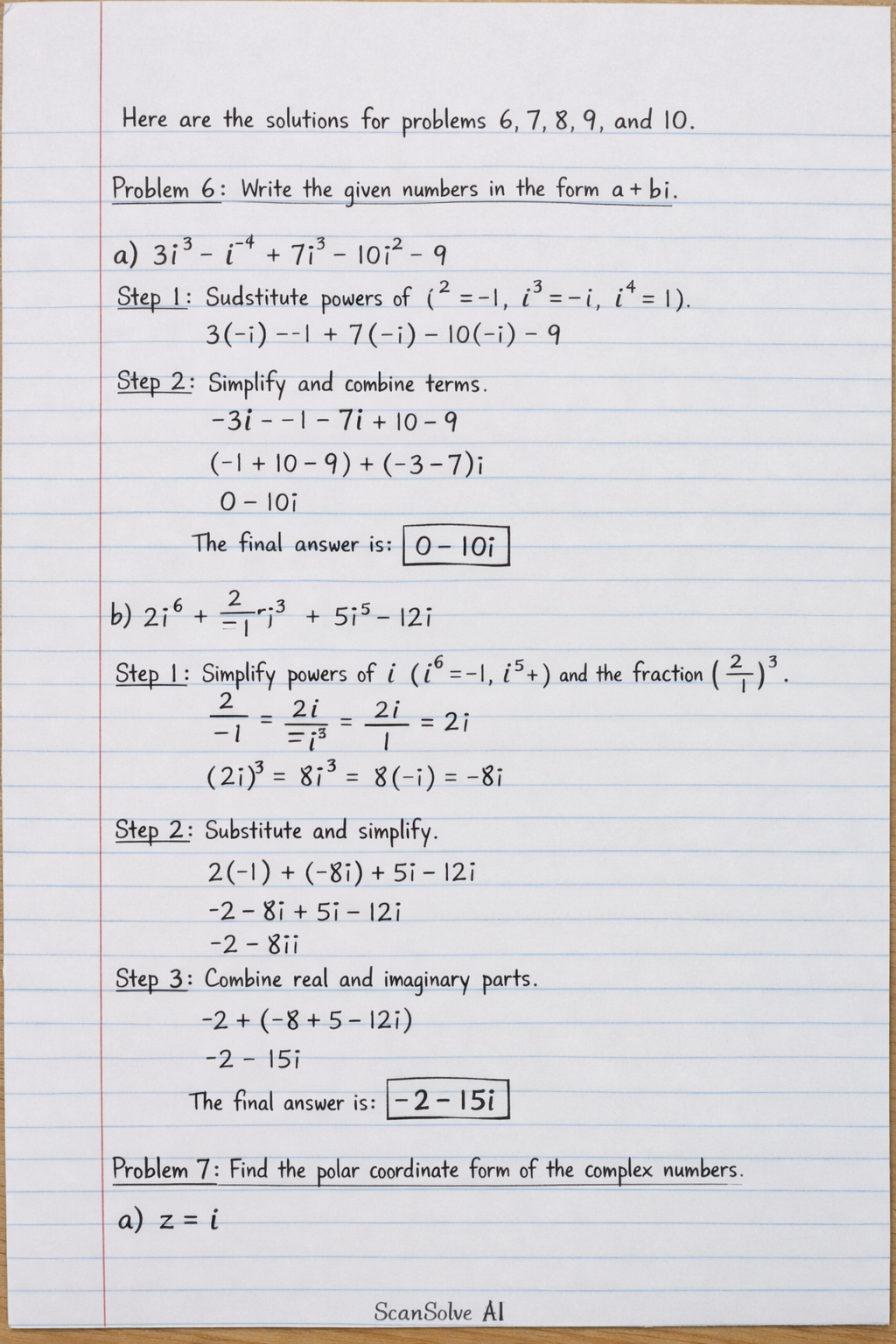
Here are the solutions for problems 6, 7, 8, 9, and 10. Problem 6: Write the given numbers in the form a+ib. a) 3i^3 - i^4 + 7i^3 - 10i^2 - 9 Step 1: Substitute powers of i (i^2=-1, i^3=-i, i^4=1). 3(-i) - (1) + 7(-i) - 10(-1) - 9 Step 2: Simplify and combine terms. -3i - 1 - 7i + 10 - 9 (-1+10-9) + (-3-7)i 0 - 10i The final answer is 0 - 10i. b) 2i^6 + ((2)/(-i))^3 + 5i^5 - 12i Step 1: Simplify powers of i (i^6=-1, i^5=i) and the fraction ((2)/(-i))^3. (2)/(-i) = (2i)/(-i^2) = (2i)/(1) = 2i (2i)^3 = 8i^3 = 8(-i) = -8i Step 2: Substitute and simplify. 2(-1) + (-8i) + 5(i) - 12i -2 - 8i + 5i - 12i Step 3: Combine real and imaginary parts. -2 + (-8+5-12)i -2 - 15i The final answer is -2 - 15i. Problem 7: Find the polar coordinate form of the complex numbers. a) z=i Step 1: Find modulus r and argument . x=0, y=1. r = sqrt(0^2+1^2) = 1 Since z=i is on the positive imaginary axis, = ()/(2). Step 2: Write in polar form r( + i). z = 1((()/(2)) + i(()/(2))) The final answer is (()/(2)) + i(()/(2)). b) z=3-4i Step 1: Find modulus r and argument . x=3, y=-4. r = sqrt(3^2+(-4)^2) = sqrt(9+16) = sqrt(25) = 5 The number is in the fourth quadrant. = ((-4)/(3)) = -((4)/(3)) Step 2: Write in polar form r( + i). z = 5((-((4)/(3))) + i(-((4)/(3)))) The final answer is 5((-((4)/(3))) + i(-((4)/(3)))). Problem 8: Find the values of x and y that satisfy the equation (x+y)+i(x-y)=14.8+6.2i. Step 1: Equate the real and imaginary parts. x+y = 14.8 (1) x-y = 6.2 (2) Step 2: Solve the system of equations. Add (1) and (2): (x+y)+(x-y) = 14.8+6.2 2x = 21 x = 10.5 Substitute x=10.5 into (1): 10.5+y = 14.8 y = 14.8-10.5 y = 4.3 The final answer is x=10.5, y=4.3. Problem 9: Express (-1+i) in the form re^i, where r is positive and - < < . Step 1: Find modulus r and argument . x=-1, y=1. r = sqrt((-1)^2+1^2) = sqrt(1+1) = sqrt(2) The number is in the second quadrant. The reference angle is ((1)/(1)) = ()/(4). = - ()/(4) = (3)/(4) This value is within (-, ). Step 2: Write in the form re^i. z = sqrt(2)e^i(3)/(4) The final answer is sqrt(2)e^i(3)/(4). Problem 10: If (a+b)+i(a-b)=(2+5i)^2+i(2-3i), find the values of a and b. Step 1: Simplify the right-hand side (RHS). (2+5i)^2 = 4 + 20i + 25i^2 = 4 + 20i - 25 = -21 + 20i i(2-3i) = 2i - 3i^2 = 2i - 3(-1) = 3 + 2i Add the simplified terms: (-21 + 20i) + (3 + 2i) = (-21+3) + (20+2)i = -18 + 22i Step 2: Equate the real and imaginary parts of the LHS and the simplified RHS. a+b = -18 (1) a-b = 22 (2) Step 3: Solve the system of equations. Add (1) and (2): (a+b)+(a-b) = -18+22 2a = 4 a = 2 Substitute a=2 into (1): 2+b = -18 b = -18-2 b = -20 The final answer is a=2, b=-20.