
We read your photo as:
Given: P(A' B) = (1)/(7) and P(A B) = (2)/(9).
ScanSolve AI Answer
This answer stops before the end.
It was cut off when it was first written. Ask ScanSolve this question again for the full working.
Here's the solution to question 1:
1. (i) Probability of Events A and B
Given: and .
(Note: We assume the given is a typo and should be .)
a) Calculate .
The probability of event B occurring is the sum of the probabilities of (A and B) and (not A and B), since these are disjoint events that make up B.
To add these fractions, find a common denominator, which is .
b) Calculate .
The notation typically means , which is . However, with the given information, cannot be determined as is unknown.
A common alternative interpretation for in some contexts, or a possible misprint for , is conditional probability . We will proceed with this interpretation as it allows for a solvable problem.
Using the values from the given information and part a):
Still stuck on this one?
Ask a follow-up, and the answer starts from this question.
More Mathematics Questions
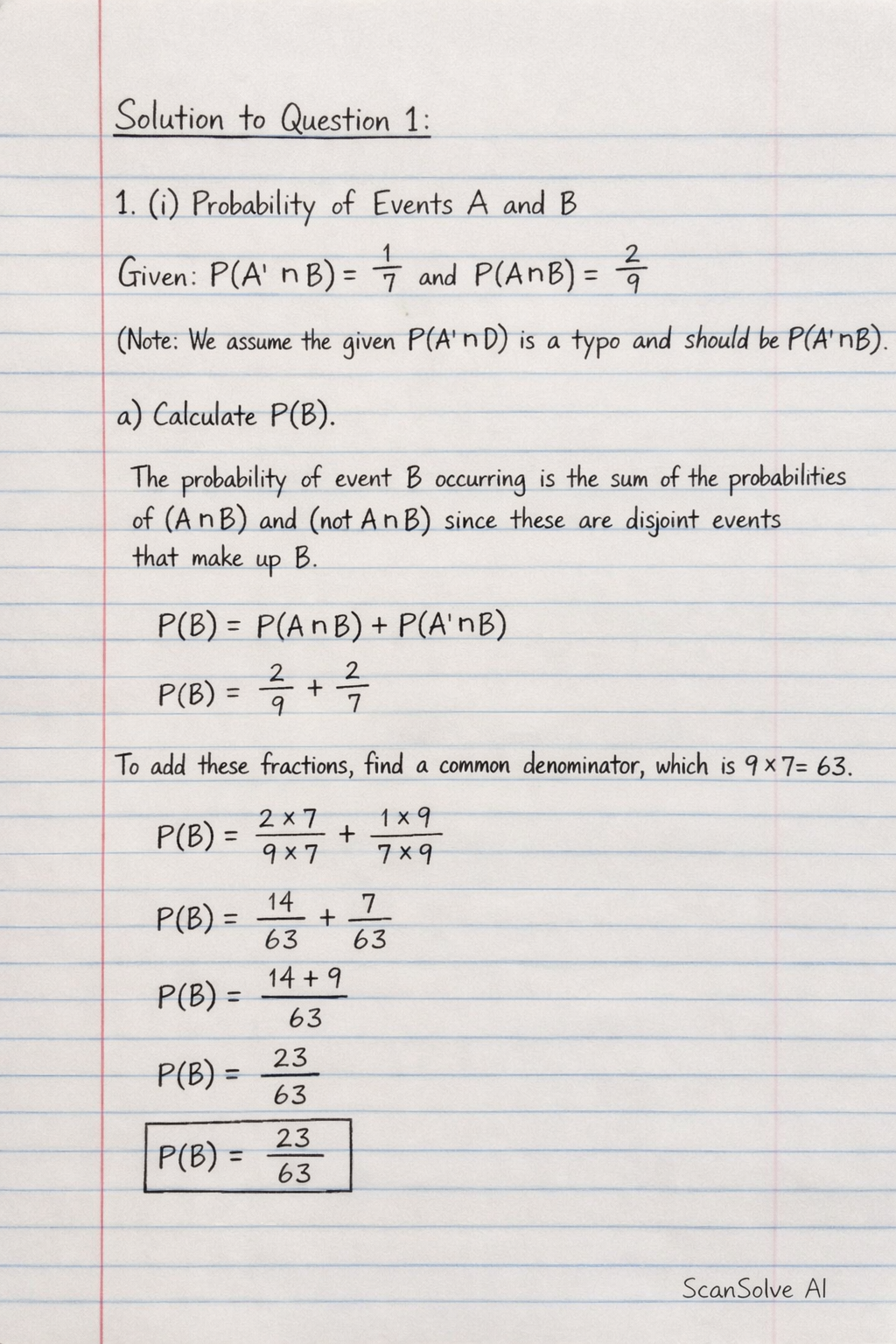
Handwritten Step-by-Step Solution
Get this as a handwritten image on WhatsApp — like a tutor wrote it for you.
Try on WhatsApp