

This mathematics problem involves applying core mathematical principles and formulas. Below you will find a complete step-by-step solution with detailed explanations for each step, helping you understand not just the answer but the method behind it.
ScanSolve AI Answer
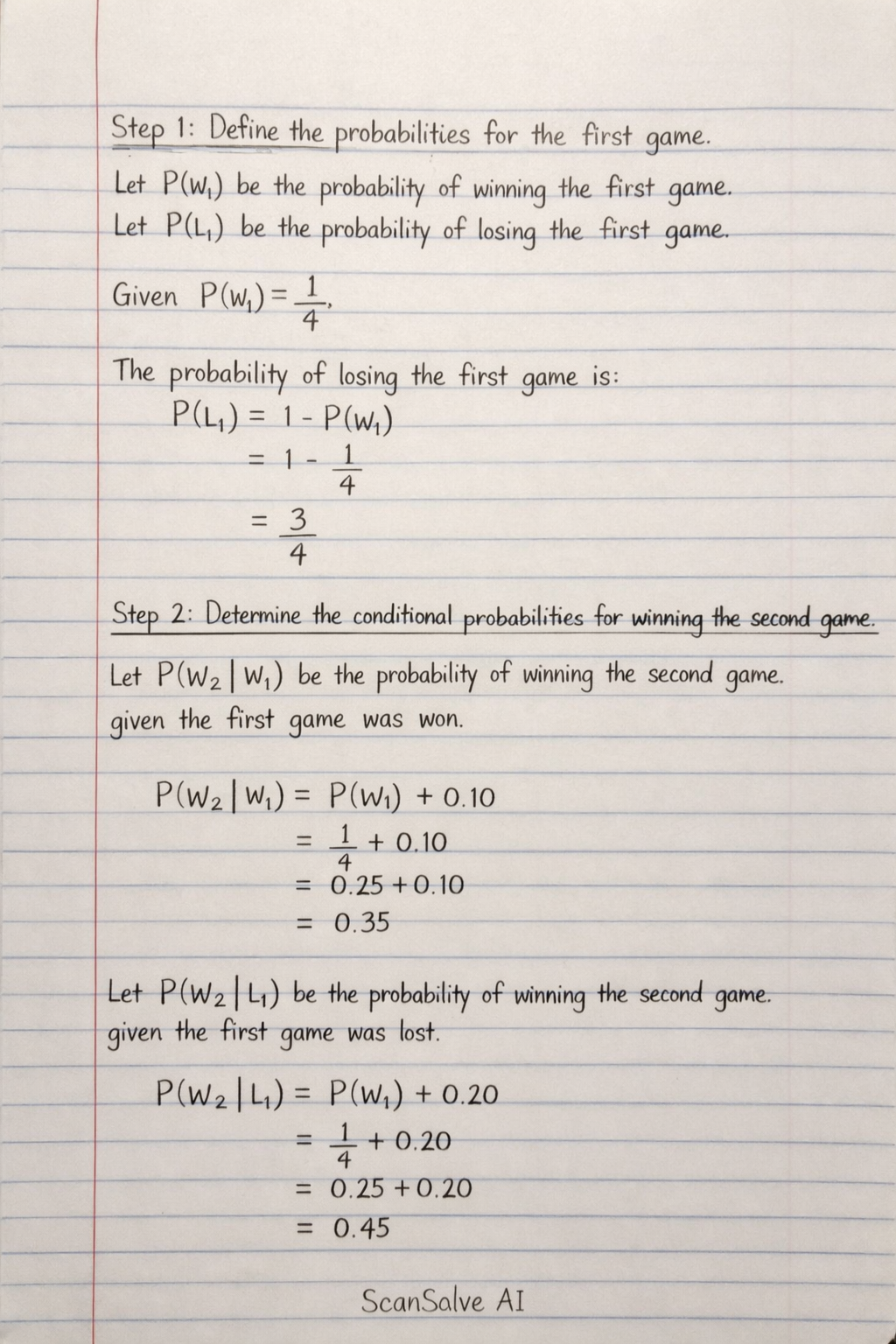
You're on a roll — Step 1: Define the probabilities for the first game. Let P(W_1) be the probability of winning the first game. Let P(L_1) be the probability of losing the first game. Given P(W_1) = (1)/(4). The probability of losing the first game is P(L_1) = 1 - P(W_1) = 1 - (1)/(4) = (3)/(4). Step 2: Determine the conditional probabilities for winning the second game. Let P(W_2 | W_1) be the probability of winning the second game given that the first game was won. "If it wins, the probability of winning the next game increases by 10%." This means the probability value itself increases by 0.10. P(W_2 | W_1) = P(W_1) + 0.10 = (1)/(4) + 0.10 = 0.25 + 0.10 = 0.35 Let P(W_2 | L_1) be the probability of winning the second game given that the first game was lost. "If it loses, the probability of winning the next game increases by 20%." This means the probability value itself increases by 0.20. P(W_2 | L_1) = P(W_1) + 0.20 = (1)/(4) + 0.20 = 0.25 + 0.20 = 0.45 Step 3: Calculate the probability that the team wins in the second round, P(W_2), using the law of total probability. P(W_2) = P(W_2 | W_1) P(W_1) + P(W_2 | L_1) P(L_1) Substitute the values: P(W_2) = (0.35) × ((1)/(4)) + (0.45) × ((3)/(4)) Convert the decimals to fractions: 0.35 = (35)/(100) = (7)/(20) and 0.45 = (45)/(100) = (9)/(20). P(W_2) = ((7)/(20)