Given position vectors a = 2i + j - 3k, b = 3i - 2j + k, and c = i + 3j - k. Find the vector AB x AC and the area of the triangle ABC.
|Mathematics
Given position vectors a = 2i + j - 3k, b = 3i - 2j + k, and c = i + 3j - k. Find the vector AB x AC and the area of the triangle ABC.
ScanSolve AI Answer
Answer
-14i - 6j - k
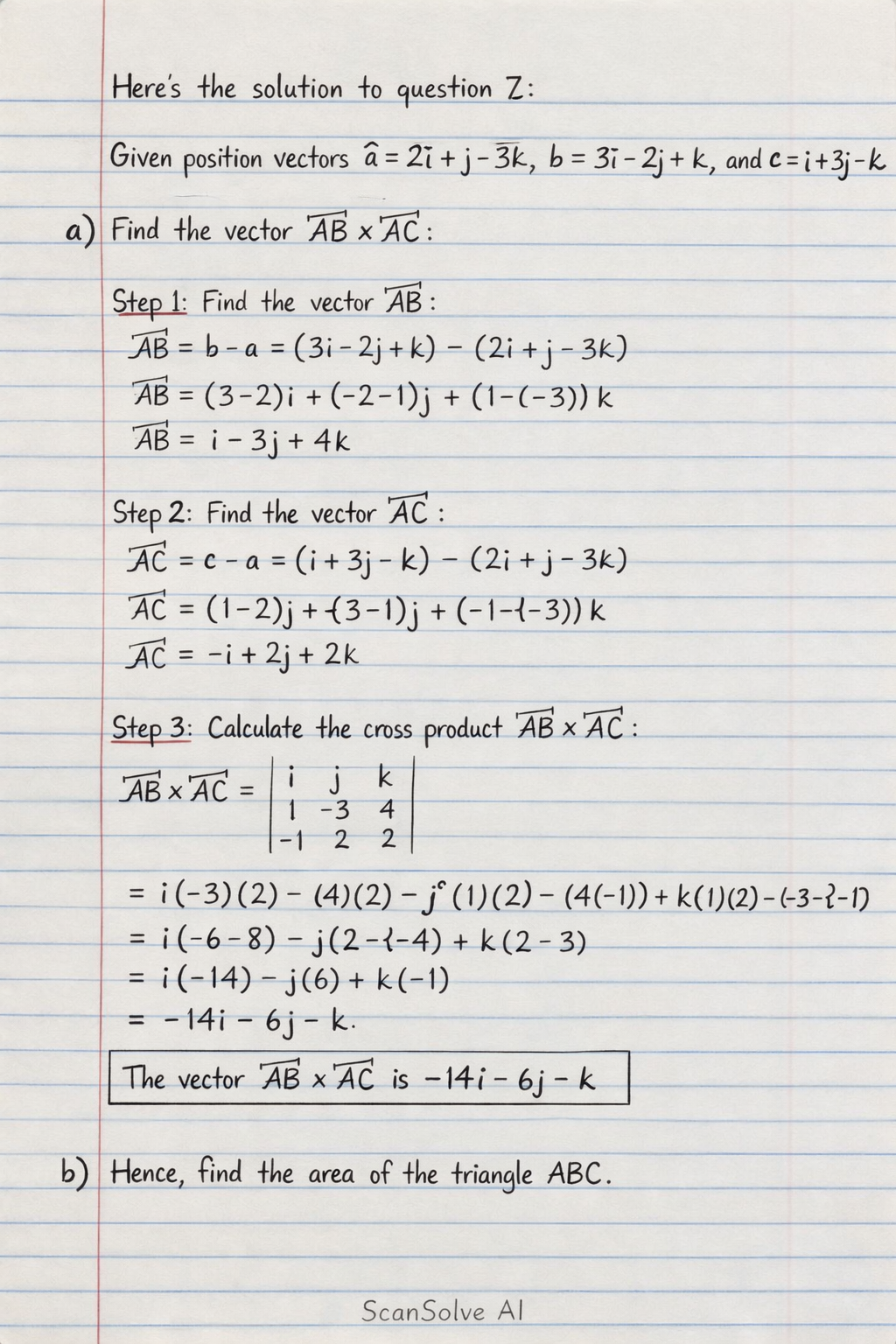
Here's the solution to question 7:
Given position vectors a=2i+j−3k, b=3i−2j+k, and c=i+3j−k.
a) Find the vector AB×AC.
Step 1: Find the vector AB.
AB=b−a=(3i−2j+k)−(2i+j−3k)AB=(3−2)i+(−2−1)j+(1−(−3))kAB=i−3j+4k
Step 2: Find the vector AC.
AC=c−a=(i+3j−k)−(2i+j−3k)AC=(1−2)i+(3−1)j+(−1−(−3))kAC=−i+2j+2k
Step 3: Calculate the cross product AB×AC.
AB×AC=i1−1j−32k42=i((−3)(2)−(4)(2))−j((1)(2)−(4)(−1))+k((1)(2)−(−3)(−1))=i(−6−8)−j(2−(−4))+k(2−3)=i(−14)−j(6)+k(−1)=−14i−6j−k
The vector AB×AC is −14i−6j−k.
b) Hence, find the area of the triangle ABC.
Step 1: The area of triangle ABC is half the magnitude of the cross product AB×AC.
Area=21∣AB×AC∣
Step 2: Calculate the magnitude of AB×AC.
∣AB×AC∣=∣−14i−6j−k∣=(−14)2+(−6)2+(−1)2=196+36+1=233
Step 3: Calculate the area of the triangle.
Area=21233
The area of the triangle ABC is 21233units2.
c) Find the Cartesian equation of the plane ABC.
Step 1: The normal vector to the plane is n=AB×AC=−14i−6j−k.
The Cartesian equation of a plane is of the form Ax+By+Cz=D, where (A,B,C) are the components of the normal vector.
So, the equation is −14x−6y−z=D.
Step 2: Use a point on the plane to find D. We can use point A with position vector a=2i+j−3k, so (x,y,z)=(2,1,−3).
−14(2)−6(1)−(−3)=D−28−6+3=D−31=D
Step 3: Write the Cartesian equation of the plane.
−14x−6y−z=−31
Multiplying by -1 to make the leading coefficient positive:
14x+6y+z=31
The Cartesian equation of the plane ABC is 14x+6y+z=31.
d) Find the acute angle between the plane ABC and the plane x−y+z=5.
Step 1: Identify the normal vector of the plane ABC.
From part c), n1=14i+6j+k.
Step 2: Identify the normal vector of the second plane, x−y+z=5.
n2=i−j+k.
Step 3: Calculate the magnitudes of the normal vectors.
∣n1∣=142+62+12=196+36+1=233∣n2∣=12+(−1)2+12=1+1+1=3
Step 4: Calculate the dot product of the normal vectors.
n1⋅n2=(14)(1)+(6)(−1)+(1)(1)=14−6+1=9
Step 5: Use the formula for the angle θ between two planes: cosθ=∣n1∣∣n2∣∣n1⋅n2∣.
cosθ=2333∣9∣=6999
Step 6: Find the acute angle θ.
θ=cos−1(6999)
The acute angle between the planes is cos−1(6999).
Was this helpful?
Need help with your own homework?
Get instant step-by-step solutions to any question. Free to start.
This mathematics problem involves applying core mathematical principles and formulas. Below you will find a complete step-by-step solution with detailed explanations for each step, helping you understand not just the answer but the method behind it.
ScanSolve AI Answer
Here's the solution to question 7: Given position vectors a = 2i + j - 3k, b = 3i - 2j + k, and c = i + 3j - k. a) Find the vector AB × AC. Step 1: Find the vector AB. AB = b - a = (3i - 2j + k) - (2i + j - 3k) AB = (3-2)i + (-2-1)j + (1-(-3))k AB = i - 3j + 4k Step 2: Find the vector AC. AC = c - a = (i + 3j - k) - (2i + j - 3k) AC = (1-2)i + (3-1)j + (-1-(-3))k AC = -i + 2j + 2k Step 3: Calculate the cross product AB × AC. AB × AC = i & j & k \\ 1 & -3 & 4 \\ -1 & 2 & 2 = i((-3)(2) - (4)(2)) - j((1)(2) - (4)(-1)) + k((1)(2) - (-3)(-1)) = i(-6 - 8) - j(2 - (-4)) + k(2 - 3) = i(-14) - j(6) + k(-1) = -14i - 6j - k The vector AB × AC is -14i - 6j - k. b) Hence, find the area of the triangle ABC. Step 1: The area of triangle ABC is half the magnitude of the cross product AB × AC. Area = (1)/(2) |AB × AC| Step 2: Calculate the magnitude of AB × AC. |AB × AC| = |-14i - 6j - k| = sqrt((-14)^2 + (-6)^2 + (-1)^2) = sqrt(196 + 36 + 1) = sqrt(233) Step 3: Calculate the area of the triangle. Area = (1)/(2) sqrt(233) The area of the triangle ABC is (1)/(2)sqrt(233) units^2. c) Find the Cartesian equation of the plane ABC. Step 1: The normal vector to the plane is n = AB × AC = -14i - 6j - k. The Cartesian equation of a plane is of the form Ax + By + Cz = D, where (A, B, C) are the components of the normal vector. So, the equation is -14x - 6y - z = D. Step 2: Use a point on the plane to find D. We can use point A with position vector a = 2i + j - 3k, so (x, y, z) = (2, 1, -3). -14(2) - 6(1) - (-3) = D -28 - 6 + 3 = D -31 = D Step 3: Write the Cartesian equation of the plane. -14x - 6y - z = -31 Multiplying by -1 to make the leading coefficient positive: 14x + 6y + z = 31 The Cartesian equation of the plane ABC is 14x + 6y + z = 31. d) Find the acute angle between the plane ABC and the plane x - y + z = 5. Step 1: Identify the normal vector of the plane ABC. From part c), n_1 = 14i + 6j + k. Step 2: Identify the normal vector of the second plane, x - y + z = 5. n_2 = i - j + k. Step 3: Calculate the magnitudes of the normal vectors. |n_1| = sqrt(14^2 + 6^2 + 1^2) = sqrt(196 + 36 + 1) = sqrt(233) |n_2| = sqrt(1^2 + (-1)^2 + 1^2) = sqrt(1 + 1 + 1) = sqrt(3) Step 4: Calculate the dot product of the normal vectors. n_1 · n_2 = (14)(1) + (6)(-1) + (1)(1) = 14 - 6 + 1 = 9 Step 5: Use the formula for the angle between two planes: = |n_1 · n_2||n_1| |n_2|. = (|9|)/(sqrt(233) 3) = (9)/(sqrt(699)) Step 6: Find the acute angle . = ^-1((9)/(sqrt(699))) The acute angle between the planes is ^-1((9)/(sqrt(699))).