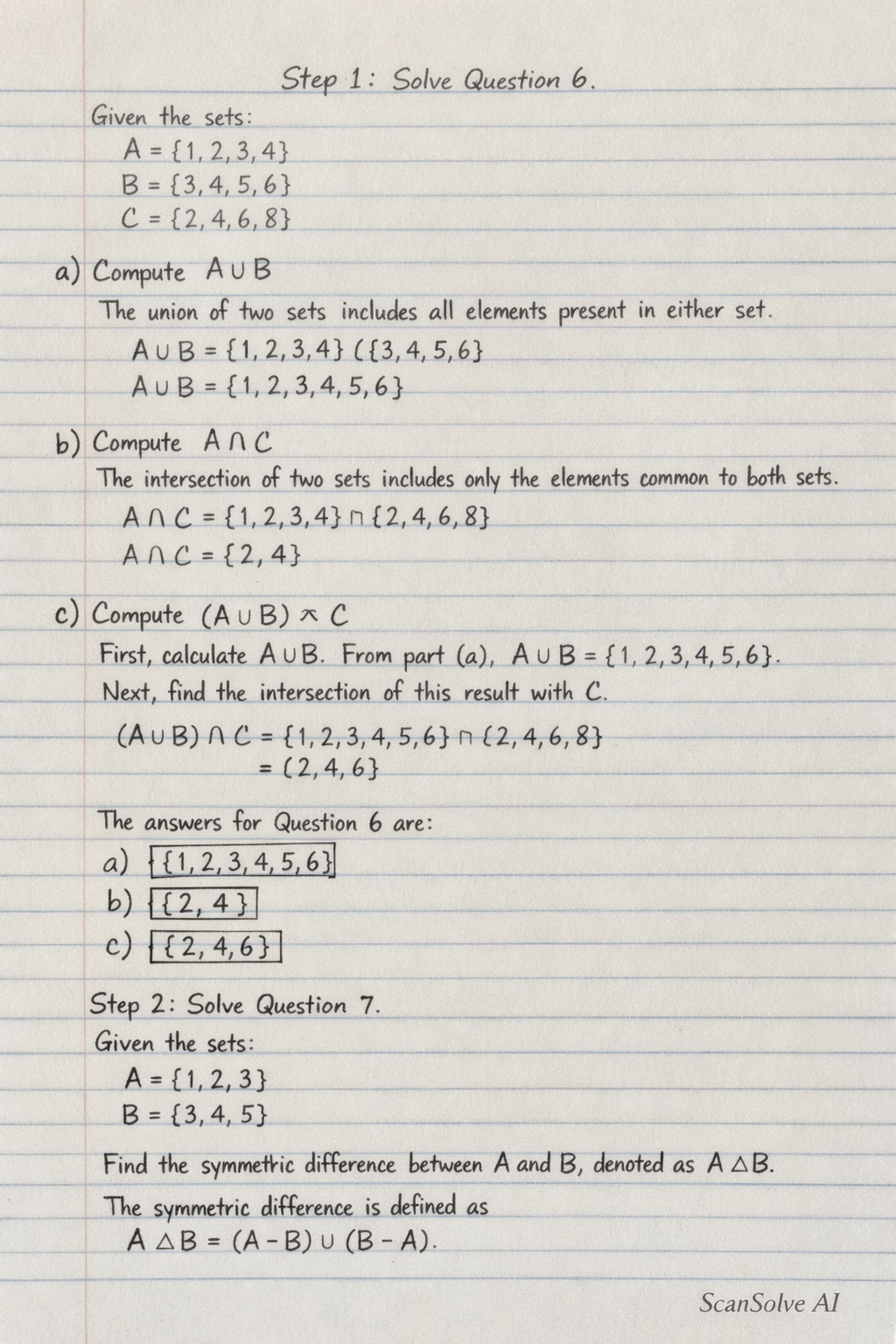
We read your photo as:

Given sets A, B, and C, compute their unions and intersections. Also, compute the symmetric difference between sets A and B.

Mathematics

ScanSolve AI Answer

Step-by-step solution

6 steps
  1. Solve Question 6.

    Given the sets:
    A={1,2,3,4}A = \{1, 2, 3, 4\}
    B={3,4,5,6}B = \{3, 4, 5, 6\}
    C={2,4,6,8}C = \{2, 4, 6, 8\}

    a) Compute A∪BA \cup B
    The union of two sets includes all elements present in either set.

    A∪B={1,2,3,4}∪{3,4,5,6}A \cup B = \{1, 2, 3, 4\} \cup \{3, 4, 5, 6\} A∪B={1,2,3,4,5,6}A \cup B = \{1, 2, 3, 4, 5, 6\}

    b) Compute A∩CA \cap C
    The intersection of two sets includes only the elements common to both sets.

    A∩C={1,2,3,4}∩{2,4,6,8}A \cap C = \{1, 2, 3, 4\} \cap \{2, 4, 6, 8\} A∩C={2,4}A \cap C = \{2, 4\}

    c) Compute (A∪B)∩C(A \cup B) \cap C
    First, calculate A∪BA \cup B. From part (a), A∪B={1,2,3,4,5,6}A \cup B = \{1, 2, 3, 4, 5, 6\}.
    Next, find the intersection of this result with CC.

    (A∪B)∩C={1,2,3,4,5,6}∩{2,4,6,8}(A \cup B) \cap C = \{1, 2, 3, 4, 5, 6\} \cap \{2, 4, 6, 8\} (A∪B)∩C={2,4,6}(A \cup B) \cap C = \{2, 4, 6\}

    The answers for Question 6 are:

    *a) {1,2,3,4,5,6}\boxed{\{1, 2, 3, 4, 5, 6\}}

    *b) {2,4}\boxed{\{2, 4\}}

    *c) {2,4,6}\boxed{\{2, 4, 6\}}

  2. Solve Question 7.

    Given the sets:
    A={1,2,3}A = \{1, 2, 3\}
    B={3,4,5}B = \{3, 4, 5\}
    Find the symmetric difference between A and B, denoted as AΔBA \Delta B.
    The symmetric difference is defined as AΔB=(A−B)∪(B−A)A \Delta B = (A - B) \cup (B - A).

    First, calculate A−BA - B:

    A−B={1,2,3}−{3,4,5}={1,2}A - B = \{1, 2, 3\} - \{3, 4, 5\} = \{1, 2\}

    Next, calculate B−AB - A:

    B−A={3,4,5}−{1,2,3}={4,5}B - A = \{3, 4, 5\} - \{1, 2, 3\} = \{4, 5\}

    Finally, find the union of these two results:

    AΔB={1,2}∪{4,5}A \Delta B = \{1, 2\} \cup \{4, 5\} AΔB={1,2,4,5}A \Delta B = \{1, 2, 4, 5\}

    The answer for Question 7 is:
    {1,2,4,5}\boxed{\{1, 2, 4, 5\}}

  3. Solve Question 8.

    Given the sets:
    A={2,4,6,8}A = \{2, 4, 6, 8\}
    B={4,6,10}B = \{4, 6, 10\}

    a) Compute A−BA - B
    The set difference A−BA - B contains elements that are in A but not in B.

    A−B={2,4,6,8}−{4,6,10}A - B = \{2, 4, 6, 8\} - \{4, 6, 10\} A−B={2,8}A - B = \{2, 8\}

    b) Compute B−AB - A
    The set difference B−AB - A contains elements that are in B but not in A.

    B−A={4,6,10}−{2,4,6,8}B - A = \{4, 6, 10\} - \{2, 4, 6, 8\} B−A={10}B - A = \{10\}

    The answers for Question 8 are:

    *a) {2,8}\boxed{\{2, 8\}}

    *b) {10}\boxed{\{10\}}

  4. Solve Question 9.

    Given the sets:
    A={1,2,3}A = \{1, 2, 3\}
    B={2,3,4}B = \{2, 3, 4\}
    C={3,4,5}C = \{3, 4, 5\}
    Compute the number of elements in A∪B∪CA \cup B \cup C, denoted as ∣A∪B∪C∣|A \cup B \cup C|.

    First, find the union of all three sets:

    A∪B={1,2,3}∪{2,3,4}={1,2,3,4}A \cup B = \{1, 2, 3\} \cup \{2, 3, 4\} = \{1, 2, 3, 4\} (A∪B)∪C={1,2,3,4}∪{3,4,5}(A \cup B) \cup C = \{1, 2, 3, 4\} \cup \{3, 4, 5\} A∪B∪C={1,2,3,4,5}A \cup B \cup C = \{1, 2, 3, 4, 5\}

    Now, count the number of elements in the resulting set:

    ∣A∪B∪C∣=5|A \cup B \cup C| = 5

    The answer for Question 9 is:
    5\boxed{5}

  5. Solve Question 10.

    Given:
    Number of students enrolled in mathematics (∣M∣|M|) = 100
    Number of students enrolled in science (∣S∣|S|) = 120
    Number of students enrolled in both subjects (∣M∩S∣|M \cap S|) = 80
    Find the number of students enrolled in at least one of the subjects, which is ∣M∪S∣|M \cup S|.

    Use the Principle of Inclusion-Exclusion for two sets:

    ∣M∪S∣=∣M∣+∣S∣−∣M∩S∣|M \cup S| = |M| + |S| - |M \cap S|

    Substitute the given values:

    ∣M∪S∣=100+120−80|M \cup S| = 100 + 120 - 80 ∣M∪S∣=220−80|M \cup S| = 220 - 80 ∣M∪S∣=140|M \cup S| = 140

    The answer for Question 10 is:
    140\boxed{140}

  6. Solve Question 11.

    Given the sets:
    A={1,2}A = \{1, 2\}
    B={2,3}B = \{2, 3\}
    C={3,4}C = \{3, 4\}

    a) Compute (A∪B)∪C(A \cup B) \cup C
    First, calculate A∪BA \cup B:

    A∪B={1,2}∪{2,3}={1,2,3}A \cup B = \{1, 2\} \cup \{2, 3\} = \{1, 2, 3\}

    Next, find the union of this result with CC:

    (A∪B)∪C={1,2,3}∪{3,4}(A \cup B) \cup C = \{1, 2, 3\} \cup \{3, 4\} (A∪B)∪C={1,2,3,4}(A \cup B) \cup C = \{1, 2, 3, 4\}

    b) Compute A∪(B∪C)A \cup (B \cup C)
    First, calculate B∪CB \cup C:

    B∪C={2,3}∪{3,4}={2,3,4}B \cup C = \{2, 3\} \cup \{3, 4\} = \{2, 3, 4\}

    Next, find the union of AA with this result:

    A∪(B∪C)={1,2}∪{2,3,4}A \cup (B \cup C) = \{1, 2\} \cup \{2, 3, 4\} A∪(B∪C)={1,2,3,4}A \cup (B \cup C) = \{1, 2, 3, 4\}

    The answers for Question 11 are:

    *a) {1,2,3,4}\boxed{\{1, 2, 3, 4\}}

    *b) {1,2,3,4}\boxed{\{1, 2, 3, 4\}}

Was this helpful?

Still stuck on this one?

Ask a follow-up, and the answer starts from this question.

Got a different question?Ask your own question
Handwritten step-by-step solution preview

Handwritten Step-by-Step Solution

Get this as a handwritten image on WhatsApp — like a tutor wrote it for you.

Try on WhatsApp