
We read your photo as:
Calculate the symmetric difference between sets A = 1, 2, 3 and B = 3, 4, 5.
Mathematics
ScanSolve AI Answer
Answer
Step-by-step solution
5 stepsUnderstand the definition of symmetric difference.
The symmetric difference of two sets and , denoted as , is the set of elements that are in either or , but not in their intersection. It can be calculated using the formula:
or equivalently:
Identify the given sets.
Given:
Calculate .
contains elements that are in but not in .
Calculate .
contains elements that are in but not in .
Calculate the union of and .
The symmetric difference between A and B is .
Was this helpful?
Try one yourself
A new problem that tests the same skill.
Still stuck on this one?
Ask a follow-up, and the answer starts from this question.
Got a different question?Ask your own question
More Mathematics Questions
QGiven sets A = 1, 3, 5 and E = 1, 2, 3, 4, find the symmetric difference A Δ E.QGiven sets A = 1, 2, 3, 4, B = 2, 4, 6, 8, and C = 3, 4, 5, 6, find the set differences A − B, B…QGiven sets A, B, and C, compute their unions and intersections. Also, compute the symmetric…QFind the symmetric difference of sets A = 1, 2, 4, 5, 8 and B = 3, 5, 6, 8, 9. Also, interpret a…QGiven sets A = 3, 4, 5, 6 and B = 3, 5, 7, 9, 11, find the union and intersection of A and B.
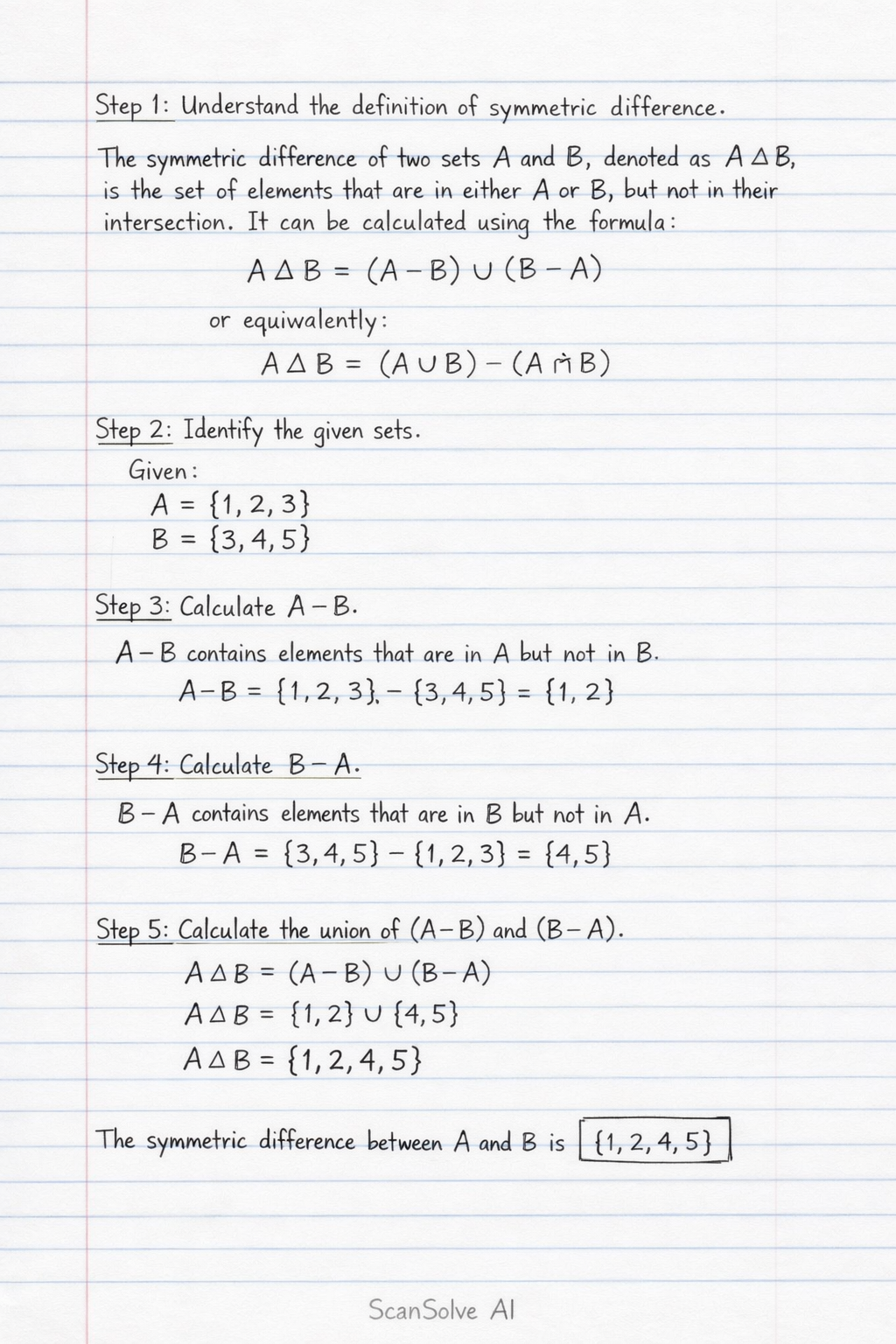
Handwritten Step-by-Step Solution
Get this as a handwritten image on WhatsApp — like a tutor wrote it for you.
Try on WhatsApp