Create a quadratic polynomial, whose sum and product of zeroes are 1 and 3/2 respectively.

Mathematics
Create a quadratic polynomial, whose sum and product of zeroes are 1 and 3/2 respectively.

ScanSolve AI Answer

Answer

2x22x+32x^2 - 2x + 3

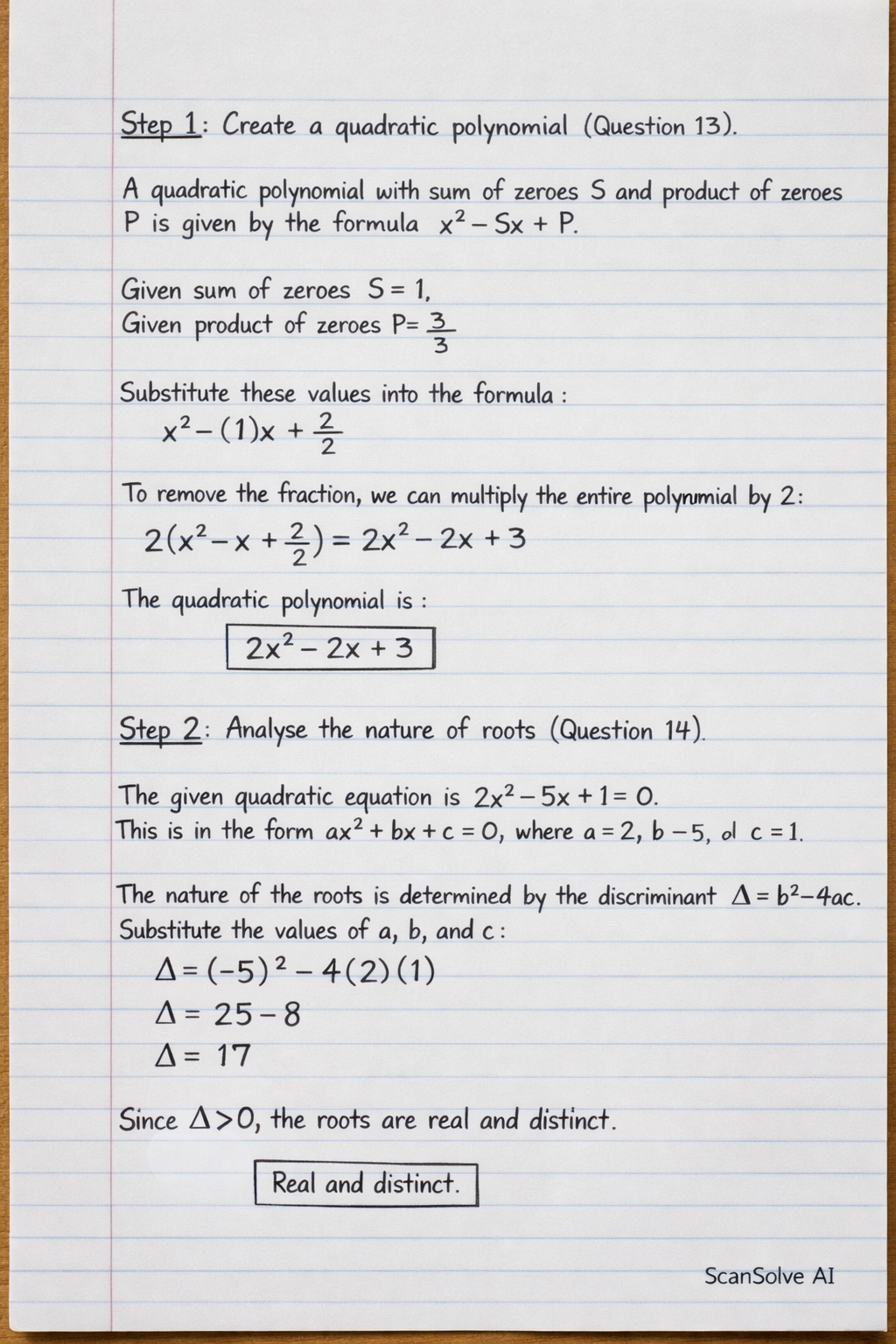
Step 1: Create a quadratic polynomial (Question 13). A quadratic polynomial with sum of zeroes SS and product of zeroes PP is given by the formula x2Sx+Px^2 - Sx + P. Given sum of zeroes S=1S = 1. Given product of zeroes P=32P = \frac{3}{2}. Substitute these values into the formula: x2(1)x+32x^2 - (1)x + \frac{3}{2} To remove the fraction, we can multiply the entire polynomial by 22: 2(x2x+32)=2x22x+32\left(x^2 - x + \frac{3}{2}\right) = 2x^2 - 2x + 3 The quadratic polynomial is: 2x22x+3\boxed{2x^2 - 2x + 3}

Step 2: Analyse the nature of roots (Question 14). The given quadratic equation is 2x25x+1=02x^2 - 5x + 1 = 0. This is in the form ax2+bx+c=0ax^2 + bx + c = 0, where a=2a=2, b=5b=-5, and c=1c=1. The nature of the roots is determined by the discriminant Δ=b24ac\Delta = b^2 - 4ac. Substitute the values of aa, bb, and cc: Δ=(5)24(2)(1)\Delta = (-5)^2 - 4(2)(1) Δ=258\Delta = 25 - 8 Δ=17\Delta = 17 Since Δ>0\Delta > 0, the roots are real and distinct. The nature of the roots is: Realanddistinct\boxed{Real and distinct}

Step 3: Define Basic Proportionality Theorem (Question 15). The Basic Proportionality Theorem (also known as Thales Theorem) states that if a line is drawn parallel to one side of a triangle intersecting the other two sides, then it divides the two sides proportionally.

Step 4: Find the value of the expression (Question 16). The expression is (sinθ+cosθ)2+(sinθcosθ)2(\sin\theta + \cos\theta)^2 + (\sin\theta - \cos\theta)^2. Expand each term using the identities (a+b)2=a2+2ab+b2(a+b)^2 = a^2 + 2ab + b^2 and (ab)2=a22ab+b2(a-b)^2 = a^2 - 2ab + b^2: (sinθ+cosθ)2=sin2θ+2sinθcosθ+cos2θ(\sin\theta + \cos\theta)^2 = \sin^2\theta + 2\sin\theta\cos\theta + \cos^2\theta (sinθcosθ)2=sin2θ2sinθcosθ+cos2θ(\sin\theta - \cos\theta)^2 = \sin^2\theta - 2\sin\theta\cos\theta + \cos^2\theta Now, add the two expanded expressions: (sin2θ+2sinθcosθ+cos2θ)+(sin2θ2sinθcosθ+cos2θ)(\sin^2\theta + 2\sin\theta\cos\theta + \cos^2\theta) + (\sin^2\theta - 2\sin\theta\cos\theta + \cos^2\theta) Combine like terms: sin2θ+cos2θ+sin2θ+cos2θ+2sinθcosθ2sinθcosθ\sin^2\theta + \cos^2\theta + \sin^2\theta + \cos^2\theta + 2\sin\theta\cos\theta - 2\sin\theta\cos\theta 2sin2θ+2cos2θ2\sin^2\theta + 2\cos^2\theta Factor out 22: 2(sin2θ+cos2θ)2(\sin^2\theta + \cos^2\theta) Using the trigonometric identity sin2θ+cos2θ=1\sin^2\theta + \cos^2\theta = 1: 2(1)=22(1) = 2 The value of the expression is: 2\boxed{2}

Step 5: Define angle of elevation (Question 17). The angle of elevation is the angle formed by the line of sight with the horizontal when an observer looks upwards at an object.

Step 6: Find the radius of the circle (Question 18). Let O be the center of the circle, A be the external point, and T be the point of tangency on the circle. The length of the tangent from point A to the circle is AT=4AT = 4 cm. The distance from point A to the center of the circle is OA=5OA = 5 cm. The radius of the circle is OTOT. We know that the radius is perpendicular to the tangent at the point of tangency, so OTA\triangle OTA is a right-angled triangle with the right angle at T. By the Pythagorean theorem: OA2=OT2+AT2OA^2 = OT^2 + AT^2 Substitute the given values: (5cm)2=OT2+(4cm)2(5\, cm)^2 = OT^2 + (4\, cm)^2 25cm2=OT2+16cm225\, cm^2 = OT^2 + 16\, cm^2 Subtract 16cm216\, cm^2 from both sides: OT2=25cm216cm2OT^2 = 25\, cm^2 - 16\, cm^2 OT2=9cm2OT^2 = 9\, cm^2 Take the square root of both sides: OT=9cm2OT = \sqrt{9\, cm^2} OT=3cmOT = 3\, \text{cm} The radius of the circle is: 3cm\boxed{3\, cm}

Was this helpful?

Need help with your own homework?

Get instant step-by-step solutions to any question. Free to start.

Ask Your Question
Handwritten step-by-step solution preview

Handwritten Step-by-Step Solution

Get this as a handwritten image on WhatsApp — like a tutor wrote it for you.

Try on WhatsApp

Still have questions?

Quick Answer

Create a quadratic polynomial (Question 13). A quadratic polynomial with sum of zeroes S and product of zeroes P is given by the formula x^2 - Sx + P.

Create a quadratic polynomial, whose sum and product of zeroes are 1 and 3/2 respectively.
Mathematics

This mathematics problem involves applying core mathematical principles and formulas. Below you will find a complete step-by-step solution with detailed explanations for each step, helping you understand not just the answer but the method behind it.

ScanSolve AI Answer
Step 1: Create a quadratic polynomial (Question 13). A quadratic polynomial with sum of zeroes S and product of zeroes P is given by the formula x^2 - Sx + P. Given sum of zeroes S = 1. Given product of zeroes P = (3)/(2). Substitute these values into the formula: x^2 - (1)x + (3)/(2) To remove the fraction, we can multiply the entire polynomial by 2: 2(x^2 - x + (3)/(2)) = 2x^2 - 2x + 3 The quadratic polynomial is: 2x^2 - 2x + 3 Step 2: Analyse the nature of roots (Question 14). The given quadratic equation is 2x^2 - 5x + 1 = 0. This is in the form ax^2 + bx + c = 0, where a=2, b=-5, and c=1. The nature of the roots is determined by the discriminant = b^2 - 4ac. Substitute the values of a, b, and c: = (-5)^2 - 4(2)(1) = 25 - 8 = 17 Since > 0, the roots are real and distinct. The nature of the roots is: Real and distinct Step 3: Define Basic Proportionality Theorem (Question 15). The Basic Proportionality Theorem (also known as Thales Theorem) states that if a line is drawn parallel to one side of a triangle intersecting the other two sides, then it divides the two sides proportionally. Step 4: Find the value of the expression (Question 16). The expression is ( + )^2 + ( - )^2. Expand each term using the identities (a+b)^2 = a^2 + 2ab + b^2 and (a-b)^2 = a^2 - 2ab + b^2: ( + )^2 = ^2 + 2 + ^2 ( - )^2 = ^2 - 2 + ^2 Now, add the two expanded expressions: (^2 + 2 + ^2) + (^2 - 2 + ^2) Combine like terms: ^2 + ^2 + ^2 + ^2 + 2 - 2 2^2 + 2^2 Factor out 2: 2(^2 + ^2) Using the trigonometric identity ^2 + ^2 = 1: 2(1) = 2 The value of the expression is: 2 Step 5: Define angle of elevation (Question 17). The angle of elevation is the angle formed by the line of sight with the horizontal when an observer looks upwards at an object. Step 6: Find the radius of the circle (Question 18). Let O be the center of the circle, A be the external point, and T be the point of tangency on the circle. The length of the tangent from point A to the circle is AT = 4 cm. The distance from point A to the center of the circle is OA = 5 cm. The radius of the circle is OT. We know that the radius is perpendicular to the tangent at the point of tangency, so OTA is a right-angled triangle with the right angle at T. By the Pythagorean theorem: OA^2 = OT^2 + AT^2 Substitute the given values: (5\, cm)^2 = OT^2 + (4\, cm)^2 25\, cm^2 = OT^2 + 16\, cm^2 Subtract 16\, cm^2 from both sides: OT^2 = 25\, cm^2 - 16\, cm^2 OT^2 = 9\, cm^2 Take the square root of both sides: OT = sqrt(9\, cm)^2 OT = 3\, cm The radius of the circle is: 3\, cm