This mathematics problem involves applying core mathematical principles and formulas. Below you will find a complete step-by-step solution with detailed explanations for each step, helping you understand not just the answer but the method behind it.
ScanSolve AI Answer
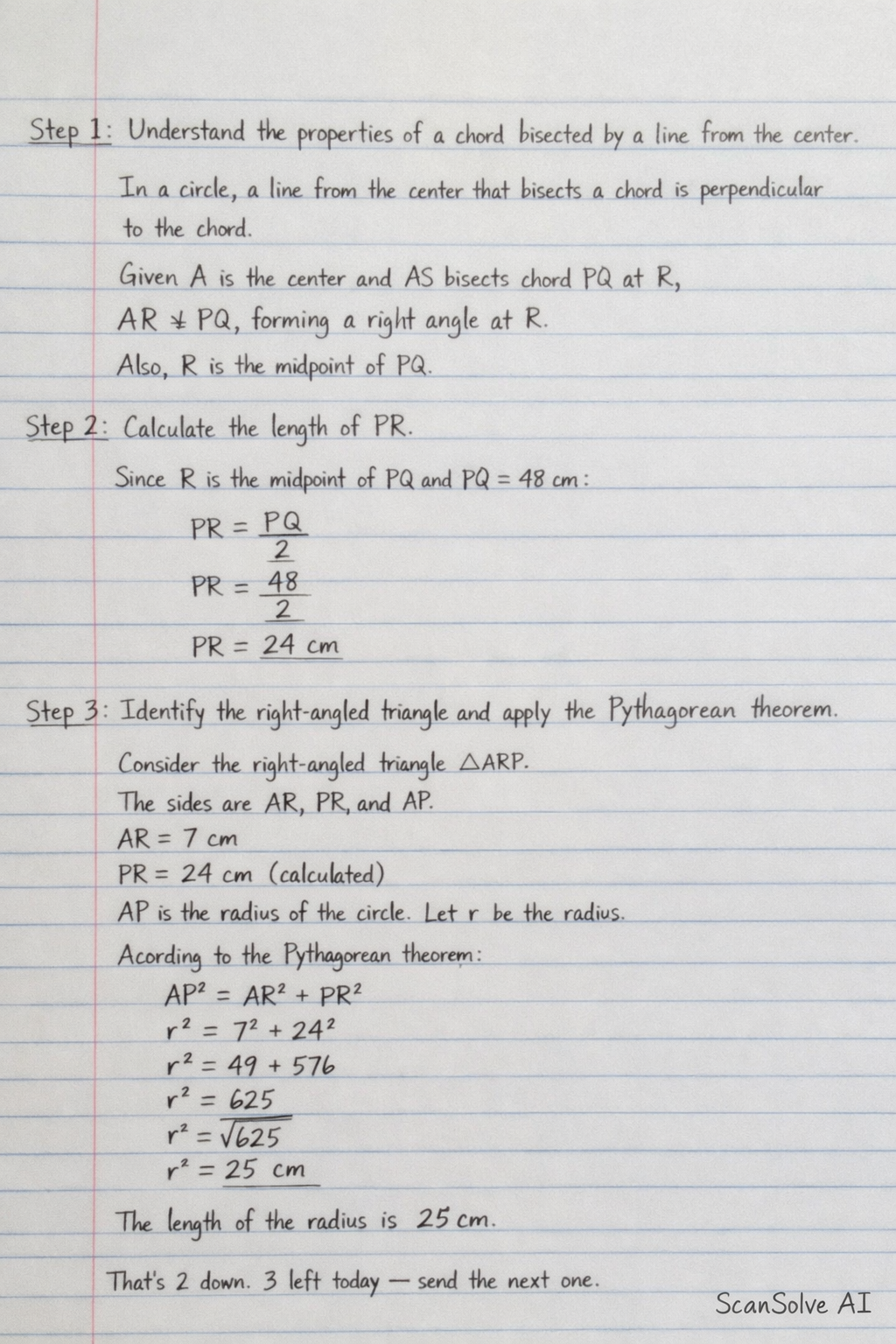
Step 1: Understand the properties of a chord bisected by a line from the center.
In a circle, a line segment from the center that bisects a chord is perpendicular to the chord.
Given that A is the center and AS bisects chord PQ at R, it means that AR is perpendicular to PQ, forming a right angle at R.
Also, R is the midpoint of PQ.
Step 2: Calculate the length of PR.
Since R is the midpoint of PQ and PQ = 48 cm:
$$PR = \frac{PQ}{2} = \frac{48}{2} = 24 \text{ cm}$$
Step 3: Identify the right-angled triangle and apply the Pythagorean theorem.
Consider the right-angled triangle $\triangle ARP$.
The sides are AR, PR, and AP.
AR is given as 7 cm.
PR is calculated as 24 cm.
AP is the radius of the circle. Let $r$ be the radius.
According to the Pythagorean theorem:
$$AP^2 = AR^2 + PR^2$$
$$r^2 = 7^2 + 24^2$$
$$r^2 = 49 + 576$$
$$r^2 = 625$$
$$r = \sqrt{625}$$
$$r = 25 \text{ cm}$$
The length of the radius is 25 cm.
That's 2 down. 3 left today — send the next one.
Given that A is the center and AS bisects chord PQ at R, it means that AR is perpendicular to PQ, forming a right angle at R.
|Mathematics
Given that A is the center and AS bisects chord PQ at R, it means that AR is perpendicular to PQ, forming a right angle at R.
ScanSolve AI Answer
Step 1: Understand the properties of a chord bisected by a line from the center.
In a circle, a line segment from the center that bisects a chord is perpendicular to the chord.
Given that A is the center and AS bisects chord PQ at R, it means that AR is perpendicular to PQ, forming a right angle at R.
Also, R is the midpoint of PQ.
Step 2: Calculate the length of PR.
Since R is the midpoint of PQ and PQ = 48 cm:
PR=2PQ=248=24 cm
Step 3: Identify the right-angled triangle and apply the Pythagorean theorem.
Consider the right-angled triangle △ARP.
The sides are AR, PR, and AP.
AR is given as 7 cm.
PR is calculated as 24 cm.
AP is the radius of the circle. Let r be the radius.
According to the Pythagorean theorem:
AP2=AR2+PR2r2=72+242r2=49+576r2=625r=625r=25 cm
The length of the radius is 25 cm.
That's 2 down. 3 left today — send the next one.
Need help with your own homework?
Get instant step-by-step solutions to any question. Free to start.