
We read your photo as:
Given that BA is parallel to CE, we can identify two similar triangles: DCE and DBA.
Mathematics
ScanSolve AI Answer
Answer
Step-by-step solution
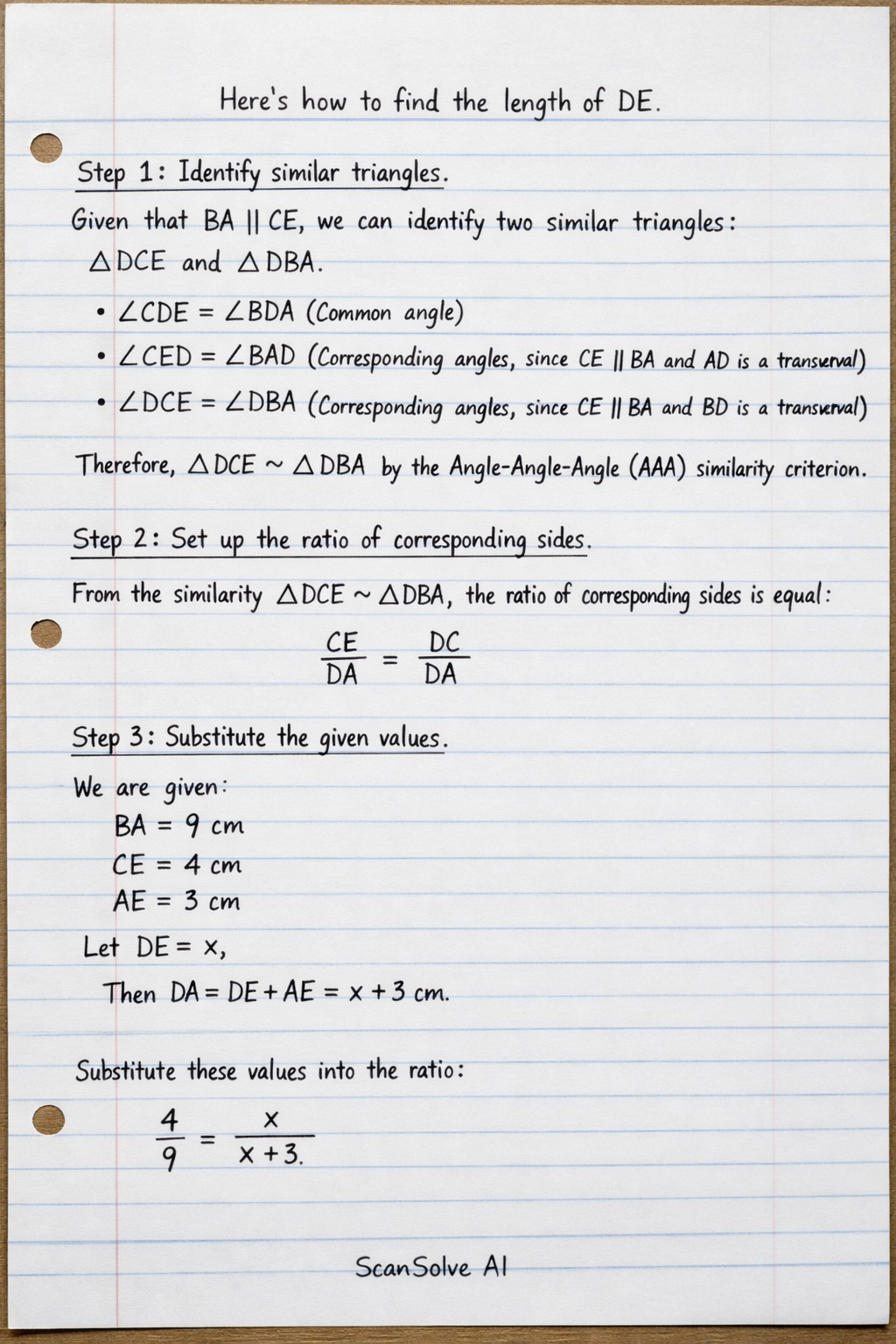
4 stepsHere's how to find the length of DE.
Identify similar triangles.
Given that BA is parallel to CE, we can identify two similar triangles: and .
- (Common angle)
- (Corresponding angles, since CE || BA and AD is a transversal)
- (Corresponding angles, since CE || BA and BD is a transversal) Therefore, by the Angle-Angle-Angle (AAA) similarity criterion.
Set up the ratio of corresponding sides.
From the similarity , the ratio of corresponding sides is equal:
Substitute the given values.
We are given:
BA =
CE =
AE =
Let DE = .
Then DA = DE + AE = .Substitute these values into the ratio:
Solve for .
Cross-multiply the equation:
Distribute the 4 on the left side:
Subtract from both sides:
Divide by 5:
So, the length of DE is .
Was this helpful?
Try one yourself
A new problem that tests the same skill.
Still stuck on this one?
Ask a follow-up, and the answer starts from this question.
Got a different question?Ask your own question
More Mathematics Questions
QSince DB = BE (given), DBE is an isosceles triangle. In an isosceles triangle, the angles opposite…QThe problem states that ABC is similar to ADE ( ABC ADE) and that BC is parallel to ED. This implies…QIn the diagram below, ABC is an equilateral triangle. ADE is an isosceles triangle such that line…QFigure 5.69 shows two secants AE and AD. Prove that m BAE = (1)/(2) (m arc BD - m arc CE)QProve that triangle ADE is similar to triangle ABC.
Browse by topic:Geometry
Handwritten Step-by-Step Solution
Get this as a handwritten image on WhatsApp — like a tutor wrote it for you.
Try on WhatsApp