
We read your photo as:
Given that matrix A is [7 4p / 5p 5p]. (i) find the value of p for which the determinant of A is -2. (ii) hence find the inverse of A.
ScanSolve AI Answer
This answer stops before the end.
It was cut off when it was first written. Ask ScanSolve this question again for the full working.
Here are the solutions to your questions:
1. Matrices
Given matrix .
- Find the value of for which the determinant of is .
Step 1: Calculate the determinant of .
For a matrix , the determinant is .
Step 2: Set the determinant equal to and solve for .
- Hence, find the inverse of .
Step 3: Substitute into matrix .
Step 4: Calculate the inverse of .
The inverse of a matrix is .
We already found .
1b. Probability
Let be the probability of selecting Mutola and be the probability of selecting Mwambi.
Given and .
The probabilities of not selecting them are and .
Assume the selections are independent events.
- (i) Find the probability that only one of them is selected.
Step 1: Identify the events for "only one selected".
This means (Mutola selected AND Mwambi NOT selected) OR (Mutola NOT selected AND Mwambi selected).
Step 2: Calculate the probabilities for each case.
Since the events are independent:
Step 3: Sum the probabilities.
- (ii) Find the probability that none of them is selected.
Step 1: Identify the event for "none selected".
This means Mutola NOT selected AND Mwambi NOT selected.
Step 2: Calculate the probability.
Since the events are independent:
2a. Simplify
Simplify .
Step 1: Factor the denominator using the difference of squares formula ().
Step 2: Substitute the factored denominator back into the expression.
Step 3: Cancel the common term from the numerator and denominator (assuming ).
2b. Geometric Progression
The sum of terms of a geometric progression (G.P.) is given by .
- (i) Find the sum of the first 4 terms of this G.P.
Step 1: Substitute into the given formula for .
Step 2: Calculate the value.
- (ii) Find the first term.
Step 1: The first term, , is equal to the sum of the first term, .
Substitute into the formula for .
Still stuck on this one?
Ask a follow-up, and the answer starts from this question.
More Mathematics Questions
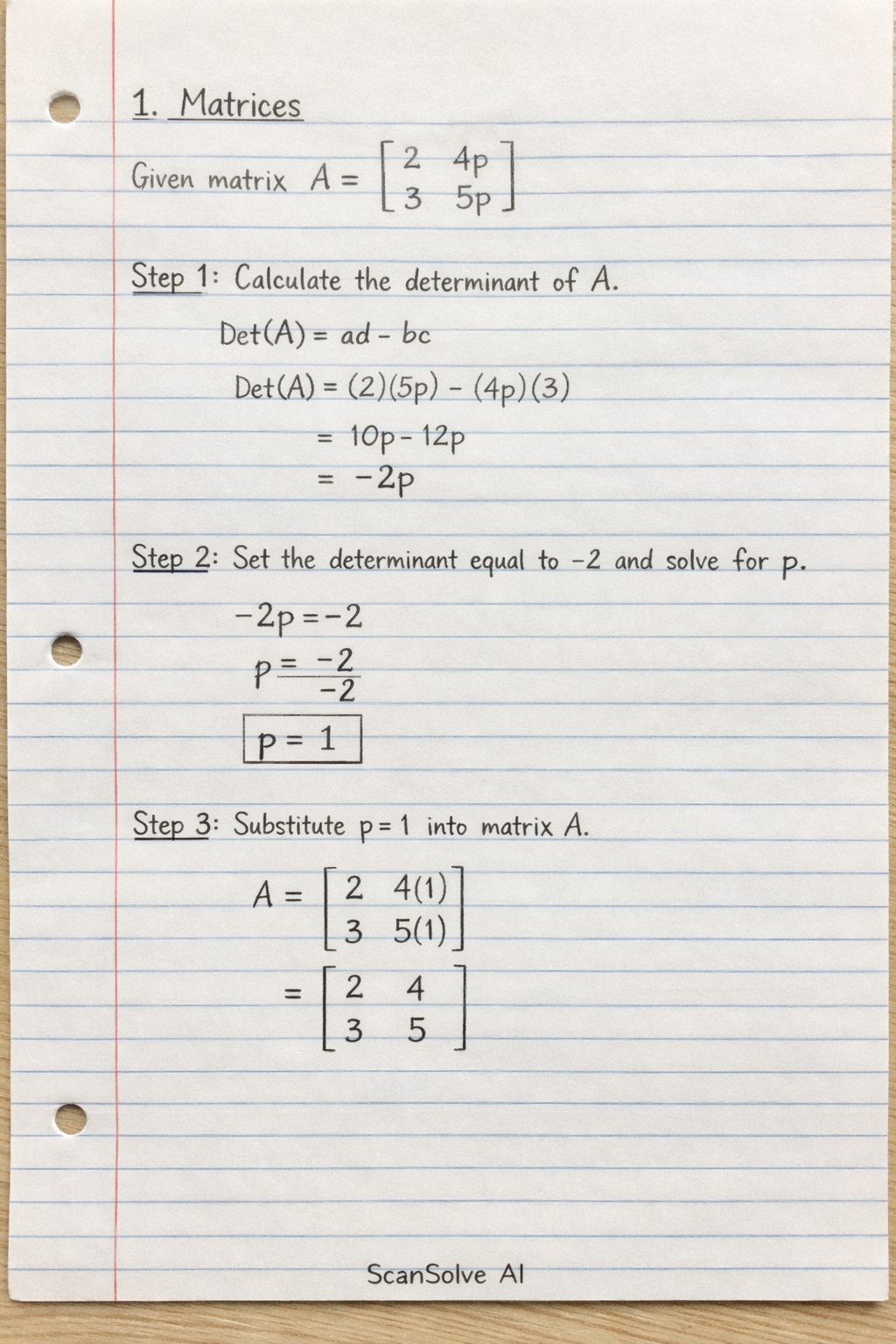
Handwritten Step-by-Step Solution
Get this as a handwritten image on WhatsApp — like a tutor wrote it for you.
Try on WhatsApp