
We read your photo as:
Given that the fraction of atoms left after 120 years is (1)/(64):
ScanSolve AI Answer
Answer
Step-by-step solution
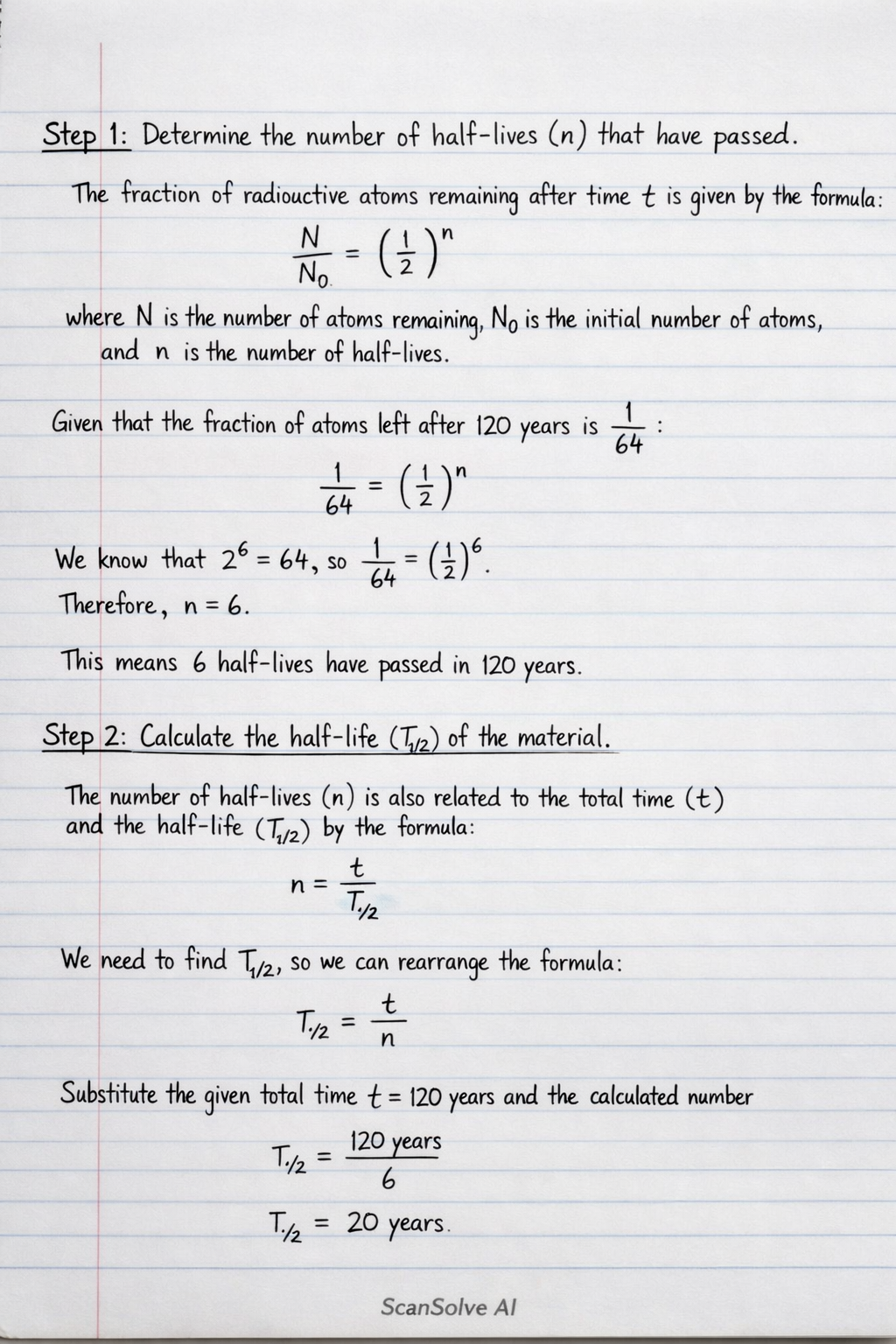
3 stepsDetermine the number of half-lives () that have passed.
The fraction of radioactive atoms remaining after time is given by the formula:
where is the number of atoms remaining, is the initial number of atoms, and is the number of half-lives.
Given that the fraction of atoms left after 120 years is :
We know that , so .
Therefore, .
This means 6 half-lives have passed in 120 years.Calculate the half-life () of the material.
The number of half-lives () is also related to the total time () and the half-life () by the formula:
We need to find , so we can rearrange the formula:
Substitute the given total time years and the calculated number of half-lives :
Compare the result with the given options.
The calculated half-life is 20 years, which corresponds to option C.
The half-life of the material is .
Try one yourself
A new problem that tests the same skill.
Still stuck on this one?
Ask a follow-up, and the answer starts from this question.
More Mathematics Questions
Handwritten Step-by-Step Solution
Get this as a handwritten image on WhatsApp — like a tutor wrote it for you.
Try on WhatsApp