Given that Z = x2 + y2 + x2y', Evaluate (i) dz/dx (ii) dz/dy, when x = 1 and y = 1. If y = ae^x + be2x, show that y'' - 3y' + 2y = 0. A body moves in a straight line according to the law of motion s = t3 - 2t2 + t. Find velocity and acceleration after 3 seconds.
|Mathematics
Given that Z = x2 + y2 + x2y', Evaluate (i) dz/dx (ii) dz/dy, when x = 1 and y = 1. If y = ae^x + be2x, show that y'' - 3y' + 2y = 0. A body moves in a straight line according to the law of motion s = t3 - 2t2 + t. Find velocity and acceleration after 3 seconds.
ScanSolve AI Answer
Answer
4
here's the solution for Question 5a:
(5a). Given that Z=x2+y2+x2y3, Evaluate (i) ∂x∂Z (ii) ∂y∂Z, when x=1 and y=1
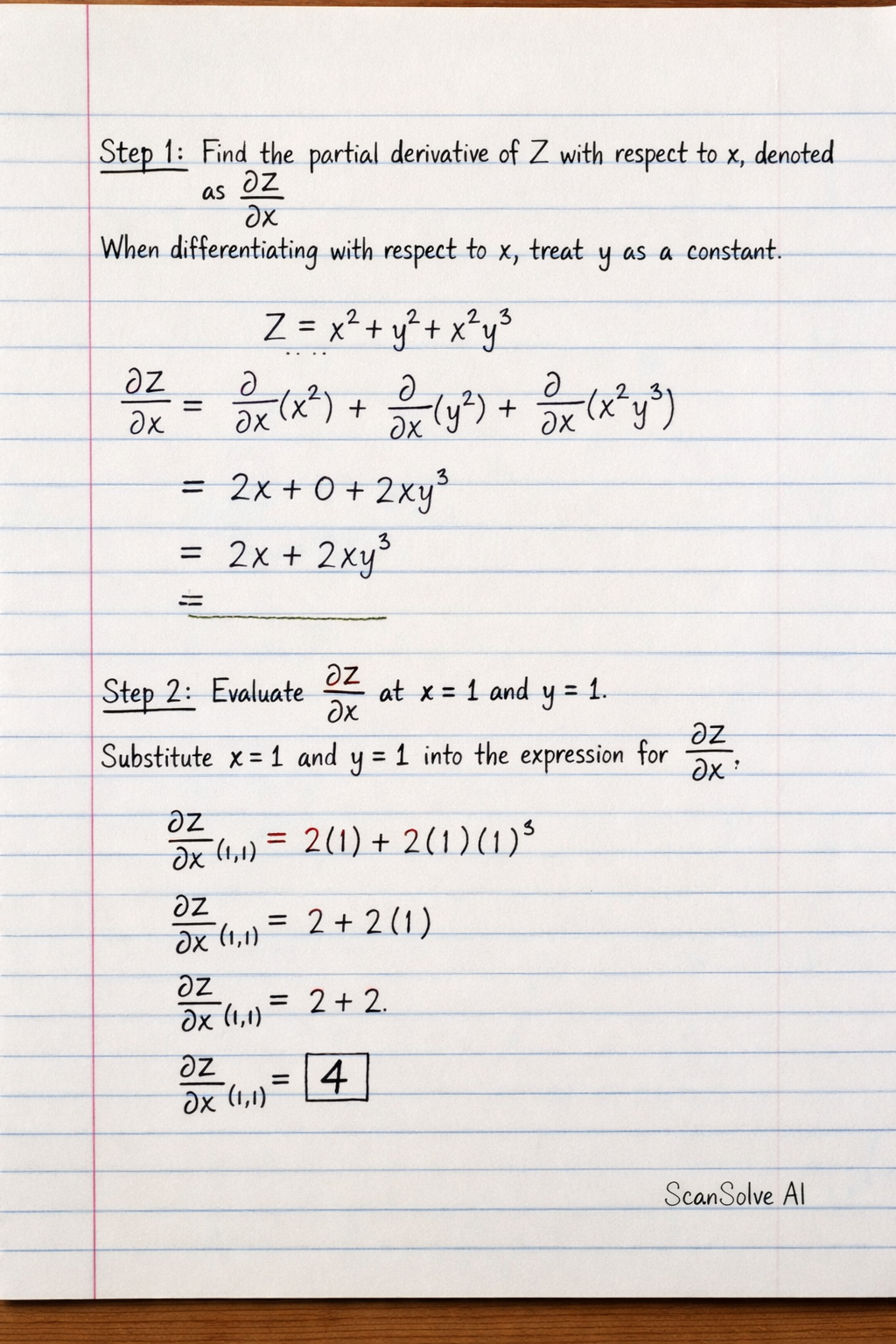
Step 1: Find the partial derivative of Z with respect to x, denoted as ∂x∂Z.
When differentiating with respect to x, treat y as a constant.
Z=x2+y2+x2y3∂x∂Z=∂x∂(x2)+∂x∂(y2)+∂x∂(x2y3)∂x∂Z=2x+0+2xy3∂x∂Z=2x+2xy3
Step 2: Evaluate ∂x∂Z at x=1 and y=1.
Substitute x=1 and y=1 into the expression for ∂x∂Z.
∂x∂Z(1,1)=2(1)+2(1)(1)3∂x∂Z(1,1)=2+2(1)(1)∂x∂Z(1,1)=2+2∂x∂Z(1,1)=4
Step 3: Find the partial derivative of Z with respect to y, denoted as ∂y∂Z.
When differentiating with respect to y, treat x as a constant.
Z=x2+y2+x2y3∂y∂Z=∂y∂(x2)+∂y∂(y2)+∂y∂(x2y3)∂y∂Z=0+2y+x2(3y2)∂y∂Z=2y+3x2y2
Step 4: Evaluate ∂y∂Z at x=1 and y=1.
Substitute x=1 and y=1 into the expression for ∂y∂Z.
∂y∂Z(1,1)=2(1)+3(1)2(1)2∂y∂Z(1,1)=2+3(1)(1)∂y∂Z(1,1)=2+3∂y∂Z(1,1)=5
What's next? 📸
Was this helpful?
Need help with your own homework?
Get instant step-by-step solutions to any question. Free to start.
When differentiating with respect to x, treat y as a constant.
Substitute x=1 and y=1 into the expression for ( Z)/( x).
When differentiating with respect to y, treat x as a constant.
Given that Z = x2 + y2 + x2y', Evaluate (i) dz/dx (ii) dz/dy, when x = 1 and y = 1. If y = ae^x + be2x, show that y'' - 3y' + 2y = 0. A body moves in a straight line according to the law of motion s = t3 - 2t2 + t. Find velocity and acceleration after 3 seconds.
This mathematics problem involves applying core mathematical principles and formulas. Below you will find a complete step-by-step solution with detailed explanations for each step, helping you understand not just the answer but the method behind it.
ScanSolve AI Answer
here's the solution for Question 5a: (5a). Given that Z = x^2 + y^2 + x^2y^3, Evaluate (i) ( Z)/( x) (ii) ( Z)/( y), when x=1 and y=1 Step 1: Find the partial derivative of Z with respect to x, denoted as ( Z)/( x). When differentiating with respect to x, treat y as a constant. Z = x^2 + y^2 + x^2y^3 ( Z)/( x) = ()/( x)(x^2) + ()/( x)(y^2) + ()/( x)(x^2y^3) ( Z)/( x) = 2x + 0 + 2xy^3 ( Z)/( x) = 2x + 2xy^3 Step 2: Evaluate ( Z)/( x) at x=1 and y=1. Substitute x=1 and y=1 into the expression for ( Z)/( x). ( Z)/( x) |_(1,1) = 2(1) + 2(1)(1)^3 ( Z)/( x) |_(1,1) = 2 + 2(1)(1) ( Z)/( x) |_(1,1) = 2 + 2 ( Z)/( x) |_(1,1) = 4 Step 3: Find the partial derivative of Z with respect to y, denoted as ( Z)/( y). When differentiating with respect to y, treat x as a constant. Z = x^2 + y^2 + x^2y^3 ( Z)/( y) = ()/( y)(x^2) + ()/( y)(y^2) + ()/( y)(x^2y^3) ( Z)/( y) = 0 + 2y + x^2(3y^2) ( Z)/( y) = 2y + 3x^2y^2 Step 4: Evaluate ( Z)/( y) at x=1 and y=1. Substitute x=1 and y=1 into the expression for ( Z)/( y). ( Z)/( y) |_(1,1) = 2(1) + 3(1)^2(1)^2 ( Z)/( y) |_(1,1) = 2 + 3(1)(1) ( Z)/( y) |_(1,1) = 2 + 3 ( Z)/( y) |_(1,1) = 5 What's next? 📸