

This mathematics problem involves applying core mathematical principles and formulas. Below you will find a complete step-by-step solution with detailed explanations for each step, helping you understand not just the answer but the method behind it.
ScanSolve AI Answer
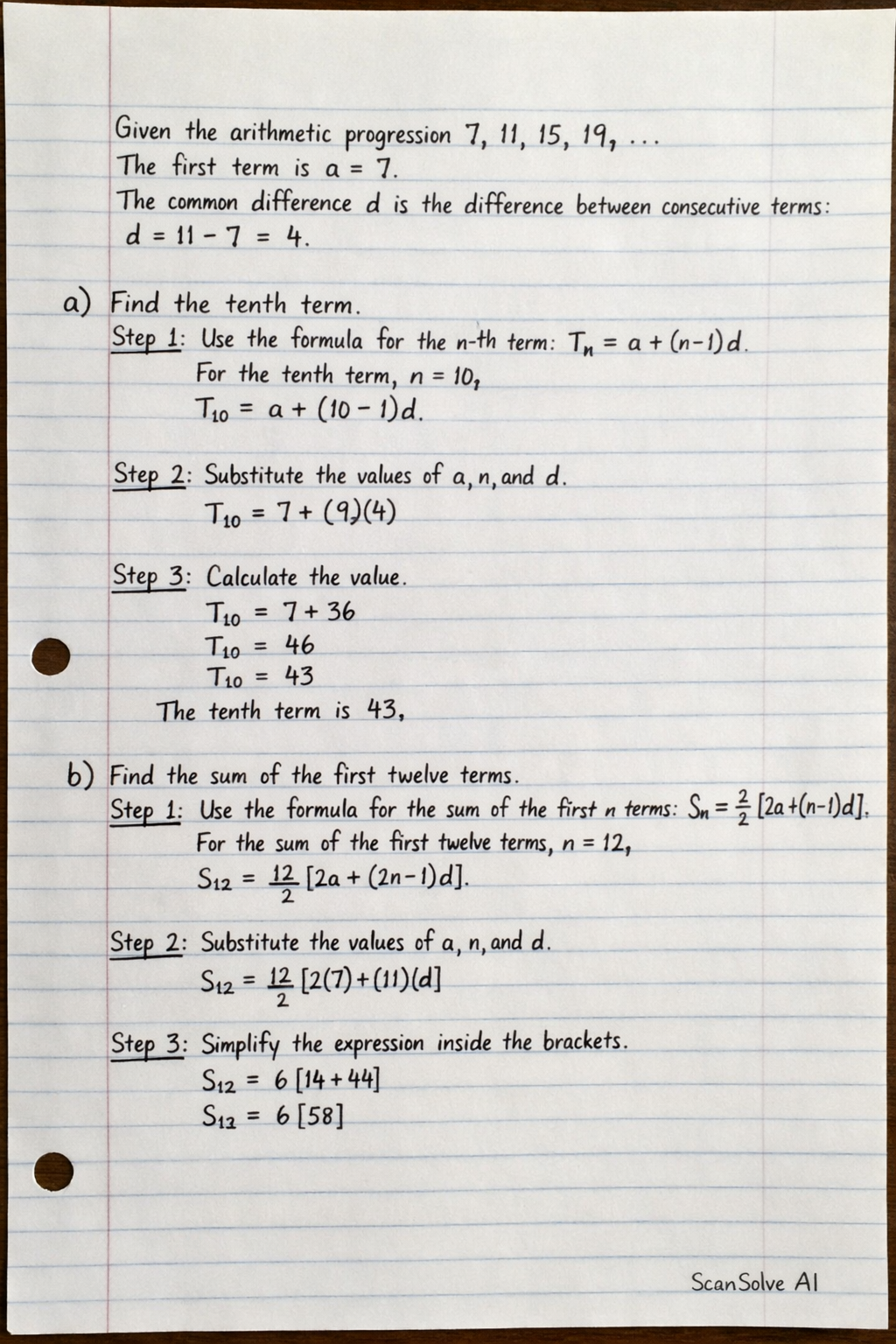
Given the arithmetic progression 7, 11, 15, 19, . The first term is a = 7. The common difference d is the difference between consecutive terms: d = 11 - 7 = 4. a) Find the tenth term. Step 1: Use the formula for the n-th term of an arithmetic progression, T_n = a + (n-1)d. For the tenth term, n=10. T_10 = a + (10-1)d Step 2: Substitute the values of a, n, and d into the formula. T_10 = 7 + (9) × 4 Step 3: Calculate the value. T_10 = 7 + 36 T_10 = 43 The tenth term is 43. b) Find the sum of the first twelve terms. Step 1: Use the formula for the sum of the first n terms of an arithmetic progression, S_n = (n)/(2)[2a + (n-1)d]. For the sum of the first twelve terms, n=12. S_12 = (12)/(2)[2a + (12-1)d] Step 2: Substitute the values of a, n, and d into the formula. S_12 = (12)/(2)[2(7) + (11) × 4] Step 3: Simplify the expression inside the brackets. S_12 = 6[14 + 44] S_12 = 6[58] Step 4: Calculate the sum. S_12 = 348 The sum of the first twelve terms is 348.