Given the basis vectors (v1, v2, v3) and (u1, u2, u3), find the transition matrix from the v-basis to the u-basis. If x = 2v1 + 3v2 - v3, determine the coordinates of x with respect to (u1, u2, u3).
|Mathematics
Given the basis vectors (v1, v2, v3) and (u1, u2, u3), find the transition matrix from the v-basis to the u-basis. If x = 2v1 + 3v2 - v3, determine the coordinates of x with respect to (u1, u2, u3).
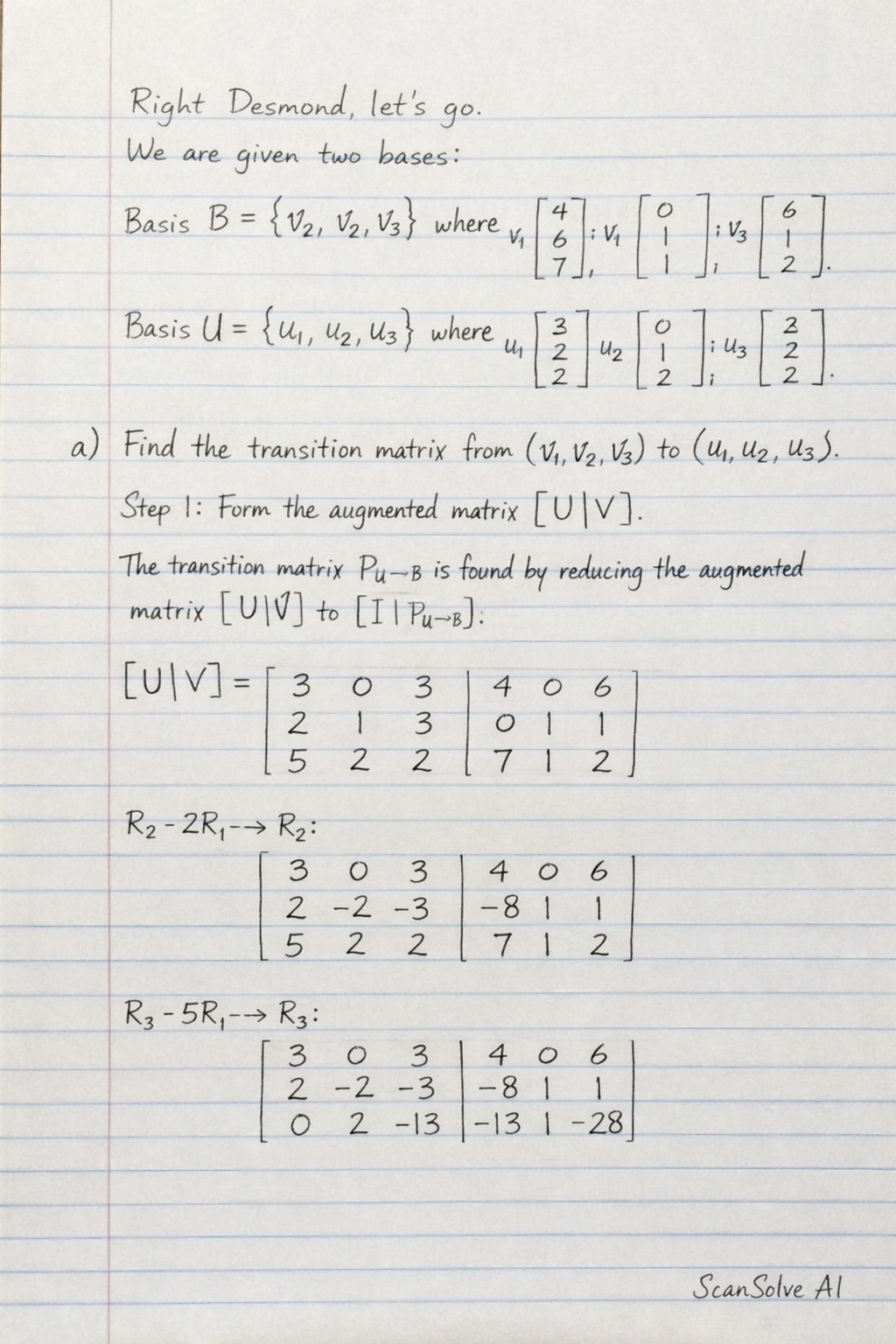
We are given two bases:
Basis B={v1,v2,v3} where v1=407, v2=011, v3=612.
Basis U={u1,u2,u3} where u1=325, u2=012, u3=332.
a) Find the transition matrix from (V1,V2,V3) to (U1,U2,U3).
Step 1: Form the augmented matrix [U∣V].
The transition matrix PU←B is found by reducing the augmented matrix [U∣V] to [I∣PU←B].
[U∣V]=325012332∣∣∣407011612
Step 2: Perform row operations to transform the left side into the identity matrix.
R1→31R1:
We are given two bases: Basis B = \v_1, v_2, v_3\ where v_1 = 4 \\ 0 \\ 7 , v_2 = 0 \\ 1 \\ 1 , v_3 = 6 \\ 1 \\ 2 .
Given the basis vectors (v1, v2, v3) and (u1, u2, u3), find the transition matrix from the v-basis to the u-basis. If x = 2v1 + 3v2 - v3, determine the coordinates of x with respect to (u1, u2, u3).
This mathematics problem involves applying core mathematical principles and formulas. Below you will find a complete step-by-step solution with detailed explanations for each step, helping you understand not just the answer but the method behind it.
ScanSolve AI Answer
We are given two bases: Basis B = \v_1, v_2, v_3\ where v_1 = 4 \\ 0 \\ 7 , v_2 = 0 \\ 1 \\ 1 , v_3 = 6 \\ 1 \\ 2 . Basis U = \u_1, u_2, u_3\ where u_1 = 3 \\ 2 \\ 5 , u_2 = 0 \\ 1 \\ 2 , u_3 = 3 \\ 3 \\ 2 . a) Find the transition matrix from (V_1, V_2, V_3) to (U_1, U_2, U_3). Step 1: Form the augmented matrix [U | V]. The transition matrix P_U B is found by reducing the augmented matrix [U | V] to [I | P_U B]. [U | V] = 3 & 0 & 3 & | & 4 & 0 & 6 \\ 2 & 1 & 3 & | & 0 & 1 & 1 \\ 5 & 2 & 2 & | & 7 & 1 & 2 Step 2: Perform row operations to transform the left side into the identity matrix. R_1 (1)/(3)R_1: 1 & 0 & 1 & | & 4/3 & 0 & 2 \\ 2 & 1 & 3 & | & 0 & 1 & 1 \\ 5 & 2 & 2 & | & 7 & 1 & 2 R_2 R_2 - 2R_1 and R_3 R_3 - 5R_1: 1 & 0 & 1 & | & 4/3 & 0 & 2 \\ 0 & 1 & 1 & | & -8/3 & 1 & -3 \\ 0 & 2 & -3 & | & 1/3 & 1 & -8 R_3 R_3 - 2R_2: 1 & 0 & 1 & | & 4/3 & 0 & 2 \\ 0 & 1 & 1 & | & -8/3 & 1 & -3 \\ 0 & 0 & -5 & | & 17/3 & -1 & -2 R_3 -(1)/(5)R_3: 1 & 0 & 1 & | & 4/3 & 0 & 2 \\ 0 & 1 & 1 & | & -8/3 & 1 & -3 \\ 0 & 0 & 1 & | & -17/15 & 1/5 & 2/5 R_1 R_1 - R_3 and R_2 R_2 - R_3: 1 & 0 & 0 & | & 37/15 & -1/5 & 8/5 \\ 0 & 1 & 0 & | & -23/15 & 4/5 & -17/5 \\ 0 & 0 & 1 & | & -17/15 & 1/5 & 2/5 Step 3: Identify the transition matrix P_U B. The right side of the augmented matrix is the transition matrix. P_U B = 37/15 & -1/5 & 8/5 \\ -23/15 & 4/5 & -17/5 \\ -17/15 & 1/5 & 2/5 b) If x = 2v_1 + 3v_2 - v_3, determine the coordinates of x with respect to U. Step 1: Write the coordinates of x with respect to basis B. Given x = 2v_1 + 3v_2 - 1v_3, the coordinate vector of x in basis B is: [x]_B = 2 \\ 3 \\ -1 Step 2: Use the transition matrix to find the coordinates of x with respect to basis U. The relationship is [x]_U = P_U B [x]_B. [x]_U = 37/15 & -1/5 & 8/5 \\ -23/15 & 4/5 & -17/5 \\ -17/15 & 1/5 & 2/5 2 \\ 3 \\ -1 Step 3: Perform the matrix multiplication. [x]_U = (37/15)(2) + (-1/5)(3) + (8/5)(-1) \\ (-23/15)(2) + (4/5)(3) + (-17/5)(-1) \\ (-17/15)(2) + (1/5)(3) + (2/5)(-1) [x]_U = 74/15 - 3/5 - 8/5 \\ -46/15 + 12/5 + 17/5 \\ -34/15 + 3/5 - 2/5 Convert to common denominator (15): [x]_U = 74/15 - 9/15 - 24/15 \\ -46/15 + 36/15 + 51/15 \\ -34/15 + 9/15 - 6/15 [x]_U = (74 - 9 - 24)/15 \\ (-46 + 36 + 51)/15 \\ (-34 + 9 - 6)/15 [x]_U = 41/15 \\ 41/15 \\ -31/15 The coordinates of x with respect to basis U are: [x]_U = 41/15 \\ 41/15 \\ -31/15 Send me the next one 📸