
We read your photo as:
Consider the letters of the word MERAFONG. How many unique word arrangements can be made using all the letters? Calculate the probability that the word arrangement will start with a letter R and end with a letter N.
ScanSolve AI Answer
Step-by-step solution
13 stepshere are the solutions to Question 11.
QUESTION 11
11.1 Consider the letters of the word MERAFONG
The word MERAFONG has 8 distinct letters: M, E, R, A, F, O, N, G.
Assumption for 11.1: We will assume that "unique word arrangements using all the letters" implies permutations without repetition, meaning each letter is used exactly once in each arrangement. The phrase "The letters may repeat" in 11.1.1 is disregarded as it contradicts the standard interpretation of such problems and makes 11.1.3 intractable at this level.
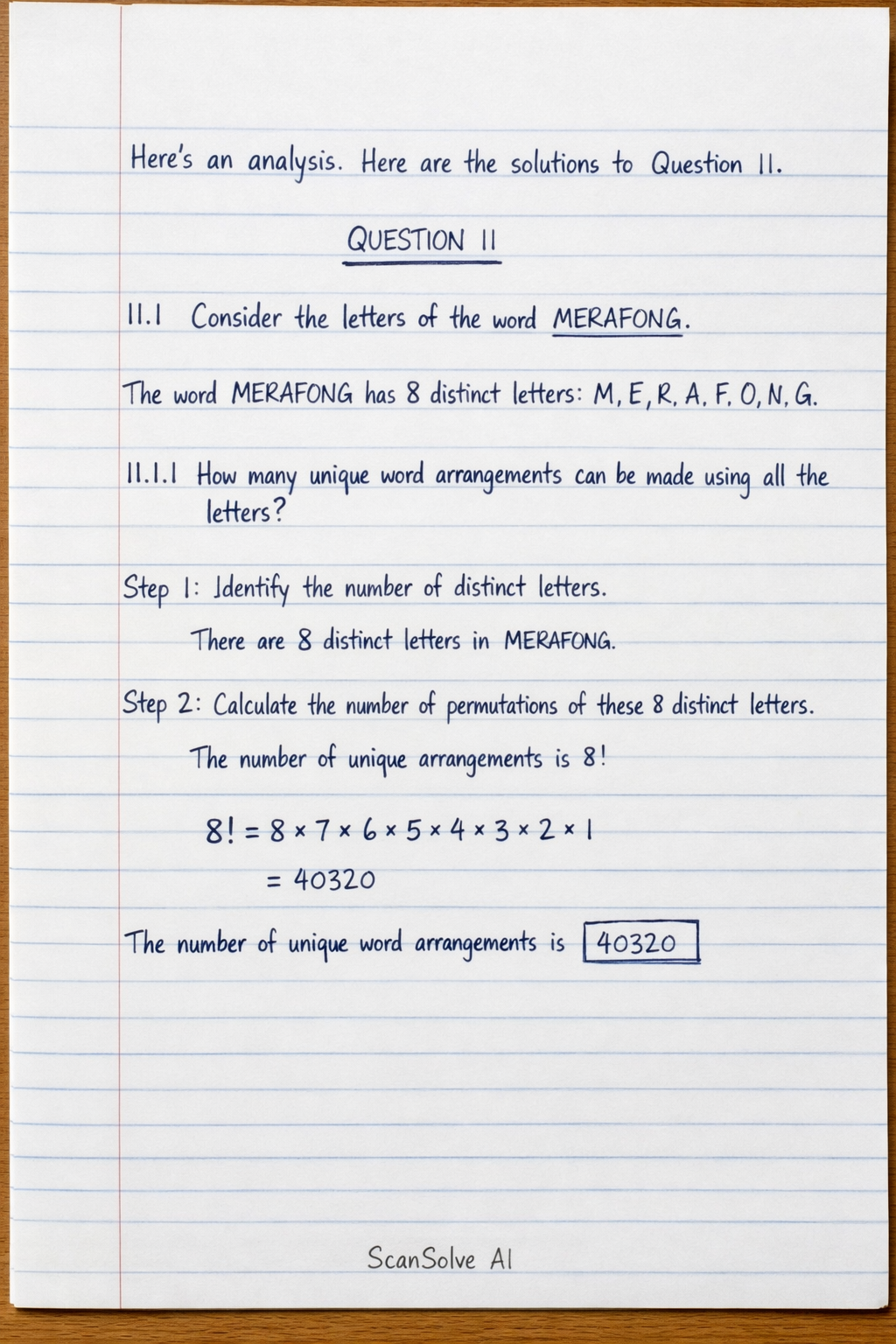
11.1.1 How many unique word arrangements can be made using all the letters?
Identify the number of distinct letters.
There are 8 distinct letters in MERAFONG.
Calculate the number of permutations of these 8 distinct letters.
The number of unique arrangements is .
The number of unique word arrangements is .
11.1.2 Calculate the probability that the word arrangement will start with a letter R and end with a letter N.
Determine the total number of possible arrangements (from 11.1.1).
Total arrangements = .
Determine the number of favorable arrangements.
- The first letter must be R (1 choice).
- The last letter must be N (1 choice).
- The remaining 6 letters (M, E, A, F, O, G) can be arranged in the 6 middle positions in ways. Number of favorable arrangements = .
Calculate the probability.
The probability is .
11.1.3 Calculate the probability that the vowels (a, e, o) will be placed next to each other in any of the word arrangements.
Determine the total number of possible arrangements (from 11.1.1).
Total arrangements = .
Determine the number of favorable arrangements.
- Identify the vowels: A, E, O (3 vowels).
- Identify the consonants: M, R, F, N, G (5 consonants).
- Treat the 3 vowels as a single block. Now we are arranging 6 items: (AEO block), M, R, F, N, G. These 6 items can be arranged in ways.
- Within the vowel block, the 3 vowels (A, E, O) can be arranged among themselves in ways. Number of favorable arrangements = .
Calculate the probability.
The probability is .
11.2 The probability that during a given weekend a PSL team player will play in an international game (S) is 0.7. The probability that the player will play in a charity golf tournament (G) during that weekend is 0.4, and the probability that the player will participate in both activities is 0.3.
Given:
11.2.1 Draw a Venn diagram to represent the given information.
Calculate the probabilities for each region of the Venn diagram.
- Probability of S only: .
- Probability of G only: .
- Probability of S or G (union): .
- Probability of neither S nor G (outside both circles): .
Draw the Venn diagram.
A Venn diagram consists of a rectangle representing the sample space (total probability 1). Inside, there are two overlapping circles, one for event S and one for event G.
- The overlapping region (intersection) contains the value 0.3.
- The part of circle S that does not overlap with G contains 0.4.
- The part of circle G that does not overlap with S contains 0.1.
- The region outside both circles but inside the rectangle contains 0.2.
11.2.2 Calculate:
a) P(S')
Use the complement rule .
b) P(S and G)'
Use the complement rule .
c) P(S or G)
Use the formula for the union of two events .
Still stuck on this one?
Ask a follow-up, and the answer starts from this question.
More Mathematics Questions
Handwritten Step-by-Step Solution
Get this as a handwritten image on WhatsApp — like a tutor wrote it for you.
Try on WhatsApp