We read your photo as:

Given the equation of the curve of the curve defined by y=x³ − 6x² + 9x − 2, Determine: (i) The critical points, (ii) Their nature, (iii) Hence sketch the curve.

Mathematics

ScanSolve AI Answer

Graph of y = x³ − 6x² + 9x − 2

Use the left and right arrow keys to trace the curve, up and down to jump between key points, and plus and minus to zoom.

Key points of y = x³ − 6x² + 9x − 2
Pointxy
y-intercept0−2
x-intercept0.270
Maximum12
x-intercept20
Minimum3−2
x-intercept3.730

Step-by-step solution

9 steps

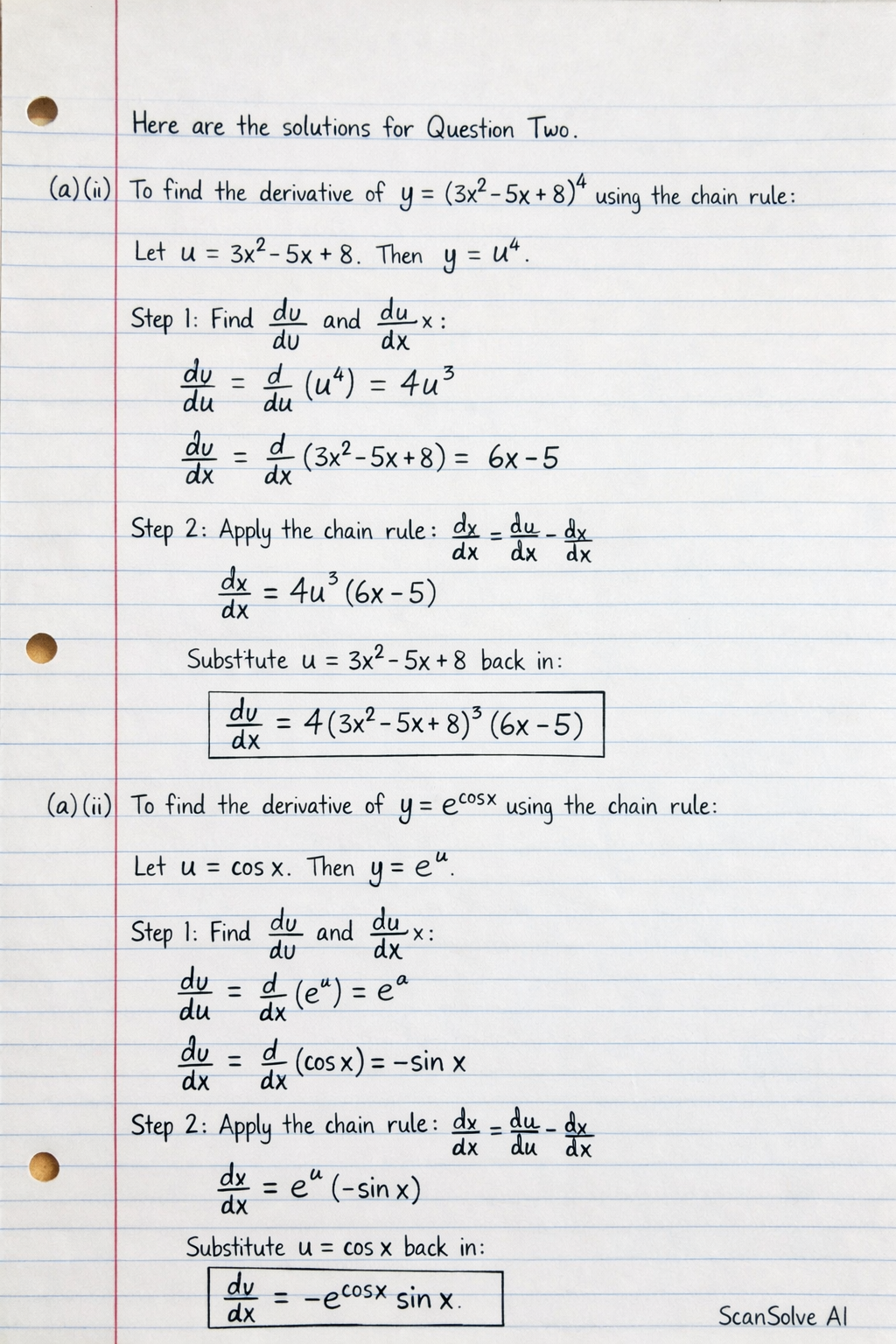
Here are the solutions for Question Two.

a) (i) To find the derivative of y=(3x2−5x+8)4y = (3x^2-5x+8)^4 using the chain rule:
Let u=3x2−5x+8u = 3x^2-5x+8. Then y=u4y = u^4.

  1. Find dydu\frac{dy}{du} and dudx\frac{du}{dx}.

    dydu=ddu(u4)=4u3\frac{dy}{du} = \frac{d}{du}(u^4) = 4u^3 dudx=ddx(3x2−5x+8)=6x−5\frac{du}{dx} = \frac{d}{dx}(3x^2-5x+8) = 6x-5
  2. Apply the chain rule dydx=dydu⋅dudx\frac{dy}{dx} = \frac{dy}{du} \cdot \frac{du}{dx}.

    dydx=4u3(6x−5)\frac{dy}{dx} = 4u^3 (6x-5)

    Substitute u=3x2−5x+8u = 3x^2-5x+8 back into the expression.

    dydx=4(3x2−5x+8)3(6x−5)\boxed{\frac{dy}{dx} = 4(3x^2-5x+8)^3 (6x-5)}

    a) (ii) To find the derivative of y=ecos⁡xy = e^{\cos x} using the chain rule:
    Let u=cos⁡xu = \cos x. Then y=euy = e^u.

  3. Find dydu\frac{dy}{du} and dudx\frac{du}{dx}.

    dydu=ddu(eu)=eu\frac{dy}{du} = \frac{d}{du}(e^u) = e^u dudx=ddx(cos⁡x)=−sin⁡x\frac{du}{dx} = \frac{d}{dx}(\cos x) = -\sin x
  4. Apply the chain rule dydx=dydu⋅dudx\frac{dy}{dx} = \frac{dy}{du} \cdot \frac{du}{dx}.

    dydx=eu(−sin⁡x)\frac{dy}{dx} = e^u (-\sin x)

    Substitute u=cos⁡xu = \cos x back into the expression.

    dydx=−ecos⁡xsin⁡x\boxed{\frac{dy}{dx} = -e^{\cos x} \sin x}

    a) (iii) To find the derivative of y=ln⁡(x4+3)y = \ln(x^4+3) using the chain rule:
    Let u=x4+3u = x^4+3. Then y=ln⁡uy = \ln u.

  5. Find dydu\frac{dy}{du} and dudx\frac{du}{dx}.

    dydu=ddu(ln⁡u)=1u\frac{dy}{du} = \frac{d}{du}(\ln u) = \frac{1}{u} dudx=ddx(x4+3)=4x3\frac{du}{dx} = \frac{d}{dx}(x^4+3) = 4x^3
  6. Apply the chain rule dydx=dydu⋅dudx\frac{dy}{dx} = \frac{dy}{du} \cdot \frac{du}{dx}.

    dydx=1u(4x3)\frac{dy}{dx} = \frac{1}{u} (4x^3)

    Substitute u=x4+3u = x^4+3 back into the expression.

    dydx=4x3x4+3\boxed{\frac{dy}{dx} = \frac{4x^3}{x^4+3}}

    b) Given y=e3xy = e^{3x}, show that d2ydx2+dydx−12y=0\frac{d^2y}{dx^2} + \frac{dy}{dx} - 12y = 0.

  7. Find the first derivative, dydx\frac{dy}{dx}.

    y=e3xy = e^{3x} dydx=ddx(e3x)=3e3x\frac{dy}{dx} = \frac{d}{dx}(e^{3x}) = 3e^{3x}
  8. Find the second derivative, d2ydx2\frac{d^2y}{dx^2}.

    d2ydx2=ddx(3e3x)=3⋅ddx(e3x)=3(3e3x)=9e3x\frac{d^2y}{dx^2} = \frac{d}{dx}\left(3e^{3x}\right) = 3 \cdot \frac{d}{dx}(e^{3x}) = 3(3e^{3x}) = 9e^{3x}
  9. Substitute yy, dydx\frac{dy}{dx}, and d2ydx2\frac{d^2y}{dx^2} into the given equation.

    d2ydx2+dydx−12y=0\frac{d^2y}{dx^2} + \frac{dy}{dx} - 12y = 0 (9e3x)+(3e3x)−12(e3x)=0(9e^{3x}) + (3e^{3x}) - 12(e^{3x}) = 0 9e3x+3e3x−12e3x=09e^{3x} + 3e^{3x} - 12e^{3x} = 0 12e3x−12e3x=012e^{3x} - 12e^{3x} = 0 0=00 = 0

    Since the left side equals the right side, the statement is proven.

Was this helpful?

Still stuck on this one?

Ask a follow-up, and the answer starts from this question.

Got a different question?Ask your own question
Handwritten step-by-step solution preview

Handwritten Step-by-Step Solution

Get this as a handwritten image on WhatsApp — like a tutor wrote it for you.

Try on WhatsApp