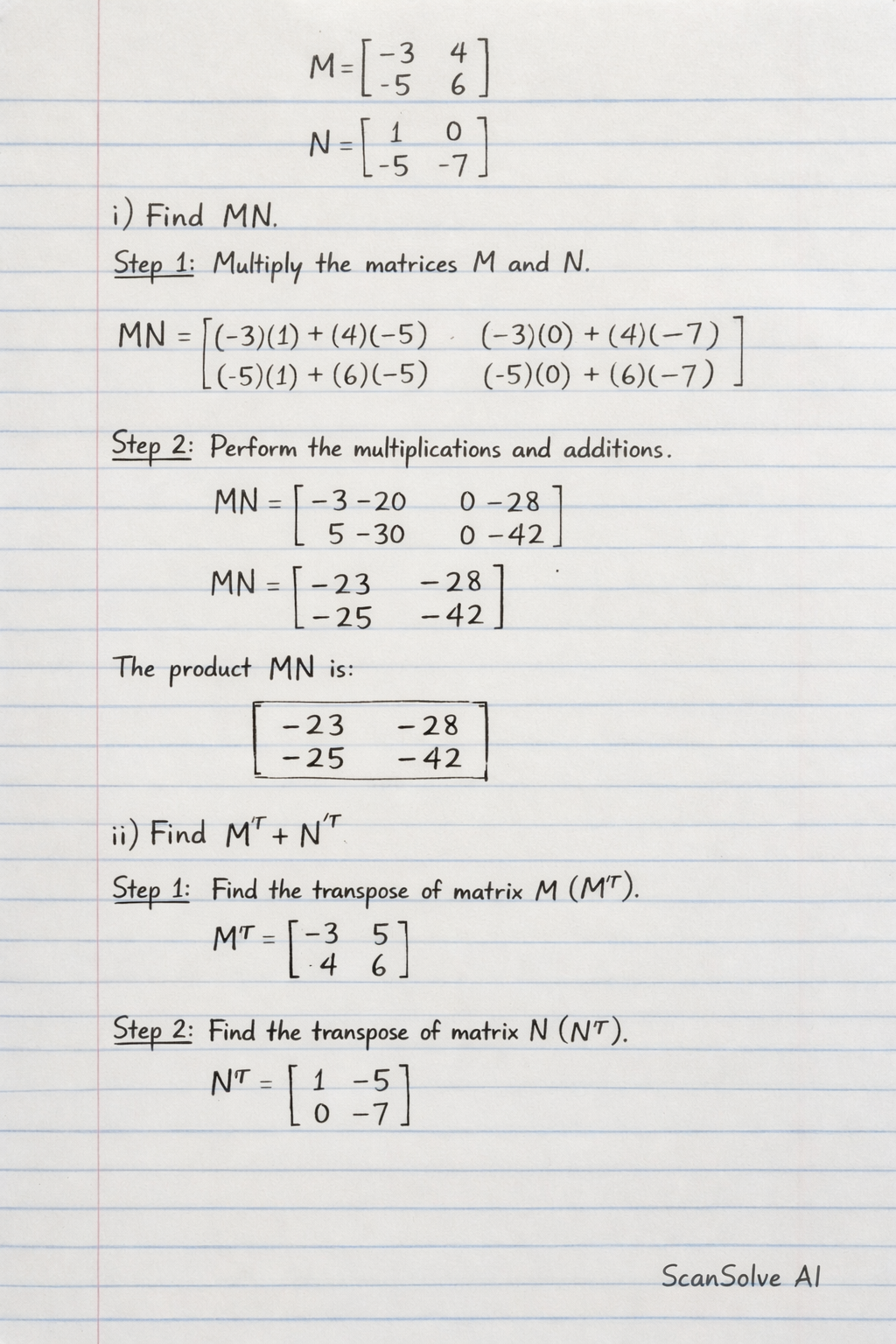
We read your photo as:

Given the matrices M = [[-3, 4], [5, 6]] and N = [[1, 0], [-5, -7]], find MN and M^T + N^T.

Mathematics

ScanSolve AI Answer

Answers

3 parts
i

(−23−28−25−42)\begin{pmatrix} -23 & -28 \\ -25 & -42 \end{pmatrix}

ii

(−204−1)\begin{pmatrix} -2 & 0 \\ 4 & -1 \end{pmatrix}

iii

(10−57−17)\begin{pmatrix} 1 & 0 \\ -\frac{5}{7} & -\frac{1}{7} \end{pmatrix}

Step-by-step solution

8 steps

Given the matrices:

M=(−3456)M = \begin{pmatrix} -3 & 4 \\ 5 & 6 \end{pmatrix} N=(10−5−7)N = \begin{pmatrix} 1 & 0 \\ -5 & -7 \end{pmatrix}

Part i· 2 steps

Find MNMN.

  1. Multiply the matrices M and N.

    To multiply two matrices, we multiply the rows of the first matrix by the columns of the second matrix.

    MN=((−3)(1)+(4)(−5)(−3)(0)+(4)(−7)(5)(1)+(6)(−5)(5)(0)+(6)(−7))MN = \begin{pmatrix} (-3)(1) + (4)(-5) & (-3)(0) + (4)(-7) \\ (5)(1) + (6)(-5) & (5)(0) + (6)(-7) \end{pmatrix}
  2. Perform the multiplications and additions.

    MN=(−3−200−285−300−42)MN = \begin{pmatrix} -3 - 20 & 0 - 28 \\ 5 - 30 & 0 - 42 \end{pmatrix} MN=(−23−28−25−42)MN = \begin{pmatrix} -23 & -28 \\ -25 & -42 \end{pmatrix}

    The product MNMN is:

    (−23−28−25−42)\boxed{\begin{pmatrix} -23 & -28 \\ -25 & -42 \end{pmatrix}}

Part ii

(−204−1)\begin{pmatrix} -2 & 0 \\ 4 & -1 \end{pmatrix}

Find MT+NTM^T + N^T.

  1. Find the transpose of matrix M (MTM^T).

    The transpose of a matrix is obtained by interchanging its rows and columns.

    MT=(−3546)M^T = \begin{pmatrix} -3 & 5 \\ 4 & 6 \end{pmatrix}
  2. Find the transpose of matrix N (NTN^T).

    NT=(1−50−7)N^T = \begin{pmatrix} 1 & -5 \\ 0 & -7 \end{pmatrix}
  3. Add the transposed matrices MTM^T and NTN^T.

    To add matrices, we add their corresponding elements.

    MT+NT=(−3546)+(1−50−7)M^T + N^T = \begin{pmatrix} -3 & 5 \\ 4 & 6 \end{pmatrix} + \begin{pmatrix} 1 & -5 \\ 0 & -7 \end{pmatrix} MT+NT=(−3+15+(−5)4+06+(−7))M^T + N^T = \begin{pmatrix} -3+1 & 5+(-5) \\ 4+0 & 6+(-7) \end{pmatrix} MT+NT=(−204−1)M^T + N^T = \begin{pmatrix} -2 & 0 \\ 4 & -1 \end{pmatrix}

    The sum MT+NTM^T + N^T is:

    (−204−1)\boxed{\begin{pmatrix} -2 & 0 \\ 4 & -1 \end{pmatrix}}

Part iii

(10−57−17)\begin{pmatrix} 1 & 0 \\ -\frac{5}{7} & -\frac{1}{7} \end{pmatrix}

Find N−1N^{-1} (N inverse).

  1. Calculate the determinant of matrix N.

    For a 2×22 \times 2 matrix (abcd)\begin{pmatrix} a & b \\ c & d \end{pmatrix}, the determinant is ad−bcad - bc.
    For N=(10−5−7)N = \begin{pmatrix} 1 & 0 \\ -5 & -7 \end{pmatrix}:

    det⁡(N)=(1)(−7)−(0)(−5)\det(N) = (1)(-7) - (0)(-5) det⁡(N)=−7−0\det(N) = -7 - 0 det⁡(N)=−7\det(N) = -7
  2. Calculate the inverse of matrix N.

    For a 2×22 \times 2 matrix (abcd)\begin{pmatrix} a & b \\ c & d \end{pmatrix}, the inverse is 1det⁡(A)(d−b−ca)\frac{1}{\det(A)} \begin{pmatrix} d & -b \\ -c & a \end{pmatrix}.

    N−1=1−7(−7−0−(−5)1)N^{-1} = \frac{1}{-7} \begin{pmatrix} -7 & -0 \\ -(-5) & 1 \end{pmatrix} N−1=−17(−7051)N^{-1} = -\frac{1}{7} \begin{pmatrix} -7 & 0 \\ 5 & 1 \end{pmatrix}
  3. Multiply each element by the scalar −17-\frac{1}{7}.

    N−1=((−17)(−7)(−17)(0)(−17)(5)(−17)(1))N^{-1} = \begin{pmatrix} (-\frac{1}{7})(-7) & (-\frac{1}{7})(0) \\ (-\frac{1}{7})(5) & (-\frac{1}{7})(1) \end{pmatrix} N−1=(10−57−17)N^{-1} = \begin{pmatrix} 1 & 0 \\ -\frac{5}{7} & -\frac{1}{7} \end{pmatrix}

    The inverse of N is:

    (10−57−17)\boxed{\begin{pmatrix} 1 & 0 \\ -\frac{5}{7} & -\frac{1}{7} \end{pmatrix}}
Was this helpful?

Try one yourself

A new problem that tests the same skill.

Still stuck on this one?

Ask a follow-up, and the answer starts from this question.

Got a different question?Ask your own question
Handwritten step-by-step solution preview

Handwritten Step-by-Step Solution

Get this as a handwritten image on WhatsApp — like a tutor wrote it for you.

Try on WhatsApp