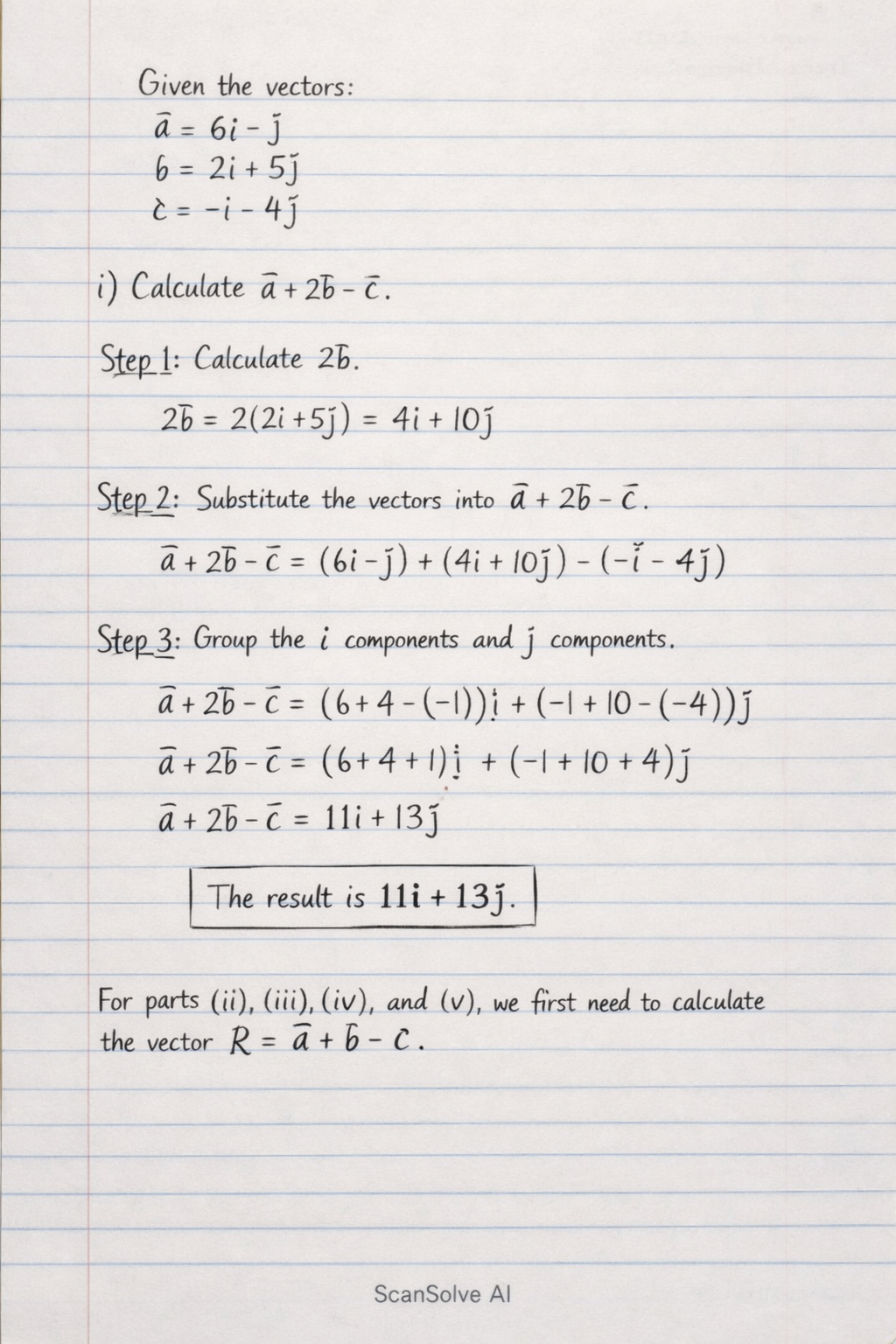
Step 2: Group the i components and j components for R.
R=(6+2−(−1))i+(−1+5−(−4))jR=(6+2+1)i+(−1+5+4)jR=9i+8j
iii) Magnitude of a+b−c
Step 1: Calculate the magnitude of R=9i+8j.
The magnitude of a vector xi+yj is x2+y2.
∣R∣=92+82∣R∣=81+64∣R∣=145
The magnitude is 145.
ii) Unit vector in the direction of a+b−c
Step 1: Calculate the unit vector R^ using the formula R^=∣R∣R.
R^=1459i+8jR^=1459i+1458j
The unit vector is 1459i+1458j.
iv) Direction of a+b−c
Step 1: Find the angle θ that the vector R=9i+8j makes with the positive x-axis.
tanθ=x−componenty−component=98θ=arctan(98)θ≈41.63∘
The direction is arctan(98)orapproximately41.63∘fromthepositivex−axis.
v) Direction cosine of a+b−c
Step 1: The direction cosines for a 2D vector xi+yj are cosα=∣R∣x and cosβ=∣R∣y, where α is the angle with the x-axis and β is the angle with the y-axis.
cosα=1459cosβ=1458
The direction cosines are 1459and1458.
Was this helpful?
Need help with your own homework?
Get instant step-by-step solutions to any question. Free to start.
This mathematics problem involves applying core mathematical principles and formulas. Below you will find a complete step-by-step solution with detailed explanations for each step, helping you understand not just the answer but the method behind it.
ScanSolve AI Answer
Given the vectors: a = 6i - j b = 2i + 5j c = -i - 4j i) Calculate a + 2b - c Step 1: Calculate 2b. 2b = 2(2i + 5j) = 4i + 10j Step 2: Substitute the vectors into the expression a + 2b - c. a + 2b - c = (6i - j) + (4i + 10j) - (-i - 4j) Step 3: Group the i components and j components. a + 2b - c = (6 + 4 - (-1))i + (-1 + 10 - (-4))j a + 2b - c = (6 + 4 + 1)i + (-1 + 10 + 4)j a + 2b - c = 11i + 13j The result is 11i + 13j. For parts (ii), (iii), (iv), and (v), we first need to calculate the vector R = a + b - c. Step 1: Calculate R = a + b - c. R = (6i - j) + (2i + 5j) - (-i - 4j) Step 2: Group the i components and j components for R. R = (6 + 2 - (-1))i + (-1 + 5 - (-4))j R = (6 + 2 + 1)i + (-1 + 5 + 4)j R = 9i + 8j iii) Magnitude of a + b - c Step 1: Calculate the magnitude of R = 9i + 8j. The magnitude of a vector xi + yj is sqrt(x^2 + y^2). |R| = sqrt(9^2 + 8^2) |R| = sqrt(81 + 64) |R| = sqrt(145) The magnitude is sqrt(145). ii) Unit vector in the direction of a + b - c Step 1: Calculate the unit vector R using the formula R = R|R|. R = 9i + 8jsqrt(145) R = (9)/(sqrt(145))i + (8)/(sqrt(145))j The unit vector is (9)/(sqrt(145))i + (8)/(sqrt(145))j. iv) Direction of a + b - c Step 1: Find the angle that the vector R = 9i + 8j makes with the positive x-axis. = y-componentx-component = (8)/(9) = ((8)/(9)) ≈ 41.63^ The direction is ((8)/(9)) or approximately 41.63^ from the positive x-axis. v) Direction cosine of a + b - c Step 1: The direction cosines for a 2D vector xi + yj are = (x)/(|R)| and = (y)/(|R)|, where is the angle with the x-axis and is the angle with the y-axis. = (9)/(sqrt(145)) = (8)/(sqrt(145)) The direction cosines are (9)/(sqrt(145)) and (8)/(sqrt(145)).