
We read your photo as:
Given the vertices of a triangle ABC as A(-2,-3), B(-4,1), and C(4,5), sketch the triangle, calculate the length of each side, and find its perimeter.
ScanSolve AI Answer
Answers
3 partsStep-by-step solution
3 stepsHere are the solutions for the triangle ABC with vertices A(-2;-3), B(-4;1), and C(4;5).
Part i
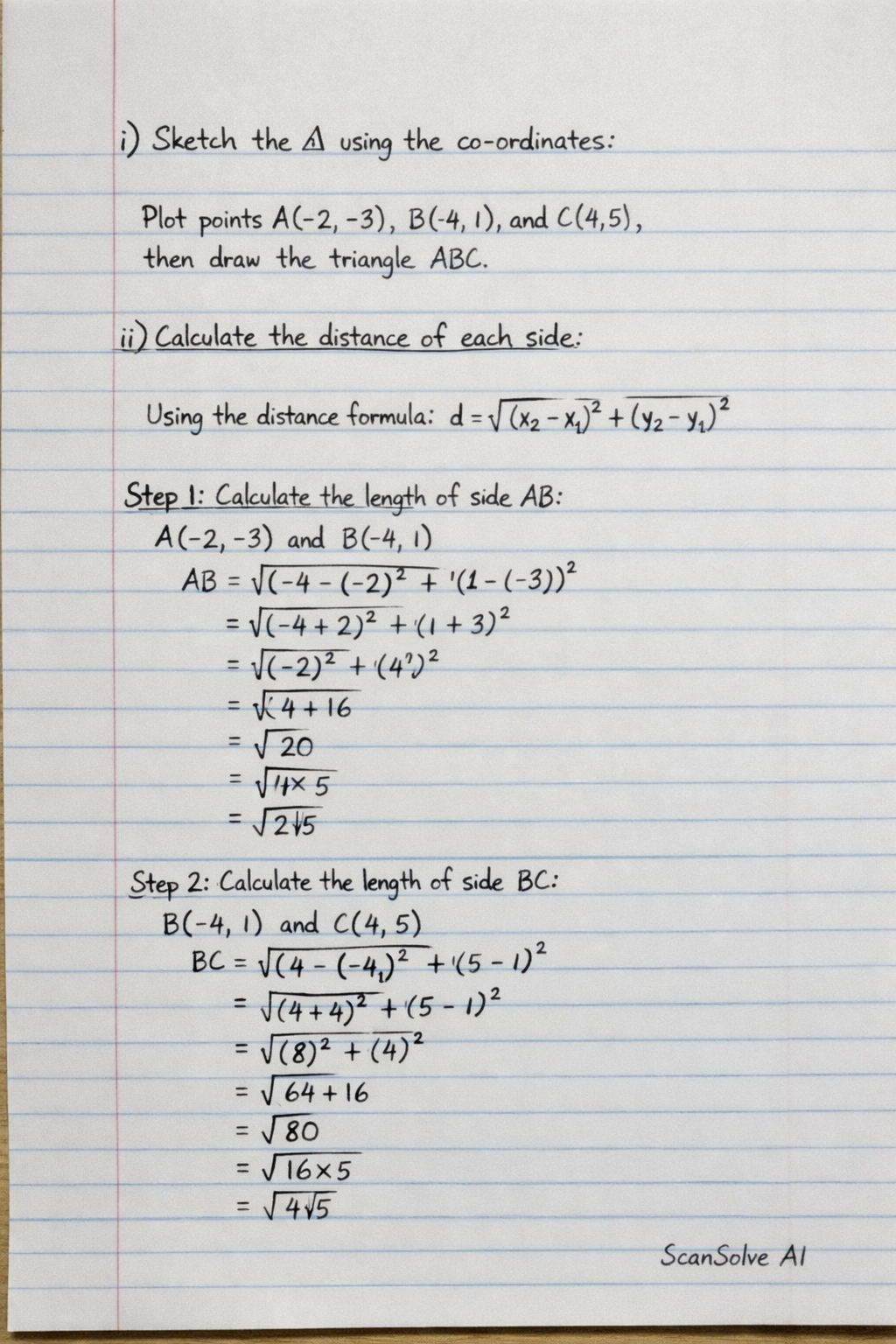
Sketch the using the co-ordinates
To sketch the triangle, plot the points A(-2,-3), B(-4,1), and C(4,5) on a Cartesian coordinate plane. Then, connect the points with straight lines to form the triangle ABC.
Part ii
Calculate the distance of each side
We use the distance formula: .
Calculate the length of side AB.
Given A and B.
Calculate the length of side BC.
Given B and C.
Calculate the length of side AC.
Given A and C.
The lengths of the sides are:
Part iii
Calculate the perimeter of the
The perimeter is the sum of the lengths of all sides.
To get a numerical value, we approximate .
The perimeter of the triangle is:
Part iv
Determine whether the is equilateral, isosceles or scalene
- An equilateral triangle has all three sides equal.
- An isosceles triangle has at least two sides equal.
- A scalene triangle has all three sides of different lengths.
Comparing the side lengths:
Since , all three sides have different lengths.
Therefore, the triangle is a scalene triangle.
Try one yourself
A new problem that tests the same skill.
Still stuck on this one?
Ask a follow-up, and the answer starts from this question.
More Mathematics Questions
Handwritten Step-by-Step Solution
Get this as a handwritten image on WhatsApp — like a tutor wrote it for you.
Try on WhatsApp