
We read your photo as:
Given theta = (1)/(3). We can construct a right-angled triangle where the opposite side is 1 and the adjacent side is 3.
ScanSolve AI Answer
Answer
Step-by-step solution
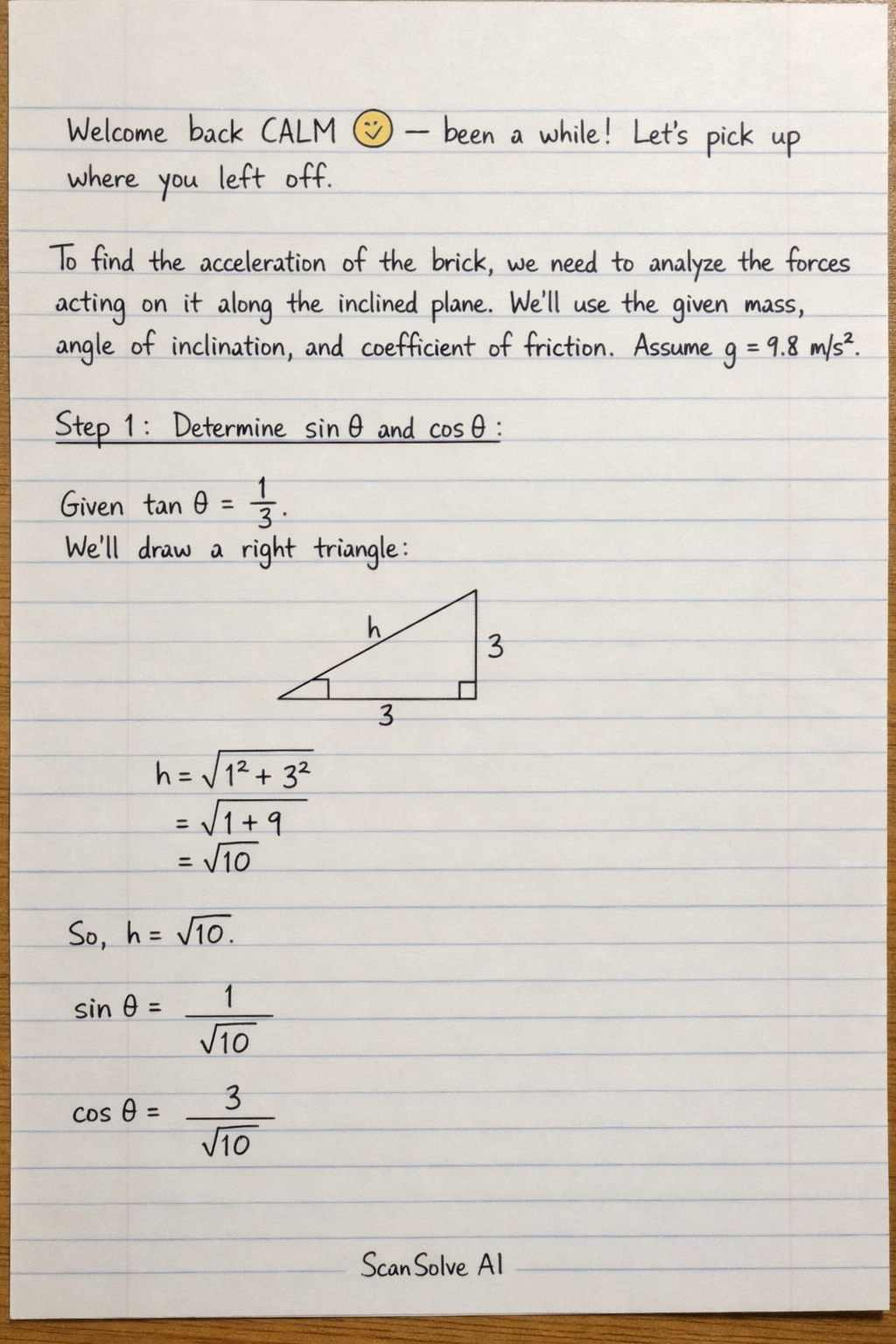
5 stepsTo find the acceleration of the brick, we need to analyze the forces acting on it along the inclined plane. We'll use the given mass, angle of inclination, and coefficient of friction. We will assume the acceleration due to gravity .
Determine and .
Given . We can construct a right-angled triangle where the opposite side is 1 and the adjacent side is 3.
The hypotenuse is calculated using the Pythagorean theorem:Now we can find and :
Calculate the normal force ().
The forces perpendicular to the inclined plane are the normal force () acting upwards and the component of gravity () acting downwards into the plane. Since there is no acceleration perpendicular to the plane, these forces balance:
Calculate the maximum static frictional force ().
The maximum static frictional force is given by , where is the coefficient of friction.
Substitute the given value of :
Determine the component of gravity parallel to the plane ().
The component of gravity pulling the brick down the incline is .
Compare forces and find acceleration.
For the brick to move, the downward component of gravity must be greater than the maximum static frictional force ().
In this case, we found:Since , the component of gravity pulling the brick down the incline is exactly equal to the maximum static frictional force. This means the net force along the incline is zero.
As the brick is released from rest, it will not start to move. Therefore, its acceleration is zero.
Applying Newton's second law along the incline:Since the mass is not zero, the acceleration must be zero.
The acceleration of the brick is .
Try one yourself
A new problem that tests the same skill.
Still stuck on this one?
Ask a follow-up, and the answer starts from this question.
More Mathematics Questions
Handwritten Step-by-Step Solution
Get this as a handwritten image on WhatsApp — like a tutor wrote it for you.
Try on WhatsApp