
We read your photo as:
Given U = \1, 2, 3, 4, 5, 6, 7, 8, 9, 10, 11, 12\. Let A = : x is divisible by 3 B = : x is a factor of 18 and C = : x is even and not divisible by 5\. Find n[A (B C)] and solve 32y - 4 x 3^
ScanSolve AI Answer
Answers
2 partsStep-by-step solution
8 stepsHere are the solutions for both parts of question 4.
Part a· 4 steps
List the elements of sets A, B, and C from the universal set .
- Set The elements in U divisible by 3 are 3, 6, 9, 12.
- Set The factors of 18 are 1, 2, 3, 6, 9, 18. From U, these are 1, 2, 3, 6, 9.
- Set The even numbers in U are 2, 4, 6, 8, 10, 12. From these, the numbers not divisible by 5 are 2, 4, 6, 8, 12 (10 is divisible by 5).
Find the union of sets B and C, .
Find the intersection of set A with , .
The common elements are 3, 6, 9, 12.
Find the number of elements in , which is .
The set has 4 elements.
The value of is .
Part b
Solve the equation .
Rewrite as .
Let .
Substitute into the equation to form a quadratic equation.
Solve the quadratic equation for .
Factor the quadratic equation: We need two numbers that multiply to 3 and add to -4. These numbers are -1 and -3.
Set each factor to zero to find the possible values for :
Substitute back for and solve for .
Case 1:
Since any non-zero number raised to the power of 0 is 1, we have:
Case 2:
Since , we have:
The solutions for are .
Try one yourself
A new problem that tests the same skill.
Still stuck on this one?
Ask a follow-up, and the answer starts from this question.
More Mathematics Questions
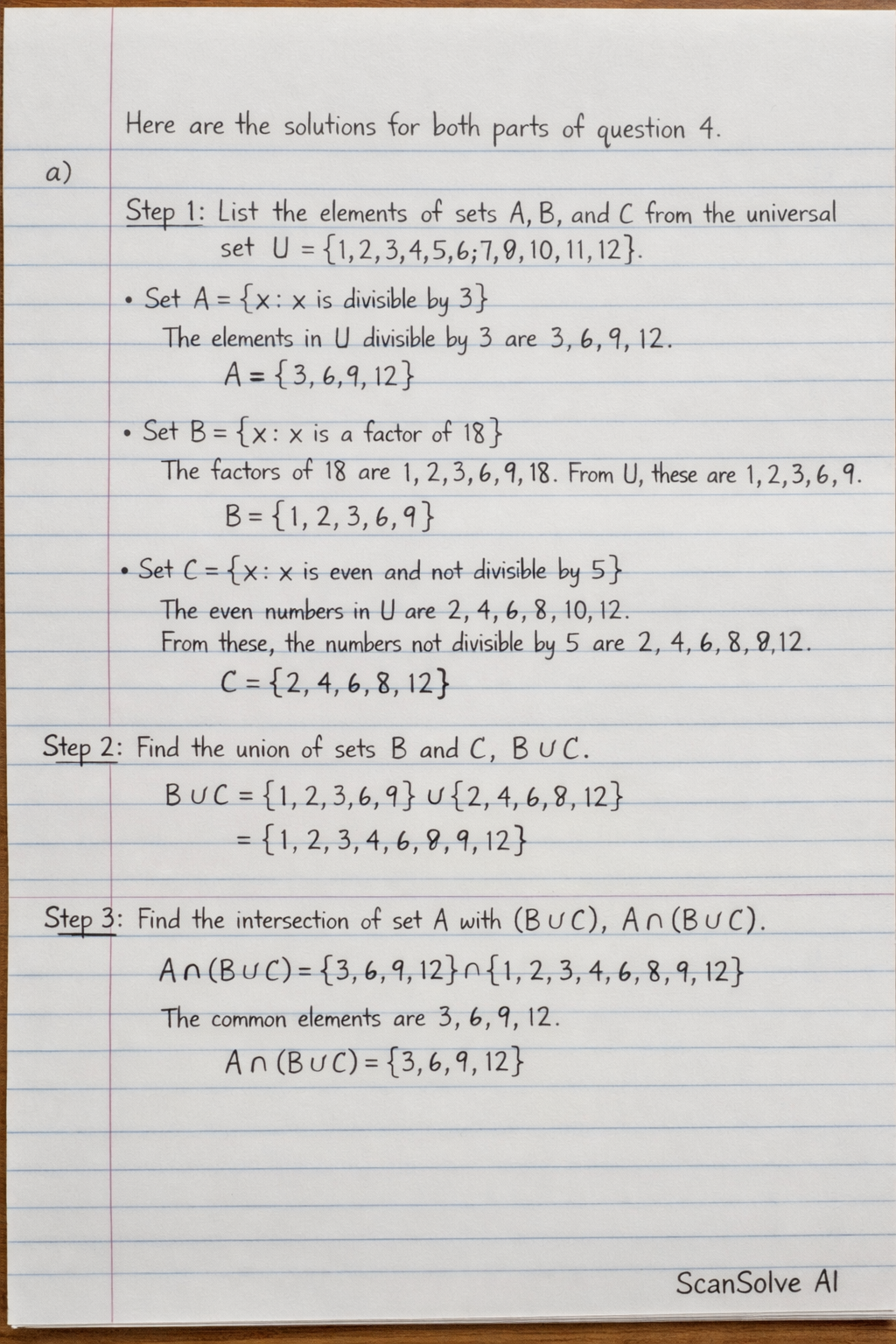
Handwritten Step-by-Step Solution
Get this as a handwritten image on WhatsApp — like a tutor wrote it for you.
Try on WhatsApp