
We read your photo as:
Given U = 16, 17, 18, 19, 20, 21, 22, x = x: x < 20, and Y = y: 17 ≤ y ≤ 21. Find: a) X ∩ Y, b) X ∪ Y, c) X ∩ Y, d) Represent X, Y and U on a Venn diagram.
ScanSolve AI Answer
Answers
3 partsStep-by-step solution
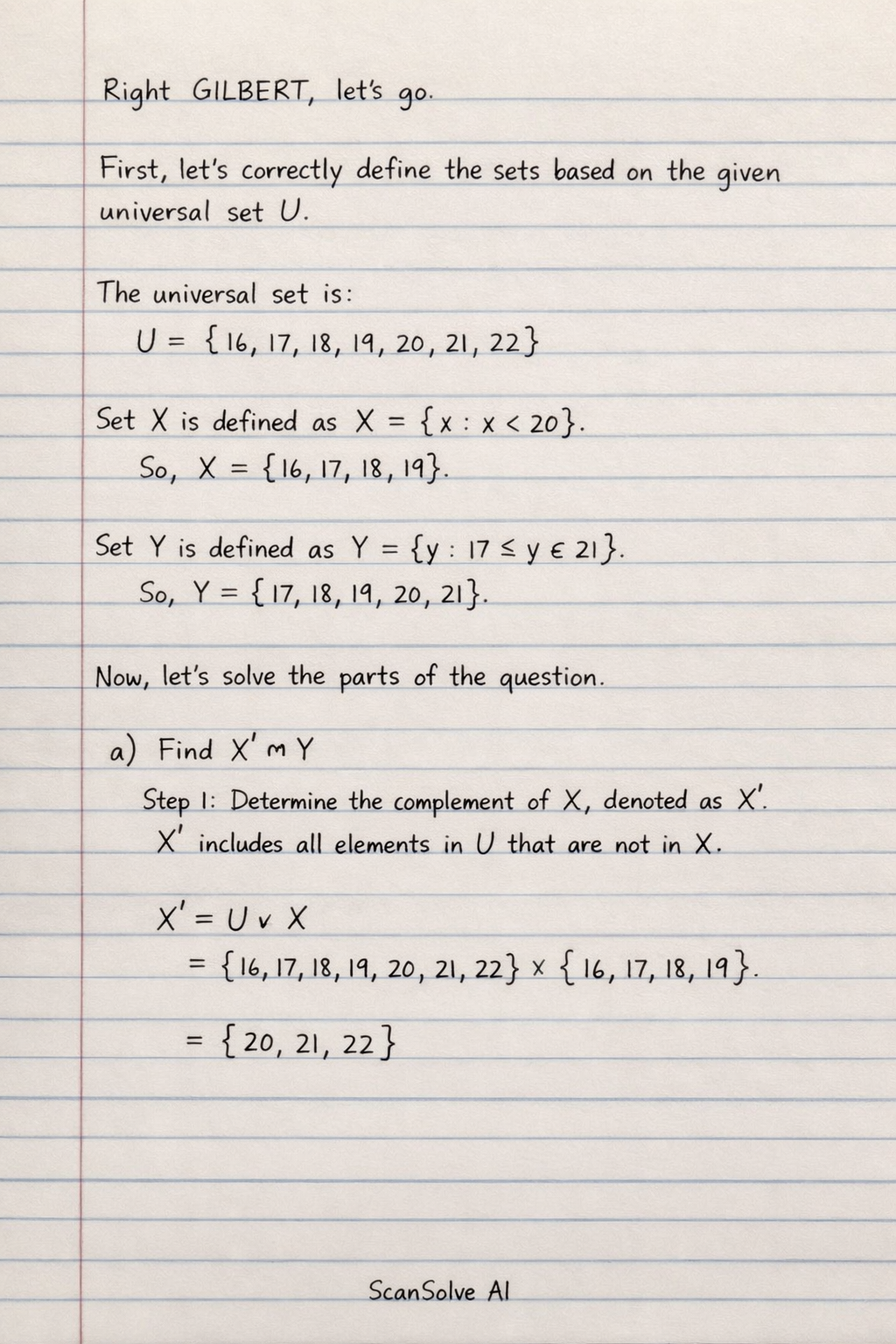
3 stepsFirst, let's correctly define the sets based on the given universal set .
The universal set is given as:
Set is defined as . Since is a subset of , we select elements from that are less than 20:
Set is defined as . Since is a subset of , we select elements from that are greater than or equal to 17 and less than or equal to 21:
(Note: Your partial work for Y, , is missing elements 20 and 21.)
Now, let's solve the parts of the question.
Part a· 2 steps
Find
Determine the complement of , denoted as .
This includes all elements in that are not in .
Find the intersection of and .
This includes elements common to both and .
Part b
Find
Find the union of and .
This includes all unique elements from both sets and .
Part c
Find
This part is a duplicate of part b) in the question.
Part d
Represent X, Y and U on a Venn diagram.
A Venn diagram for these sets would consist of a rectangle representing the universal set , and two overlapping circles representing sets and .
The elements would be placed in the following regions:
- Intersection (): Elements common to both and . These elements go in the overlapping region of the circles.
- Only (): Elements in but not in . This element goes in the part of circle that does not overlap with .
- Only (): Elements in but not in . These elements go in the part of circle that does not overlap with .
- Outside and (): Elements in but not in or . This element goes inside the rectangle but outside both circles.
Still stuck on this one?
Ask a follow-up, and the answer starts from this question.
More Mathematics Questions
Handwritten Step-by-Step Solution
Get this as a handwritten image on WhatsApp — like a tutor wrote it for you.
Try on WhatsApp