
We read your photo as:
Let U = 1, 2, ..., 20. Define sets A, B, and C within U. Draw a Venn diagram for A, B, C. A = squares, B = factors of 20, C = multiples of 4.
ScanSolve AI Answer
Step-by-step solution
5 stepsHere's the solution for question 2.
First, we define the universal set and the three subsets A, B, and C.
The universal set is given as .
Part a· 3 steps
Define the sets A, B, and C.
Define Set A (all square numbers within ).
Square numbers are numbers that are the product of an integer multiplied by itself.
The square numbers in are:
(This is greater than 20, so it's not in )Define Set B (factors of 20 within ).
Factors of 20 are numbers that divide 20 evenly.
The factors of 20 are:
Define Set C (multiples of 4 within ).
Multiples of 4 are numbers that can be divided by 4 evenly.
The multiples of 4 in are:
(This is greater than 20, so it's not in )
Part b· 2 steps
Draw a Venn diagram to show the relationship between sets A, B, C.
To draw the Venn diagram, we first find the intersections of the sets.
Find the intersections of the sets.
- : Elements common to A and B.
- : Elements common to A and C.
- : Elements common to B and C.
- : Elements common to A, B, and C. From and , the common element is 4.
Determine the elements unique to each region of the Venn diagram.
- Elements in :
- Elements in only (not in C):
- Elements in only (not in B):
- Elements in only (not in A):
- Elements in A only:
- Elements in B only:
- Elements in C only:
- Elements outside A, B, and C (in but not in ):
A Venn diagram would consist of a rectangle representing the universal set , and three overlapping circles representing sets A, B, and C. The elements would be placed in the corresponding regions as follows:
- Region :
- Region :
- Region :
- Region :
- Region :
- Region :
- Region :
- Region (outside all circles):
Still stuck on this one?
Ask a follow-up, and the answer starts from this question.
More Mathematics Questions
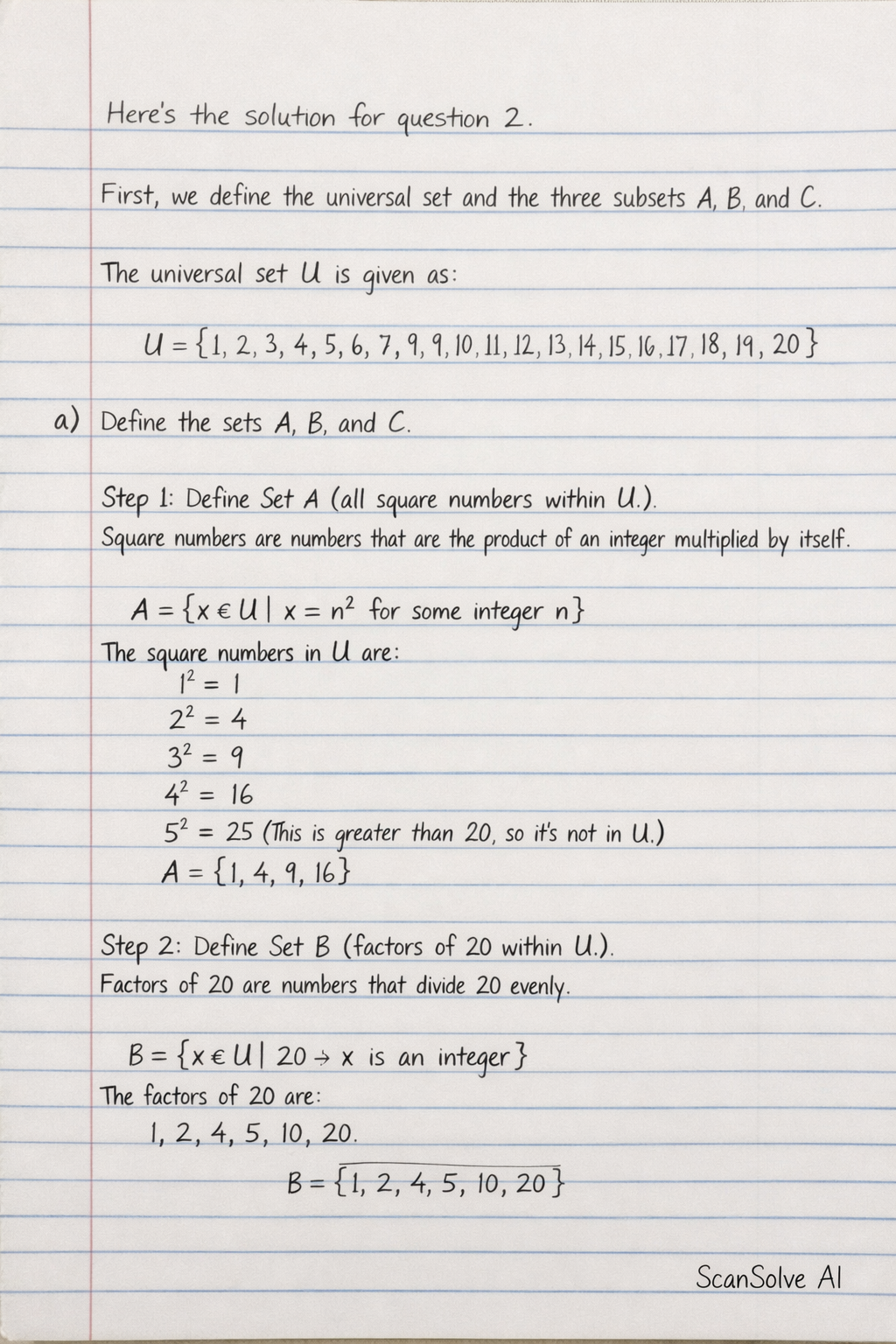
Handwritten Step-by-Step Solution
Get this as a handwritten image on WhatsApp — like a tutor wrote it for you.
Try on WhatsApp