
We read your photo as:
Let U be the universal set. If n(C \ W) = 20%, n(W \ C) = 65%, and n((C U W)') = 5%, find n(C U W) and represent the information in a Venn diagram.
ScanSolve AI Answer
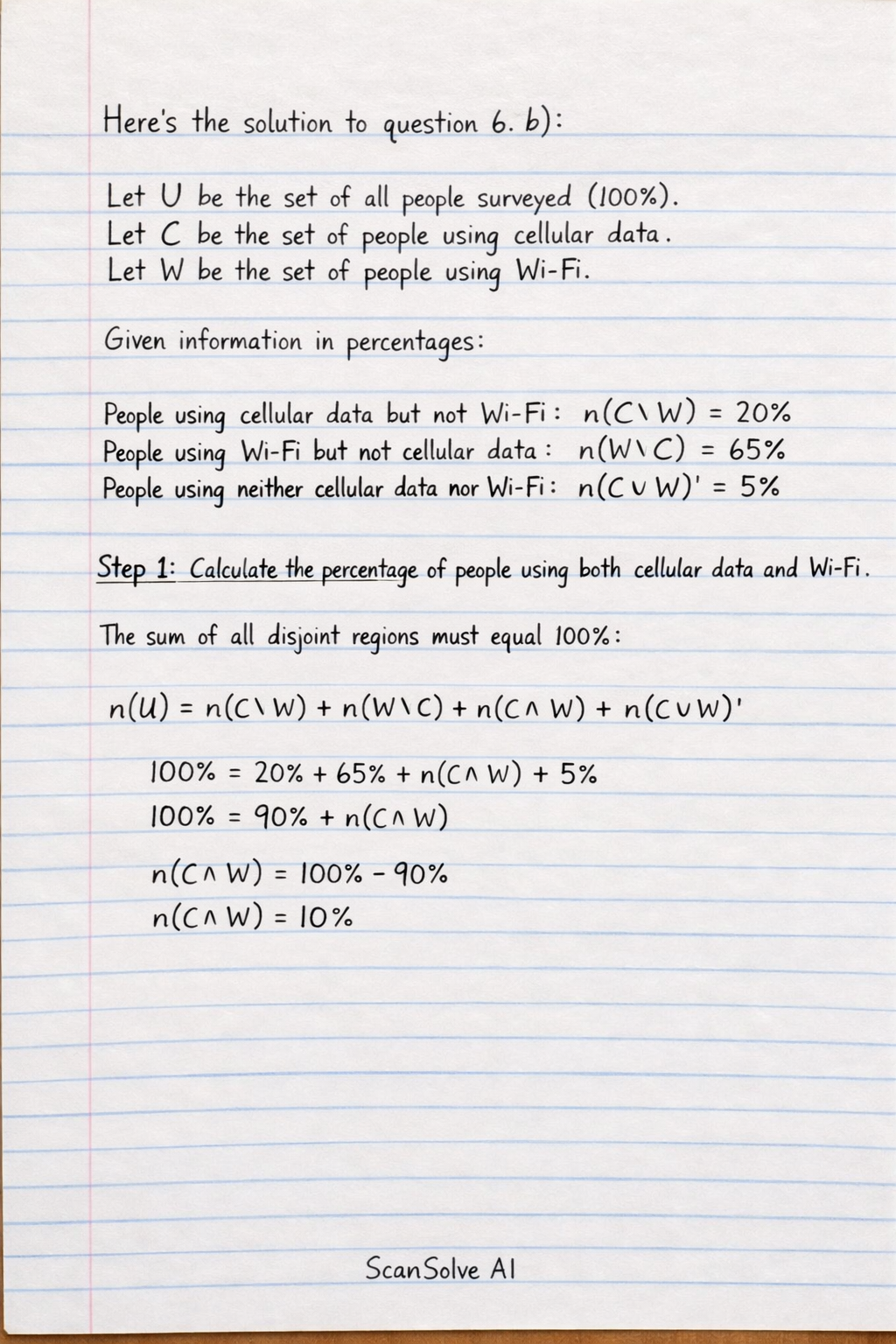
Here's the solution to question 6. b):
Let be the set of all people surveyed (representing 100%).
Let be the set of people using cellular data.
Let be the set of people using Wi-Fi.
Given information in percentages:
People using cellular data but not Wi-Fi:
People using Wi-Fi but not cellular data:
People using neither cellular data nor Wi-Fi:
Step 1: Calculate the percentage of people using both cellular data and Wi-Fi.
The sum of all disjoint regions must equal 100%:
b) (i) If C and W denote the sets of people who are using cellular data and Wi-Fi respectively, write the cardinality of .
The cardinality of is the percentage of people using at least one of the services.
The cardinality of is .
b) (ii) Represent the above information in a Venn-diagram.
A Venn diagram would illustrate:
- A rectangle representing the universal set (100%).
- Two overlapping circles, one labeled and one labeled .
- The region for only () contains 20%.
- The region for only () contains 65%.
- The intersection region () contains 10%.
- The region outside both circles () contains 5%.
b) (iii) Find the percent of people who are using Wi-Fi.
The percent of people using Wi-Fi is the sum of those using Wi-Fi only and those using both:
The percent of people using Wi-Fi is .
b) (iv) By what percent of the people who are not using cellular data is more or less than the people who are not using Wi-Fi?
First, find the percent of people who are not using cellular data ():
Next, find the percent of people who are not using Wi-Fi ():
Now, find the difference:
Since the result is positive, the percentage of people not using cellular data is 45% more than the percentage of people not using Wi-Fi.
It is \boxed{\text{45% more}}.
Still stuck on this one?
Ask a follow-up, and the answer starts from this question.
More Mathematics Questions
Handwritten Step-by-Step Solution
Get this as a handwritten image on WhatsApp — like a tutor wrote it for you.
Try on WhatsApp