We read your photo as:

If P, Q, and R are sets such that; n(P) = 20, n(Q) = 16, n(R) = 21, n(P∩Q) = 7, n(P∩R)=8, n(Q∩R) = 5 and R(P∩Q∩R) = 3. a. represent this information on a Venn Diagram. b. Find; i. n(PUQUR) ii. the probability of (PUQ)' U R

Mathematics

ScanSolve AI Answer

Step-by-step solution

5 steps

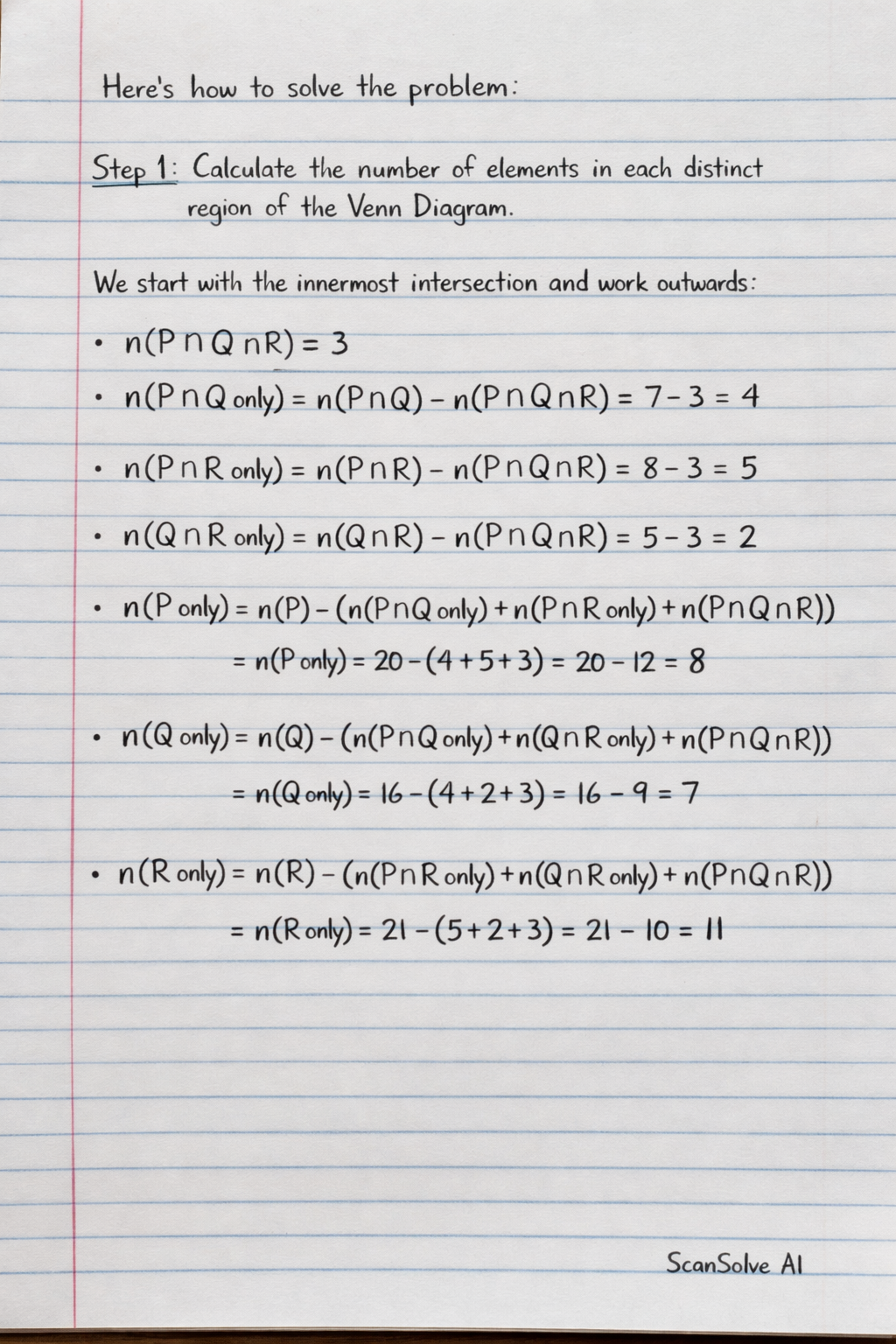
Here's how to solve the problem:

  1. Calculate the number of elements in each distinct region of the Venn Diagram.

    We start with the innermost intersection and work outwards:

    • n(P∩Q∩R)=3n(P \cap Q \cap R) = 3
    • n(P∩Q only)=n(P∩Q)−n(P∩Q∩R)=7−3=4n(P \cap Q \text{ only}) = n(P \cap Q) - n(P \cap Q \cap R) = 7 - 3 = 4
    • n(P∩R only)=n(P∩R)−n(P∩Q∩R)=8−3=5n(P \cap R \text{ only}) = n(P \cap R) - n(P \cap Q \cap R) = 8 - 3 = 5
    • n(Q∩R only)=n(Q∩R)−n(P∩Q∩R)=5−3=2n(Q \cap R \text{ only}) = n(Q \cap R) - n(P \cap Q \cap R) = 5 - 3 = 2
    • n(P only)=n(P)−(n(P∩Q only)+n(P∩R only)+n(P∩Q∩R))n(P \text{ only}) = n(P) - (n(P \cap Q \text{ only}) + n(P \cap R \text{ only}) + n(P \cap Q \cap R)) n(P only)=20−(4+5+3)=20−12=8n(P \text{ only}) = 20 - (4 + 5 + 3) = 20 - 12 = 8
    • n(Q only)=n(Q)−(n(P∩Q only)+n(Q∩R only)+n(P∩Q∩R))n(Q \text{ only}) = n(Q) - (n(P \cap Q \text{ only}) + n(Q \cap R \text{ only}) + n(P \cap Q \cap R)) n(Q only)=16−(4+2+3)=16−9=7n(Q \text{ only}) = 16 - (4 + 2 + 3) = 16 - 9 = 7
    • n(R only)=n(R)−(n(P∩R only)+n(Q∩R only)+n(P∩Q∩R))n(R \text{ only}) = n(R) - (n(P \cap R \text{ only}) + n(Q \cap R \text{ only}) + n(P \cap Q \cap R)) n(R only)=21−(5+2+3)=21−10=11n(R \text{ only}) = 21 - (5 + 2 + 3) = 21 - 10 = 11
  2. Represent this information on a Venn Diagram (Part a).

    Since I cannot draw a diagram, here are the values for each region:

    • Elements in PP only: 8
    • Elements in QQ only: 7
    • Elements in RR only: 11
    • Elements in P∩QP \cap Q only (not in RR): 4
    • Elements in P∩RP \cap R only (not in QQ): 5
    • Elements in Q∩RQ \cap R only (not in PP): 2
    • Elements in P∩Q∩RP \cap Q \cap R: 3
  3. Find n(P∪Q∪R)n(P \cup Q \cup R) (Part b.i).

    Using the Principle of Inclusion-Exclusion:

    n(P∪Q∪R)=n(P)+n(Q)+n(R)−n(P∩Q)−n(P∩R)−n(Q∩R)+n(P∩Q∩R)n(P \cup Q \cup R) = n(P) + n(Q) + n(R) - n(P \cap Q) - n(P \cap R) - n(Q \cap R) + n(P \cap Q \cap R)

    Substitute the given values:

    n(P∪Q∪R)=20+16+21−7−8−5+3n(P \cup Q \cup R) = 20 + 16 + 21 - 7 - 8 - 5 + 3 n(P∪Q∪R)=57−20+3n(P \cup Q \cup R) = 57 - 20 + 3 n(P∪Q∪R)=37+3n(P \cup Q \cup R) = 37 + 3 n(P∪Q∪R)=40n(P \cup Q \cup R) = \boxed{\text{40}}
  4. Find n((P∪Q)′∪R)n((P \cup Q)' \cup R) (for Part b.ii).

    The set (P∪Q)′∪R(P \cup Q)' \cup R consists of all elements that are either not in PP or QQ, or are in RR.
    From the Venn Diagram regions, the elements not in PP or QQ are those in R onlyR \text{ only} (which is 11), plus any elements outside P∪Q∪RP \cup Q \cup R.
    The elements in RR are n(R)=21n(R) = 21.
    The union (P∪Q)′∪R(P \cup Q)' \cup R can be understood as all elements in RR, plus any elements that are outside P∪Q∪RP \cup Q \cup R.
    If we assume there are no elements outside P∪Q∪RP \cup Q \cup R (i.e., n(U)=n(P∪Q∪R)n(\mathcal{U}) = n(P \cup Q \cup R)), then the elements not in PP or QQ are simply the elements in R onlyR \text{ only}.
    In this case, (P∪Q)′∪R=(R only)∪R=R(P \cup Q)' \cup R = (R \text{ only}) \cup R = R.
    So, n((P∪Q)′∪R)=n(R)=21n((P \cup Q)' \cup R) = n(R) = 21.

  5. Calculate the probability of (P∪Q)′∪R(P \cup Q)' \cup R (Part b.ii).

    To calculate probability, we need a universal set n(U)n(\mathcal{U}). Since no universal set is specified, we assume the universal set is P∪Q∪RP \cup Q \cup R.
    So, n(U)=n(P∪Q∪R)=40n(\mathcal{U}) = n(P \cup Q \cup R) = 40.
    The probability is:

    P((P∪Q)′∪R)=n((P∪Q)′∪R)n(U)P((P \cup Q)' \cup R) = \frac{n((P \cup Q)' \cup R)}{n(\mathcal{U})} P((P∪Q)′∪R)=2140P((P \cup Q)' \cup R) = \frac{21}{40}

    The probability of (P∪Q)′∪R(P \cup Q)' \cup R is 2140\boxed{\frac{21}{40}}.

Was this helpful?

Still stuck on this one?

Ask a follow-up, and the answer starts from this question.

Got a different question?Ask your own question
Handwritten step-by-step solution preview

Handwritten Step-by-Step Solution

Get this as a handwritten image on WhatsApp — like a tutor wrote it for you.

Try on WhatsApp