
We read your photo as:
Given sets A = 2, 3, 4, 5, 6, 7, 8, 9 and B = 2, 3, 5, 7. Find the intersection of A and B and draw a Venn diagram. Also, consider sets P and Q...
ScanSolve AI Answer
Answers
2 partsStep-by-step solution
4 stepshere's the solution for the next part of your question.
Part 1· 2 steps
Sets A and B
Given sets:
Find the common elements (intersection) of A and B.
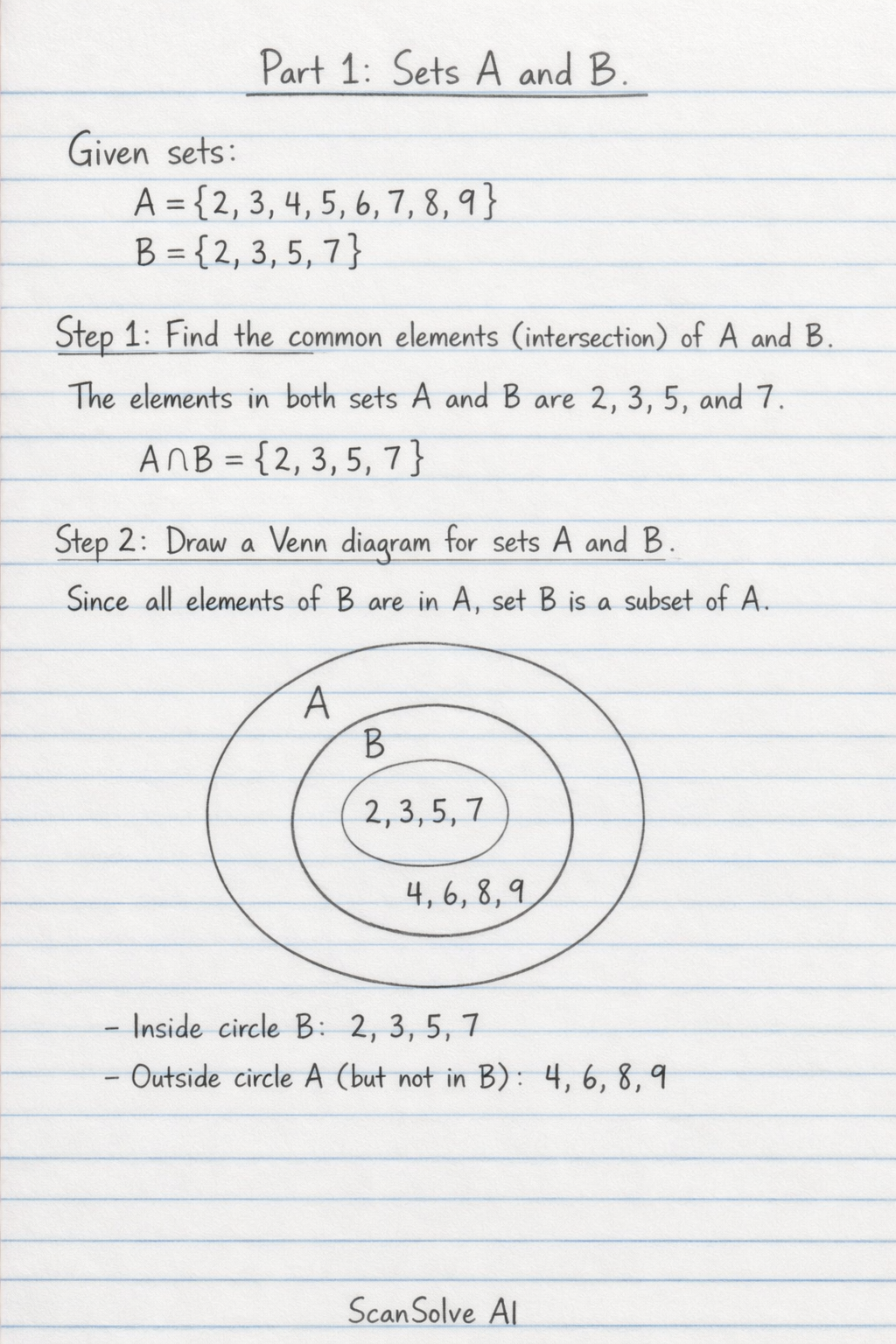
The elements that are present in both set A and set B are 2, 3, 5, and 7.
Draw a Venn diagram for sets A and B.
Since all elements of B are also in A, set B is a subset of set A. This means the circle representing B should be drawn entirely inside the circle representing A.
- Place the elements common to both A and B (which are all elements of B) inside the inner circle (B): .
- Place the elements that are in A but not in B in the region of circle A outside circle B: .
Here is the Venn diagram:
\begin{tikzpicture}
\begin{scope}
    \draw (0,0) circle (2cm) node[above right] {$A$};
    \draw (0,0) circle (1cm) node[above right] {$B$};
    \node at (0, 0.5) {2};
    \node at (-0.5, 0) {3};
    \node at (0.5, 0) {5};
    \node at (0, -0.5) {7};
    \node at (1.5, 1.5) {4};
    \node at (-1.5, 1.5) {6};
    \node at (1.5, -1.5) {8};
    \node at (-1.5, -1.5) {9};
\end{scope}
\end{tikzpicture}
Part 2
Sets P and Q
Given sets:
(The definition for Q is cut off, assuming "less than 10")
List the elements of set P.
Prime numbers are natural numbers greater than 1 that have no positive divisors other than 1 and themselves. The prime numbers less than 10 are 2, 3, 5, and 7.
List the elements of set Q (assuming "less than 10").
Even numbers are integers divisible by 2. The even numbers less than 10 are 0, 2, 4, 6, and 8.
Still stuck on this one?
Ask a follow-up, and the answer starts from this question.
More Mathematics Questions
Handwritten Step-by-Step Solution
Get this as a handwritten image on WhatsApp — like a tutor wrote it for you.
Try on WhatsApp