We read your photo as:

Given sets P, Q, R and universal set mu, find P R, P' Q, and n(Q R)?

Mathematics

ScanSolve AI Answer

Step-by-step solution

10 steps

Here are the solutions to the problems:

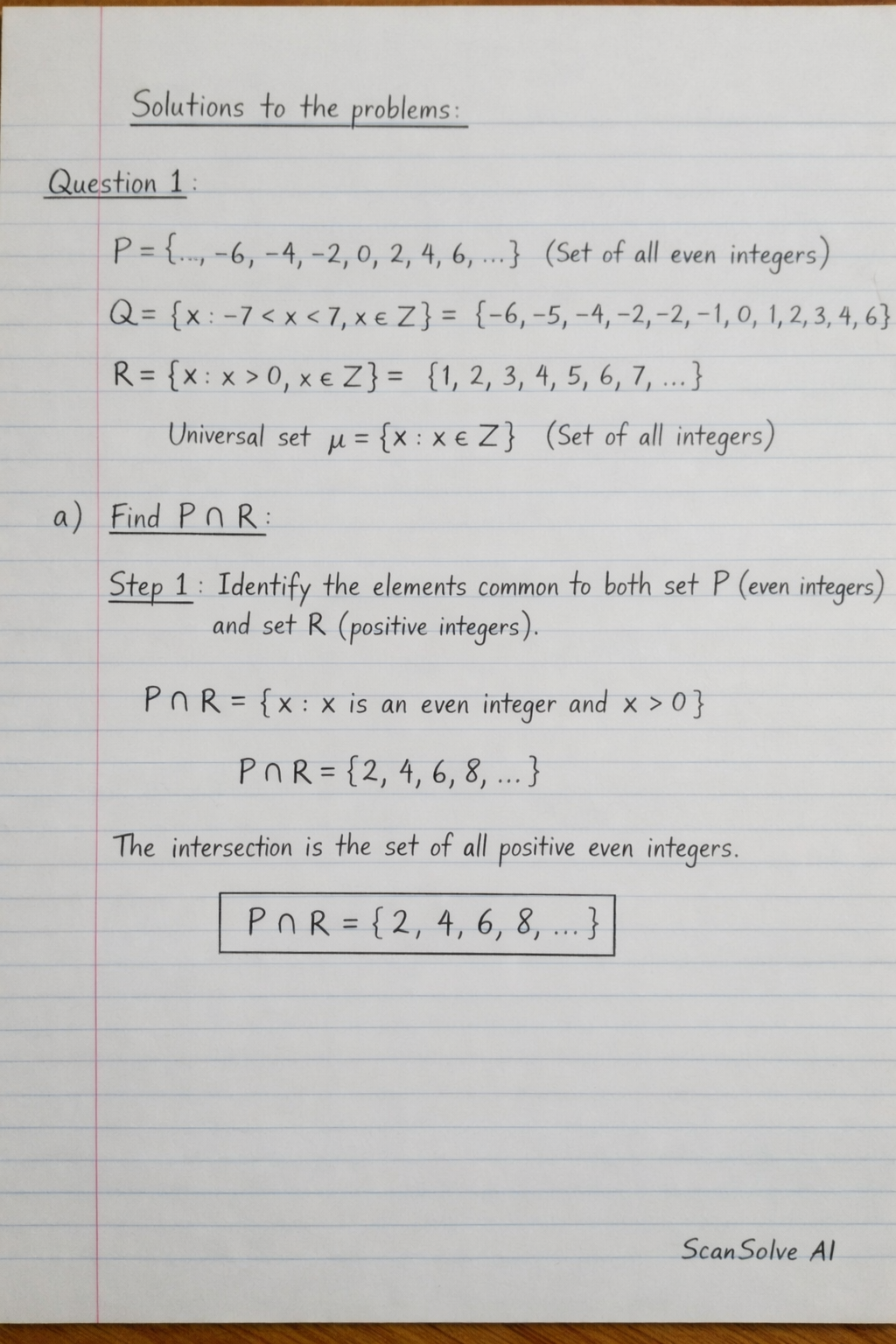
Question 1:
Given the sets:
P={...,−6,−4,−2,0,2,4,6,...}P = \{..., -6, -4, -2, 0, 2, 4, 6, ...\} (Set of all even integers)
Q={x:−7<x<7,x∈Z}={−6,−5,−4,−3,−2,−1,0,1,2,3,4,5,6}Q = \{x: -7 < x < 7, x \in \mathbb{Z}\} = \{-6, -5, -4, -3, -2, -1, 0, 1, 2, 3, 4, 5, 6\}
R={x:x>0,x∈Z}={1,2,3,4,5,6,7,...}R = \{x: x > 0, x \in \mathbb{Z}\} = \{1, 2, 3, 4, 5, 6, 7, ...\} (Set of all positive integers)
Universal set μ={x:x∈Z}\mu = \{x: x \in \mathbb{Z}\} (Set of all integers)

a) Find P∩RP \cap R:

  1. Identify the elements common to both set PP (even integers) and set RR (positive integers).

    P∩R={x:x is an even integer and x>0}P \cap R = \{x : x \text{ is an even integer and } x > 0\} P∩R={2,4,6,8,...}P \cap R = \{2, 4, 6, 8, ...\}

    The intersection is the set of all positive even integers.

    P∩R={2,4,6,8,...}\boxed{P \cap R = \{2, 4, 6, 8, ...\}}

    b) Find P′∩QP' \cap Q:

  2. Determine the complement of PP, denoted as P′P'.

    Since PP is the set of all even integers and the universal set is all integers, P′P' is the set of all odd integers.

    P′={...,−5,−3,−1,1,3,5,...}P' = \{..., -5, -3, -1, 1, 3, 5, ...\}
  3. Find the intersection of P′P' and QQ.

    P′∩Q={x:x is an odd integer and −7<x<7}P' \cap Q = \{x : x \text{ is an odd integer and } -7 < x < 7\} P′∩Q={−5,−3,−1,1,3,5}P' \cap Q = \{-5, -3, -1, 1, 3, 5\} P′∩Q={−5,−3,−1,1,3,5}\boxed{P' \cap Q = \{-5, -3, -1, 1, 3, 5\}}

    c) Find n(Q∩R)n(Q \cap R):

  4. Find the intersection of set QQ and set RR.

    Q∩R={x:−7<x<7 and x>0,x∈Z}Q \cap R = \{x : -7 < x < 7 \text{ and } x > 0, x \in \mathbb{Z}\} Q∩R={1,2,3,4,5,6}Q \cap R = \{1, 2, 3, 4, 5, 6\}
  5. Count the number of elements in the set Q∩RQ \cap R.

    n(Q∩R)=6n(Q \cap R) = 6 n(Q∩R)=6\boxed{n(Q \cap R) = 6}

    Question 2:
    A binary operation ∗* is defined on the set of real numbers, R\mathbb{R}, by p∗q=3p+2q2p+3qp * q = \frac{3p + 2q}{2p + 3q}.

    a) Evaluate (3)∗(2)(\sqrt{3}) * (\sqrt{2}).

  6. Substitute p=3p = \sqrt{3} and q=2q = \sqrt{2} into the given formula.

    (3)∗(2)=3(3)+2(2)2(3)+3(2)=33+2223+32(\sqrt{3}) * (\sqrt{2}) = \frac{3(\sqrt{3}) + 2(\sqrt{2})}{2(\sqrt{3}) + 3(\sqrt{2})} = \frac{3\sqrt{3} + 2\sqrt{2}}{2\sqrt{3} + 3\sqrt{2}}
  7. Rationalize the denominator by multiplying the numerator and denominator by the conjugate of the denominator, which is 23−322\sqrt{3} - 3\sqrt{2}.

    33+2223+32×23−3223−32\frac{3\sqrt{3} + 2\sqrt{2}}{2\sqrt{3} + 3\sqrt{2}} \times \frac{2\sqrt{3} - 3\sqrt{2}}{2\sqrt{3} - 3\sqrt{2}}
  8. Expand the numerator and the denominator.

    Numerator:

    (33+22)(23−32)=(33)(23)−(33)(32)+(22)(23)−(22)(32)(3\sqrt{3} + 2\sqrt{2})(2\sqrt{3} - 3\sqrt{2}) = (3\sqrt{3})(2\sqrt{3}) - (3\sqrt{3})(3\sqrt{2}) + (2\sqrt{2})(2\sqrt{3}) - (2\sqrt{2})(3\sqrt{2}) =6(3)−96+46−6(2)= 6(3) - 9\sqrt{6} + 4\sqrt{6} - 6(2) =18−96+46−12= 18 - 9\sqrt{6} + 4\sqrt{6} - 12 =6−56= 6 - 5\sqrt{6}

    Denominator (using (a+b)(a−b)=a2−b2(a+b)(a-b) = a^2 - b^2):

    (23+32)(23−32)=(23)2−(32)2(2\sqrt{3} + 3\sqrt{2})(2\sqrt{3} - 3\sqrt{2}) = (2\sqrt{3})^2 - (3\sqrt{2})^2 =(4×3)−(9×2)= (4 \times 3) - (9 \times 2) =12−18= 12 - 18 =−6= -6
  9. Combine the simplified numerator and denominator.

    6−56−6\frac{6 - 5\sqrt{6}}{-6}
  10. Simplify the expression.

    6−6−56−6=−1+566\frac{6}{-6} - \frac{5\sqrt{6}}{-6} = -1 + \frac{5\sqrt{6}}{6} −1+566\boxed{-1 + \frac{5\sqrt{6}}{6}}
Was this helpful?

Still stuck on this one?

Ask a follow-up, and the answer starts from this question.

Got a different question?Ask your own question
Handwritten step-by-step solution preview

Handwritten Step-by-Step Solution

Get this as a handwritten image on WhatsApp — like a tutor wrote it for you.

Try on WhatsApp