
We read your photo as:
In the Venn Diagram, P, Q and R are subsets of the universal set. If n( U ) = 125, the value of x i. the value of x ii. n(PUQUR)
ScanSolve AI Answer
Step-by-step solution
3 stepsHere's how to solve the problem:
Sum the number of elements in all regions of the Venn Diagram to find .
Combine the constant terms:
Combine the terms:
So, the total number of elements in the union of P, Q, and R is:
Use the given total number of elements in the universal set, , to find the value of .
Since no elements are shown outside the sets P, Q, and R, we assume .
Subtract 41 from both sides:
Divide by 21:
The value of is .
Calculate .
This represents the number of elements in the universal set that are not in P, Q, or R.
Substitute the value of into the expression for :
Now, calculate :
The value of is .
Still stuck on this one?
Ask a follow-up, and the answer starts from this question.
More Mathematics Questions
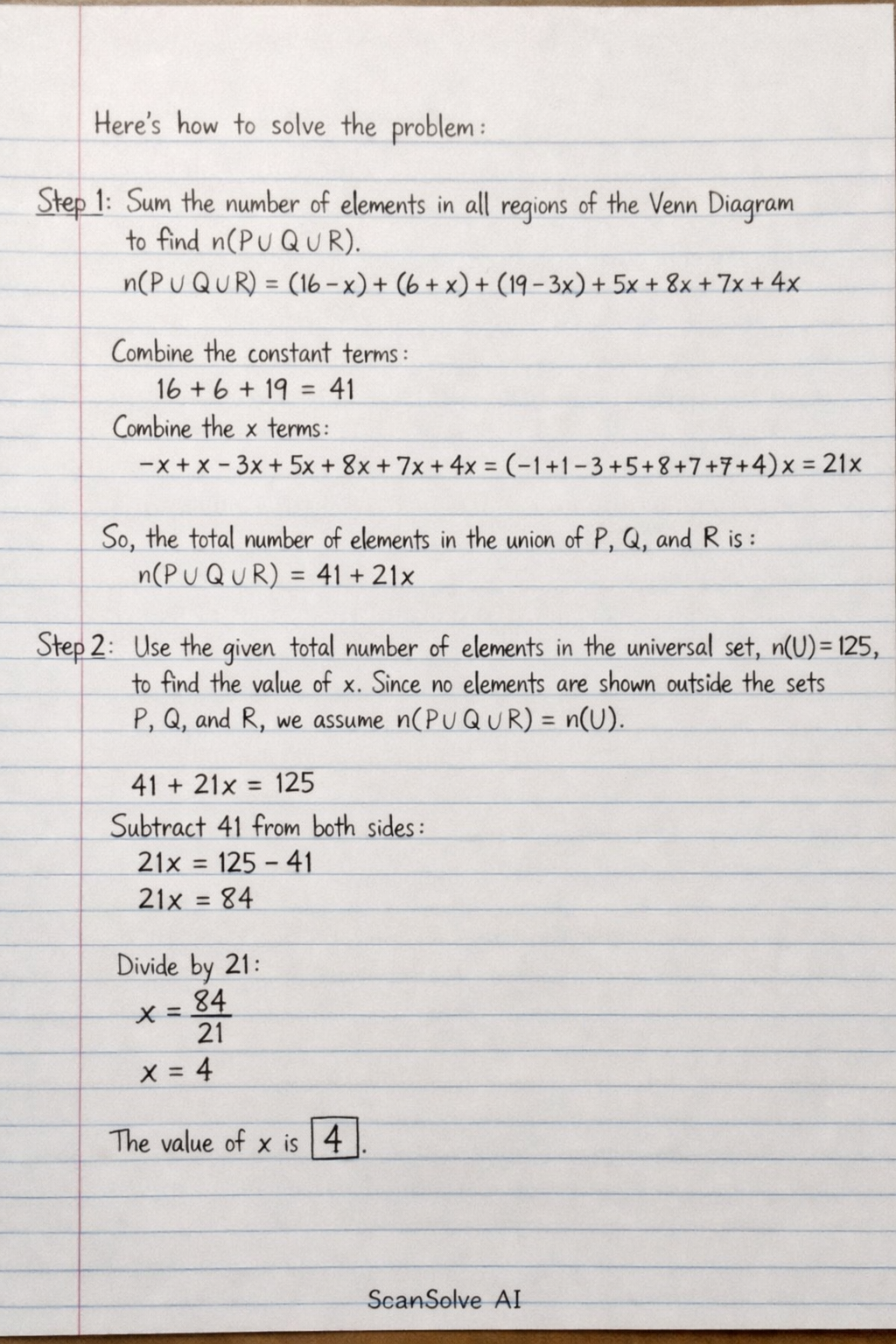
Handwritten Step-by-Step Solution
Get this as a handwritten image on WhatsApp — like a tutor wrote it for you.
Try on WhatsApp