From the Venn-diagram given alongside answer the following questions: a) What is the cardinal number of the universal set? Write it.

Mathematics
From the Venn-diagram given alongside answer the following questions: a) What is the cardinal number of the universal set? Write it.

ScanSolve AI Answer

Answer

9

Here are the solutions to the questions based on the provided Venn diagram.

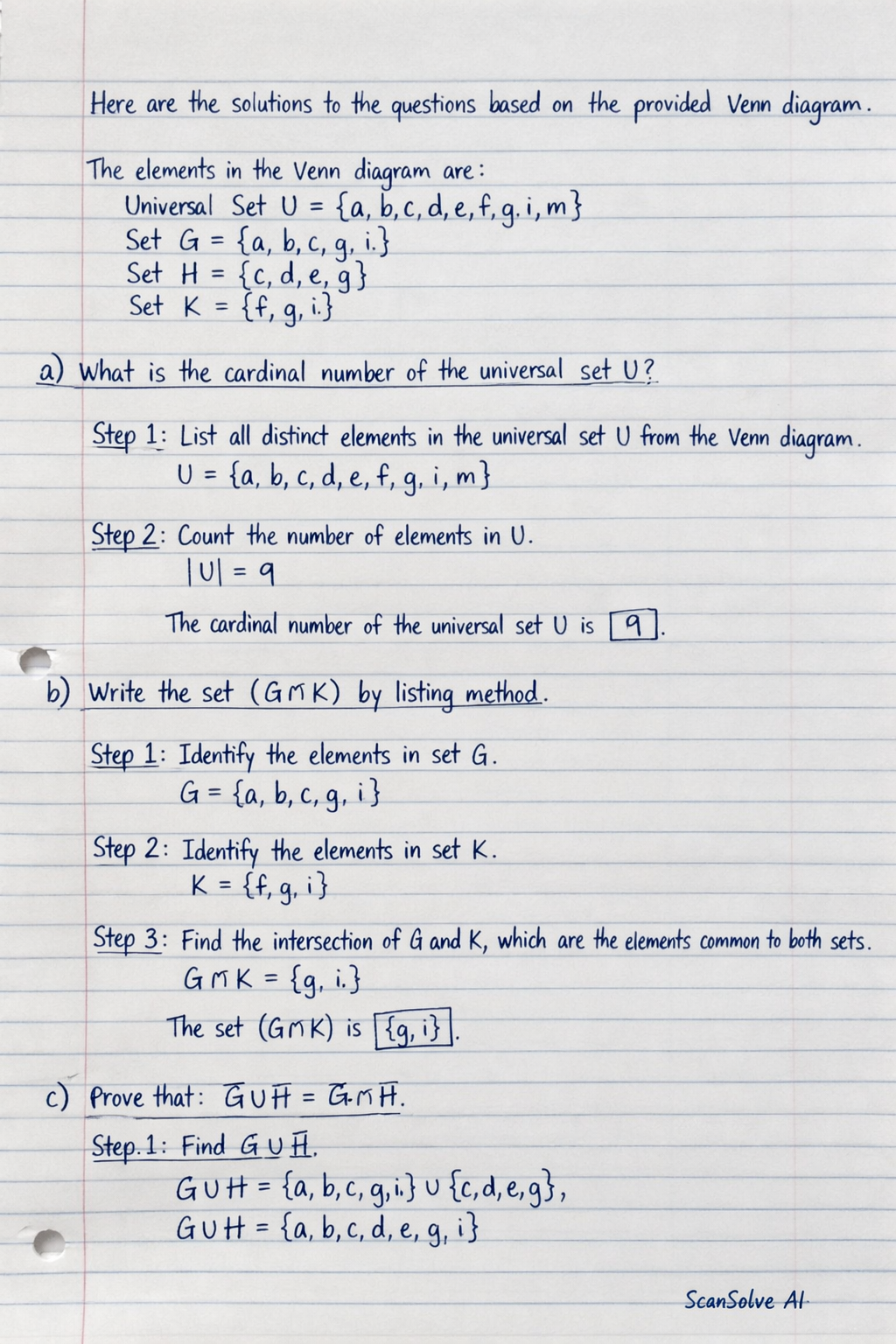
The elements in the Venn diagram are: Universal Set U={a,b,c,d,e,f,g,i,m}U = \{a, b, c, d, e, f, g, i, m\} Set G={a,b,c,g,i}G = \{a, b, c, g, i\} Set H={c,d,e,g}H = \{c, d, e, g\} Set K={f,g,i}K = \{f, g, i\}

a) What is the cardinal number of the universal set U?

Step 1: List all distinct elements in the universal set U from the Venn diagram. U={a,b,c,d,e,f,g,i,m}U = \{a, b, c, d, e, f, g, i, m\}

Step 2: Count the number of elements in U. U=9|U| = 9 The cardinal number of the universal set U is 9\boxed{*9*}.

b) Write the set (GK)(G \cap K) by listing method.

Step 1: Identify the elements in set G. G={a,b,c,g,i}G = \{a, b, c, g, i\}

Step 2: Identify the elements in set K. K={f,g,i}K = \{f, g, i\}

Step 3: Find the intersection of G and K, which are the elements common to both sets. GK={g,i}G \cap K = \{g, i\} The set (GK)(G \cap K) is {g,i}\boxed{*\{g, i\}*}.

c) Prove that: GH=GH\overline{G \cup H} = \overline{G} \cap \overline{H}

Step 1: Find GHG \cup H. GH={a,b,c,g,i}{c,d,e,g}G \cup H = \{a, b, c, g, i\} \cup \{c, d, e, g\} GH={a,b,c,d,e,g,i}G \cup H = \{a, b, c, d, e, g, i\}

Step 2: Find the complement of GHG \cup H, denoted as GH\overline{G \cup H}. GH=U(GH)\overline{G \cup H} = U - (G \cup H) GH={a,b,c,d,e,f,g,i,m}{a,b,c,d,e,g,i}\overline{G \cup H} = \{a, b, c, d, e, f, g, i, m\} - \{a, b, c, d, e, g, i\} GH={f,m}\overline{G \cup H} = \{f, m\}

Step 3: Find the complement of G, denoted as G\overline{G}. G=UG\overline{G} = U - G G={a,b,c,d,e,f,g,i,m}{a,b,c,g,i}\overline{G} = \{a, b, c, d, e, f, g, i, m\} - \{a, b, c, g, i\} G={d,e,f,m}\overline{G} = \{d, e, f, m\}

Step 4: Find the complement of H, denoted as H\overline{H}. H=UH\overline{H} = U - H H={a,b,c,d,e,f,g,i,m}{c,d,e,g}\overline{H} = \{a, b, c, d, e, f, g, i, m\} - \{c, d, e, g\} H={a,b,f,i,m}\overline{H} = \{a, b, f, i, m\}

Step 5: Find the intersection of G\overline{G} and H\overline{H}, denoted as GH\overline{G} \cap \overline{H}. GH={d,e,f,m}{a,b,f,i,m}\overline{G} \cap \overline{H} = \{d, e, f, m\} \cap \{a, b, f, i, m\} GH={f,m}\overline{G} \cap \overline{H} = \{f, m\}

Step 6: Compare the results from Step 2 and Step 5. Since GH={f,m}\overline{G \cup H} = \{f, m\} and GH={f,m}\overline{G} \cap \overline{H} = \{f, m\}, Therefore, GH=GH\boxed{\overline{G \cup H} = \overline{G} \cap \overline{H}} is proven.

d) What percent of the elements of universal set U have (GHK)(G \cup H \cup K)?

Step 1: Find the union of sets G, H, and K. GHK={a,b,c,g,i}{c,d,e,g}{f,g,i}G \cup H \cup K = \{a, b, c, g, i\} \cup \{c, d, e, g\} \cup \{f, g, i\} GHK={a,b,c,d,e,f,g,i}G \cup H \cup K = \{a, b, c, d, e, f, g, i\}

Step 2: Find the cardinal number of GHKG \cup H \cup K. GHK=8|G \cup H \cup K| = 8

Step 3: Recall the cardinal number of the universal set U. U=9|U| = 9

Step 4: Calculate the percentage of elements in UU that are in (GHK)(G \cup H \cup K). Percentage=GHKU×100%\text{Percentage} = \frac{|G \cup H \cup K|}{|U|} \times 100\% Percentage=89×100%\text{Percentage} = \frac{8}{9} \times 100\% Percentage0.8889×100%\text{Percentage} \approx 0.8889 \times 100\% Percentage88.89%\text{Percentage} \approx 88.89\% The percentage of elements of universal set U that have (GHK)(G \cup H \cup K) is approximately 88.89%\boxed{*88.89\%*}.

Was this helpful?

Need help with your own homework?

Get instant step-by-step solutions to any question. Free to start.

Ask Your Question
Handwritten step-by-step solution preview

Handwritten Step-by-Step Solution

Get this as a handwritten image on WhatsApp — like a tutor wrote it for you.

Try on WhatsApp

Still have questions?

Quick Answer

Universal Set U = \a, b, c, d, e, f, g, i, m\ Set G = \a, b, c, g, i\ Set H = \c, d, e, g\ Set K = \f, g, i\ a) What is the cardinal number of the universal set U? Step 1: List all distinct elements in the universal set U from the Venn diagram.

From the Venn-diagram given alongside answer the following questions: a) What is the cardinal number of the universal set? Write it.
Mathematics

This mathematics problem involves applying core mathematical principles and formulas. Below you will find a complete step-by-step solution with detailed explanations for each step, helping you understand not just the answer but the method behind it.

ScanSolve AI Answer
Here are the solutions to the questions based on the provided Venn diagram. The elements in the Venn diagram are: Universal Set U = \a, b, c, d, e, f, g, i, m\ Set G = \a, b, c, g, i\ Set H = \c, d, e, g\ Set K = \f, g, i\ a) What is the cardinal number of the universal set U? Step 1: List all distinct elements in the universal set U from the Venn diagram. U = \a, b, c, d, e, f, g, i, m\ Step 2: Count the number of elements in U. |U| = 9 The cardinal number of the universal set U is 9. b) Write the set (G K) by listing method. Step 1: Identify the elements in set G. G = \a, b, c, g, i\ Step 2: Identify the elements in set K. K = \f, g, i\ Step 3: Find the intersection of G and K, which are the elements common to both sets. G K = \g, i\ The set (G K) is \g, i\. c) Prove that: G H = G H Step 1: Find G H. G H = \a, b, c, g, i\ \c, d, e, g\ G H = \a, b, c, d, e, g, i\ Step 2: Find the complement of G H, denoted as G H. G H = U - (G H) G H = \a, b, c, d, e, f, g, i, m\ - \a, b, c, d, e, g, i\ G H = \f, m\ Step 3: Find the complement of G, denoted as G. G = U - G G = \a, b, c, d, e, f, g, i, m\ - \a, b, c, g, i\ G = \d, e, f, m\ Step 4: Find the complement of H, denoted as H. H = U - H H = \a, b, c, d, e, f, g, i, m\ - \c, d, e, g\ H = \a, b, f, i, m\ Step 5: Find the intersection of G and H, denoted as G H. G H = \d, e, f, m\ \a, b, f, i, m\ G H = \f, m\ Step 6: Compare the results from Step 2 and Step 5. Since G H = \f, m\ and G H = \f, m\, Therefore, G H = G H is proven. d) What percent of the elements of universal set U have (G H K)? Step 1: Find the union of sets G, H, and K. G H K = \a, b, c, g, i\ \c, d, e, g\ \f, g, i\ G H K = \a, b, c, d, e, f, g, i\ Step 2: Find the cardinal number of G H K. |G H K| = 8 Step 3: Recall the cardinal number of the universal set U. |U| = 9 Step 4: Calculate the percentage of elements in U that are in (G H K). Percentage = (|G H K|)/(|U|) × 100\% Percentage = (8)/(9) × 100\% Percentage ≈ 0.8889 × 100\% Percentage ≈ 88.89\% The percentage of elements of universal set U that have (G H K) is approximately 88.89\%.