
We read your photo as:
In the Venn diagram below, U is the universal set and M and N are subsets of U. Use the Venn diagram to answer the following questions: list the elements of NUM ii (MnN)' iii NInm
ScanSolve AI Answer
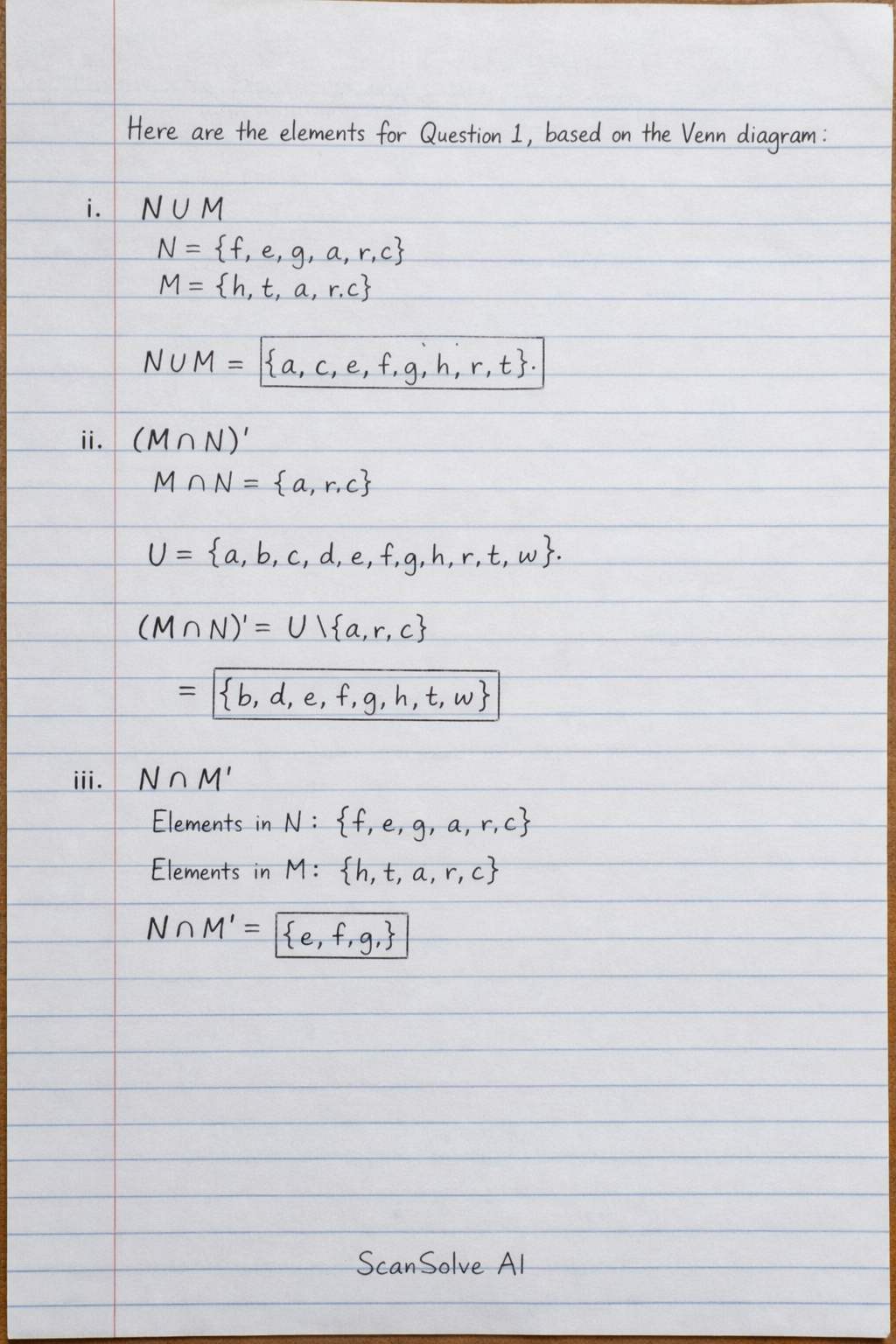
Here are the elements for Question 1, based on the Venn diagram:
Question 1: List the elements of:
-
i. This represents the union of set and set , which includes all elements present in either or or both. From the diagram:
-
ii. First, find the intersection of and , which are the elements common to both sets. Then, find the complement of , which includes all elements in the universal set that are not in . The universal set .
-
iii. This represents the elements that are in set but not in set . Elements in : Elements in :
-
iv. This represents the elements that are in set but not in set . Elements in : Elements in :
-
v. This represents the universal set, which includes all elements shown in the diagram.
Still stuck on this one?
Ask a follow-up, and the answer starts from this question.
More Mathematics Questions
Handwritten Step-by-Step Solution
Get this as a handwritten image on WhatsApp — like a tutor wrote it for you.
Try on WhatsApp