We read your photo as:

Given universal set mu = Z, P = \..., -4, -2, 0, 2, 4, ... Q = : -7 < x < 7 and R = : x > 0 find P R, P' Q, and n(Q R).

Mathematics

ScanSolve AI Answer

Step-by-step solution

9 steps

Here are the solutions to the problems.

:
Given the sets:
Universal set μ={x:x∈Z}\mu = \{x : x \in \mathbb{Z}\} (all integers)
P={...,−6,−4,−2,0,2,4,6,...}P = \{..., -6, -4, -2, 0, 2, 4, 6, ...\} (all even integers)
Q={x:−7<x<7}Q = \{x : -7 < x < 7\}
R={x:x>0}R = \{x : x > 0\}

First, let's list the elements of QQ and RR as integers:
Q={−6,−5,−4,−3,−2,−1,0,1,2,3,4,5,6}Q = \{-6, -5, -4, -3, -2, -1, 0, 1, 2, 3, 4, 5, 6\}
R={1,2,3,4,5,6,7,...}R = \{1, 2, 3, 4, 5, 6, 7, ...\} (all positive integers)

a) P∩RP \cap R

  1. Find the intersection of set PP (even integers) and set RR (positive integers).

    This means finding the elements that are both even and positive.

    P∩R={x:x is an even integer and x>0}P \cap R = \{x : x \text{ is an even integer and } x > 0\} P∩R={2,4,6,8,...}P \cap R = \{2, 4, 6, 8, ...\}

    The intersection is {2,4,6,8,...}\boxed{\{2, 4, 6, 8, ...\}}.

    b) P′∩QP' \cap Q

  2. Determine P′P', the complement of PP.

    Since PP is the set of all even integers, P′P' is the set of all odd integers.

    P′={...,−5,−3,−1,1,3,5,...}P' = \{..., -5, -3, -1, 1, 3, 5, ...\}
  3. Find the intersection of P′P' (odd integers) and Q={−6,−5,−4,−3,−2,−1,0,1,2,3,4,5,6}Q = \{-6, -5, -4, -3, -2, -1, 0, 1, 2, 3, 4, 5, 6\}.

    This means finding the elements that are both odd and within the range of QQ.

    P′∩Q={−5,−3,−1,1,3,5}P' \cap Q = \{-5, -3, -1, 1, 3, 5\}

    The intersection is {−5,−3,−1,1,3,5}\boxed{\{-5, -3, -1, 1, 3, 5\}}.

    c) n(Q∩R)n(Q \cap R)

  4. Find the intersection of set QQ and set RR.

    Q∩R={x:−7<x<7 and x>0,x∈Z}Q \cap R = \{x : -7 < x < 7 \text{ and } x > 0, x \in \mathbb{Z}\} Q∩R={1,2,3,4,5,6}Q \cap R = \{1, 2, 3, 4, 5, 6\}
  5. Find the number of elements in the set Q∩RQ \cap R.

    n(Q∩R)=6n(Q \cap R) = 6

    The number of elements is 6\boxed{6}.

    :
    A binary operation ∗* is defined on the set of real numbers, R\mathbb{R}, by p∗q=3p+2q2p+3qp * q = \frac{3p + 2q}{2p + 3q}.

    a) Evaluate (3)∗(2)(\sqrt{3}) * (\sqrt{2}).

  6. Substitute p=3p = \sqrt{3} and q=2q = \sqrt{2} into the given formula.

    (3)∗(2)=33+2223+32(\sqrt{3}) * (\sqrt{2}) = \frac{3\sqrt{3} + 2\sqrt{2}}{2\sqrt{3} + 3\sqrt{2}}
  7. Rationalize the denominator by multiplying the numerator and denominator by the conjugate of the denominator, which is 23−322\sqrt{3} - 3\sqrt{2}.

    (3)∗(2)=(33+22)(23−32)(23+32)(23−32)(\sqrt{3}) * (\sqrt{2}) = \frac{(3\sqrt{3} + 2\sqrt{2})(2\sqrt{3} - 3\sqrt{2})}{(2\sqrt{3} + 3\sqrt{2})(2\sqrt{3} - 3\sqrt{2})}
  8. Expand the numerator and the denominator.

    Numerator:

    (33+22)(23−32)=(33)(23)−(33)(32)+(22)(23)−(22)(32)(3\sqrt{3} + 2\sqrt{2})(2\sqrt{3} - 3\sqrt{2}) = (3\sqrt{3})(2\sqrt{3}) - (3\sqrt{3})(3\sqrt{2}) + (2\sqrt{2})(2\sqrt{3}) - (2\sqrt{2})(3\sqrt{2}) =(6×3)−96+46−(6×2)= (6 \times 3) - 9\sqrt{6} + 4\sqrt{6} - (6 \times 2) =18−96+46−12= 18 - 9\sqrt{6} + 4\sqrt{6} - 12 =6−56= 6 - 5\sqrt{6}

    Denominator:

    (23+32)(23−32)=(23)2−(32)2(2\sqrt{3} + 3\sqrt{2})(2\sqrt{3} - 3\sqrt{2}) = (2\sqrt{3})^2 - (3\sqrt{2})^2 =(4×3)−(9×2)= (4 \times 3) - (9 \times 2) =12−18= 12 - 18 =−6= -6
  9. Combine the simplified numerator and denominator.

    (3)∗(2)=6−56−6(\sqrt{3}) * (\sqrt{2}) = \frac{6 - 5\sqrt{6}}{-6} (3)∗(2)=−(6−56)6(\sqrt{3}) * (\sqrt{2}) = \frac{-(6 - 5\sqrt{6})}{6} (3)∗(2)=−6+566(\sqrt{3}) * (\sqrt{2}) = \frac{-6 + 5\sqrt{6}}{6}

    The evaluation is 56−66\boxed{\frac{5\sqrt{6} - 6}{6}}.

Was this helpful?

Still stuck on this one?

Ask a follow-up, and the answer starts from this question.

Got a different question?Ask your own question
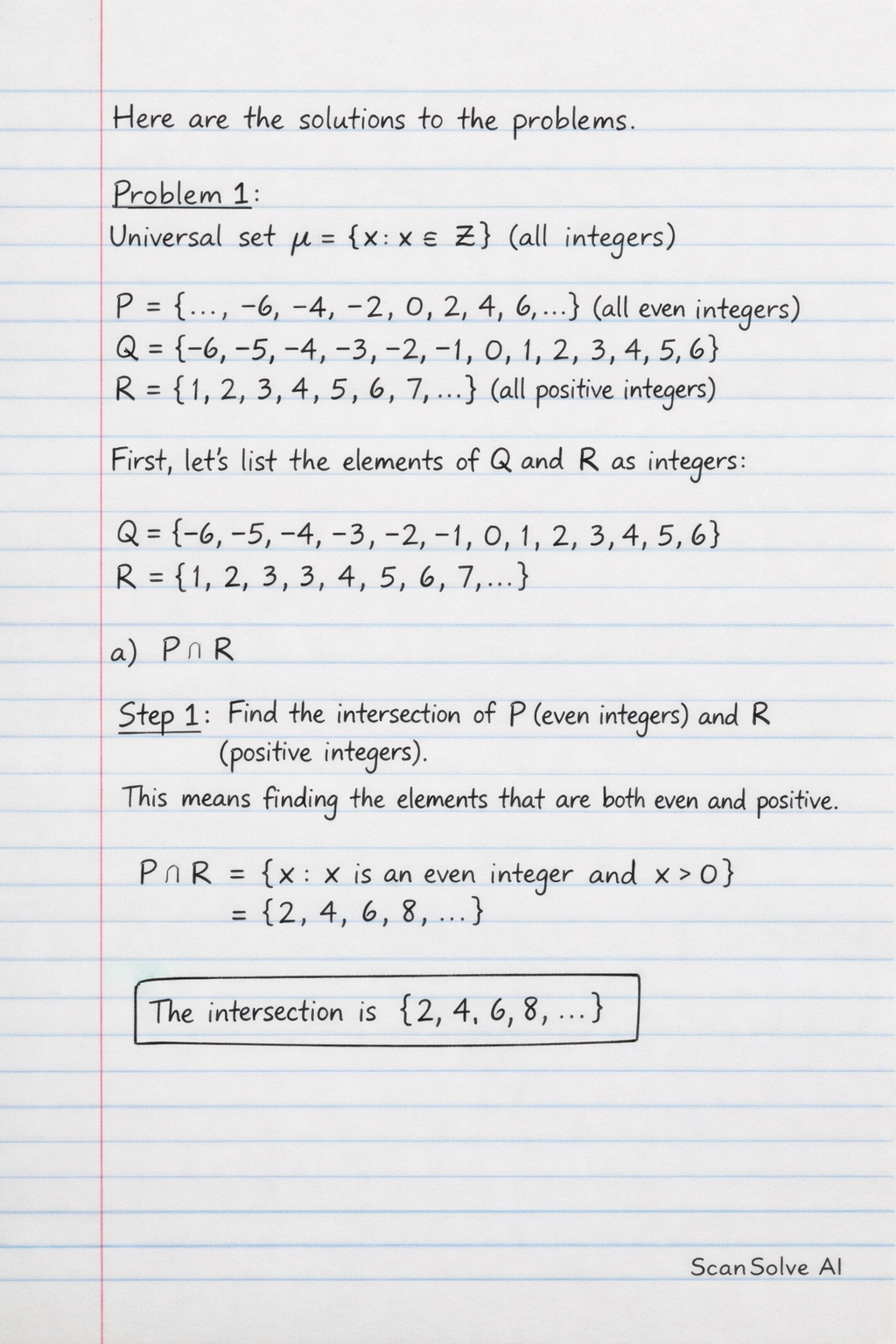
Handwritten step-by-step solution preview

Handwritten Step-by-Step Solution

Get this as a handwritten image on WhatsApp — like a tutor wrote it for you.

Try on WhatsApp