We read your photo as:

Given the universal set mu = ; 1 < x < 20, x is an integer set P = : x is a multiple of 3 and set Q = : x is a prime number find P Q', P' Q, and (P Q)'.

Mathematics

ScanSolve AI Answer

Answers

3 parts
a

{6,9,12,15,18}\{6, 9, 12, 15, 18\}

b

{2,3,4,5,7,8,10,11,13,14,16,17,19}\{2, 3, 4, 5, 7, 8, 10, 11, 13, 14, 16, 17, 19\}

c

{4,8,10,14,16}\{4, 8, 10, 14, 16\}

Step-by-step solution

2 steps

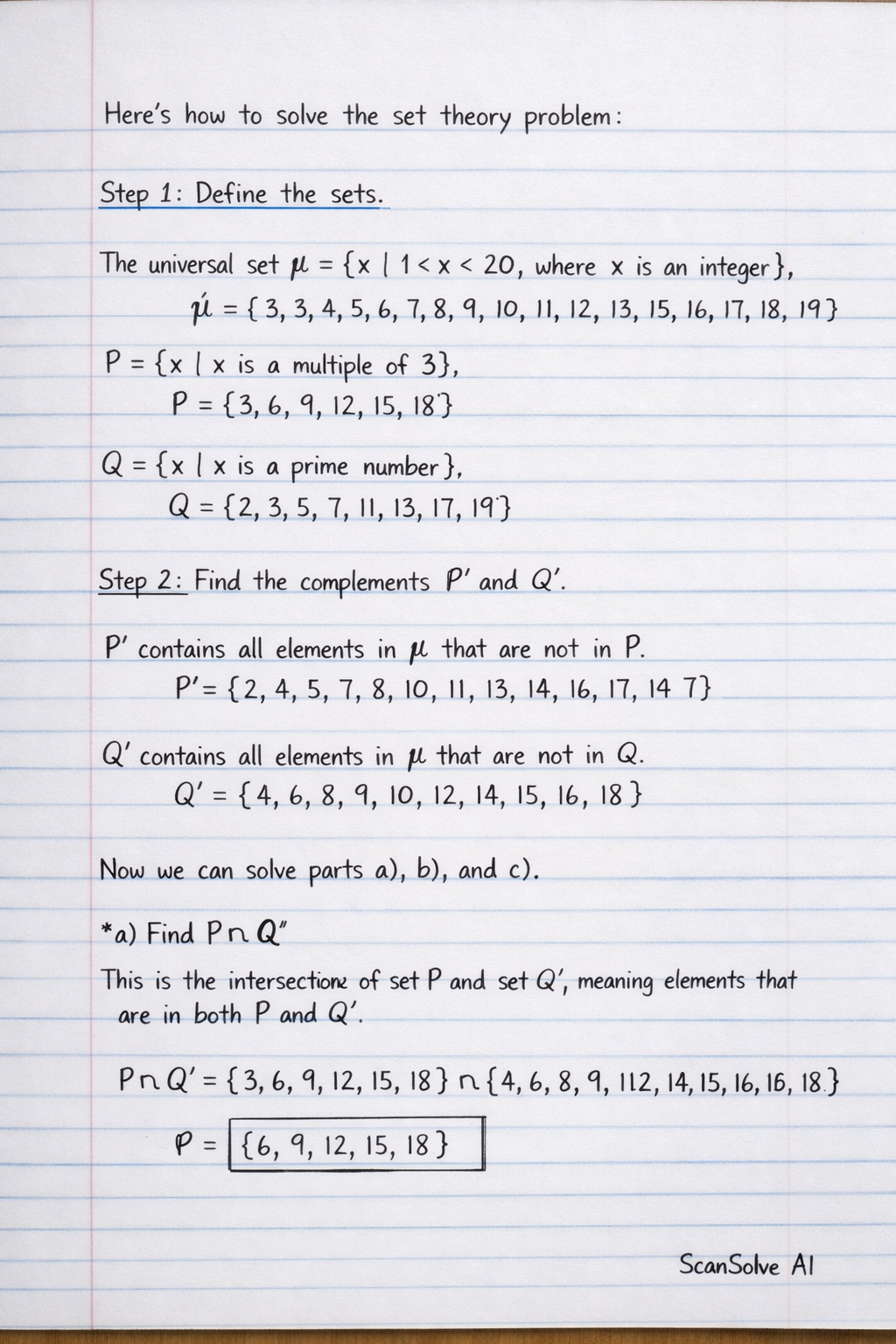
Here's how to solve the set theory problem:

First, let's list the elements of the universal set μ\mu, set PP, and set QQ.

  1. Define the sets.

    The universal set μ={x;1<x<20, where x is an integer}\mu = \{x; 1 < x < 20, \text{ where } x \text{ is an integer}\}.

    μ={2,3,4,5,6,7,8,9,10,11,12,13,14,15,16,17,18,19}\mu = \{2, 3, 4, 5, 6, 7, 8, 9, 10, 11, 12, 13, 14, 15, 16, 17, 18, 19\}

    Set P={x:x is a multiple of 3}P = \{x: x \text{ is a multiple of } 3\}.

    P={3,6,9,12,15,18}P = \{3, 6, 9, 12, 15, 18\}

    Set Q={x:x is a prime number}Q = \{x: x \text{ is a prime number}\}.

    Q={2,3,5,7,11,13,17,19}Q = \{2, 3, 5, 7, 11, 13, 17, 19\}
  2. Find the complements P′P' and Q′Q'.

    P′P' contains all elements in μ\mu that are not in PP.

    P′={2,4,5,7,8,10,11,13,14,16,17,19}P' = \{2, 4, 5, 7, 8, 10, 11, 13, 14, 16, 17, 19\}

    Q′Q' contains all elements in μ\mu that are not in QQ.

    Q′={4,6,8,9,10,12,14,15,16,18}Q' = \{4, 6, 8, 9, 10, 12, 14, 15, 16, 18\}

    Now we can solve parts a), b), and c).

    a) Find P∩Q′P \cap Q'
    This is the intersection of set PP and set Q′Q', meaning elements that are in both PP and Q′Q'.

    P∩Q′={3,6,9,12,15,18}∩{4,6,8,9,10,12,14,15,16,18}P \cap Q' = \{3, 6, 9, 12, 15, 18\} \cap \{4, 6, 8, 9, 10, 12, 14, 15, 16, 18\} P∩Q′={6,9,12,15,18}P \cap Q' = \boxed{\{6, 9, 12, 15, 18\}}

    b) Find P′∪QP' \cup Q
    This is the union of set P′P' and set QQ, meaning all elements that are in P′P' or in QQ (or both).

    P′∪Q={2,4,5,7,8,10,11,13,14,16,17,19}∪{2,3,5,7,11,13,17,19}P' \cup Q = \{2, 4, 5, 7, 8, 10, 11, 13, 14, 16, 17, 19\} \cup \{2, 3, 5, 7, 11, 13, 17, 19\} P′∪Q={2,3,4,5,7,8,10,11,13,14,16,17,19}P' \cup Q = \boxed{\{2, 3, 4, 5, 7, 8, 10, 11, 13, 14, 16, 17, 19\}}

    c) Find (P∪Q)′(P \cup Q)'
    First, find the union of PP and QQ.

    P∪Q={3,6,9,12,15,18}∪{2,3,5,7,11,13,17,19}P \cup Q = \{3, 6, 9, 12, 15, 18\} \cup \{2, 3, 5, 7, 11, 13, 17, 19\} P∪Q={2,3,5,6,7,9,11,12,13,15,17,18,19}P \cup Q = \{2, 3, 5, 6, 7, 9, 11, 12, 13, 15, 17, 18, 19\}

    Next, find the complement of (P∪Q)(P \cup Q), which means elements in μ\mu that are not in P∪QP \cup Q.

    (P∪Q)′=μ∖(P∪Q)(P \cup Q)' = \mu \setminus (P \cup Q) (P∪Q)′={2,3,4,5,6,7,8,9,10,11,12,13,14,15,16,17,18,19}∖{2,3,5,6,7,9,11,12,13,15,17,18,19}(P \cup Q)' = \{2, 3, 4, 5, 6, 7, 8, 9, 10, 11, 12, 13, 14, 15, 16, 17, 18, 19\} \setminus \{2, 3, 5, 6, 7, 9, 11, 12, 13, 15, 17, 18, 19\} (P∪Q)′={4,8,10,14,16}(P \cup Q)' = \boxed{\{4, 8, 10, 14, 16\}}
Was this helpful?

Still stuck on this one?

Ask a follow-up, and the answer starts from this question.

Got a different question?Ask your own question
Handwritten step-by-step solution preview

Handwritten Step-by-Step Solution

Get this as a handwritten image on WhatsApp — like a tutor wrote it for you.

Try on WhatsApp