We read your photo as:

Given vectors U(2,1,3) and V(4,-5,1), calculate the dot product, squared magnitude of U, magnitude of V, and the cosine of the angle between U and V.

Mathematics

ScanSolve AI Answer

Step-by-step solution

2 steps
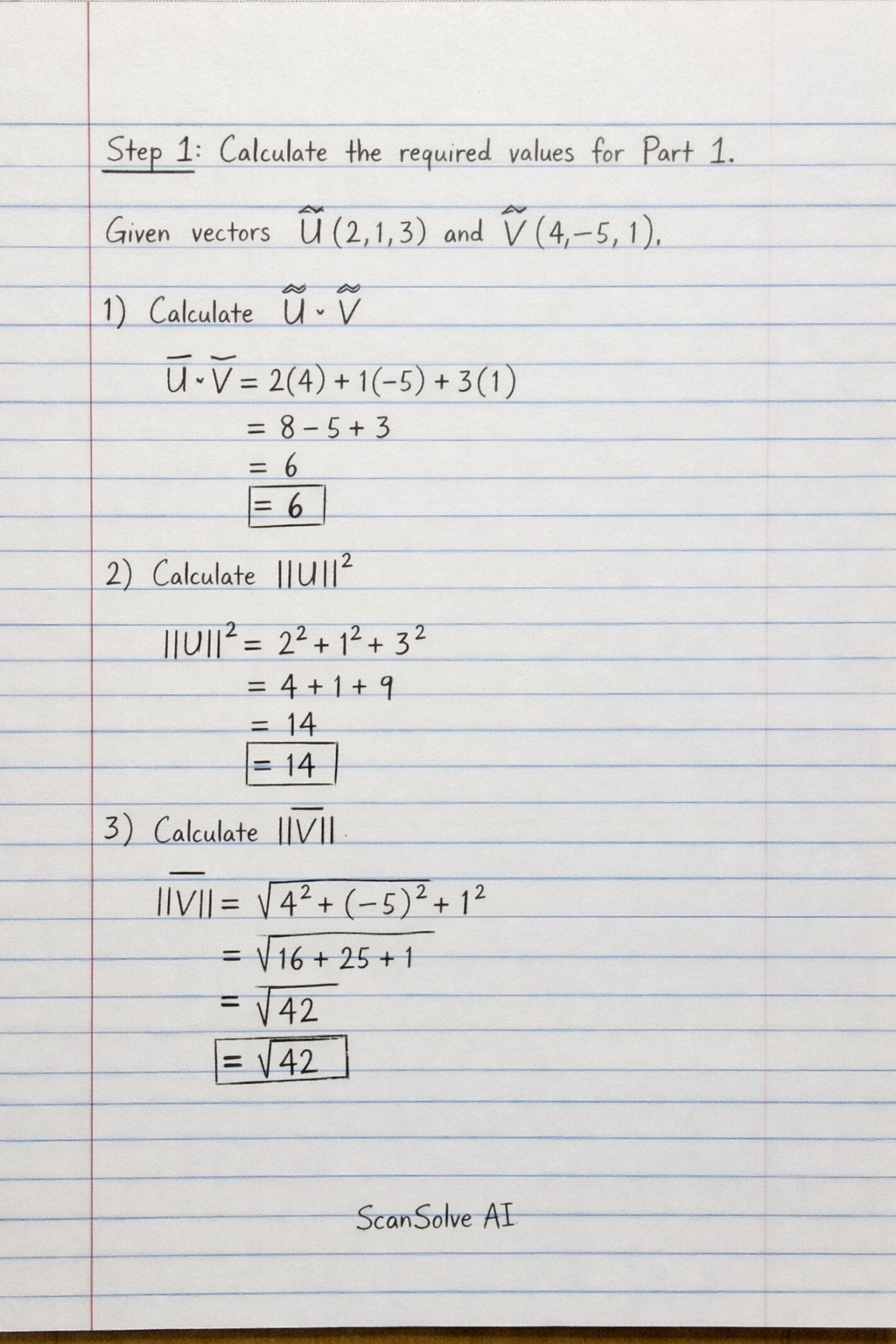
  1. Calculate the required values for Part 1.

    Given vectors U⃗(2,1,3)\vec{U}(2,1,3) and V⃗(4,−5,1)\vec{V}(4,-5,1).

    • 1) Calculate U⃗⋅V⃗\vec{U} \cdot \vec{V} The dot product of two vectors U⃗=(ux,uy,uz)\vec{U} = (u_x, u_y, u_z) and V⃗=(vx,vy,vz)\vec{V} = (v_x, v_y, v_z) is uxvx+uyvy+uzvzu_x v_x + u_y v_y + u_z v_z.

      U⃗⋅V⃗=(2)(4)+(1)(−5)+(3)(1)=8−5+3=6\vec{U} \cdot \vec{V} = (2)(4) + (1)(-5) + (3)(1) = 8 - 5 + 3 = \boxed{6}
    • 2) Calculate ∣∣U⃗∣∣2||\vec{U}||^2 The squared magnitude of a vector U⃗\vec{U} is ∣∣U⃗∣∣2=ux2+uy2+uz2||\vec{U}||^2 = u_x^2 + u_y^2 + u_z^2.

      ∣∣U⃗∣∣2=22+12+32=4+1+9=14||\vec{U}||^2 = 2^2 + 1^2 + 3^2 = 4 + 1 + 9 = \boxed{14}
    • 3) Calculate ∣∣V⃗∣∣||\vec{V}|| The magnitude of a vector V⃗\vec{V} is ∣∣V⃗∣∣=vx2+vy2+vz2||\vec{V}|| = \sqrt{v_x^2 + v_y^2 + v_z^2}.

      ∣∣V⃗∣∣=42+(−5)2+12=16+25+1=42=42||\vec{V}|| = \sqrt{4^2 + (-5)^2 + 1^2} = \sqrt{16 + 25 + 1} = \sqrt{42} = \boxed{\sqrt{42}}
    • 4) Calculate cos⁡(U⃗,V⃗)\cos(\vec{U}, \vec{V}) The cosine of the angle θ\theta between two vectors is given by cos⁡(θ)=U⃗⋅V⃗∣∣U⃗∣∣⋅∣∣V⃗∣∣\cos(\theta) = \frac{\vec{U} \cdot \vec{V}}{||\vec{U}|| \cdot ||\vec{V}||}. First, find ∣∣U⃗∣∣=∣∣U⃗∣∣2=14||\vec{U}|| = \sqrt{||\vec{U}||^2} = \sqrt{14}.

      cos⁡(U⃗,V⃗)=614⋅42=614⋅42=614⋅3⋅14=6142⋅3=6143\cos(\vec{U}, \vec{V}) = \frac{6}{\sqrt{14} \cdot \sqrt{42}} = \frac{6}{\sqrt{14 \cdot 42}} = \frac{6}{\sqrt{14 \cdot 3 \cdot 14}} = \frac{6}{\sqrt{14^2 \cdot 3}} = \frac{6}{14\sqrt{3}}

      Simplify the fraction and rationalize the denominator:

      cos⁡(U⃗,V⃗)=373=33733=337⋅3=37=37\cos(\vec{U}, \vec{V}) = \frac{3}{7\sqrt{3}} = \frac{3\sqrt{3}}{7\sqrt{3}\sqrt{3}} = \frac{3\sqrt{3}}{7 \cdot 3} = \frac{\sqrt{3}}{7} = \boxed{\frac{\sqrt{3}}{7}}
    • 5) Calculate ∣∣U⃗+V⃗∣∣||\vec{U} + \vec{V}|| First, calculate the vector sum U⃗+V⃗\vec{U} + \vec{V}:

      U⃗+V⃗=(2+4,1+(−5),3+1)=(6,−4,4)\vec{U} + \vec{V} = (2+4, 1+(-5), 3+1) = (6, -4, 4)

      Now, calculate its magnitude:

      ∣∣U⃗+V⃗∣∣=62+(−4)2+42=36+16+16=68||\vec{U} + \vec{V}|| = \sqrt{6^2 + (-4)^2 + 4^2} = \sqrt{36 + 16 + 16} = \sqrt{68}

      Simplify the radical:

      68=4⋅17=217=217\sqrt{68} = \sqrt{4 \cdot 17} = 2\sqrt{17} = \boxed{2\sqrt{17}}
  2. Calculate the required values for Part 2.

    Given points A(−4,2,−1)A(-4,2,-1), B(−1,−2,4)B(-1,-2,4), and C(−2,3,1)C(-2,3,1).

    • 1) Calculate AB⃗\vec{AB} The vector AB⃗\vec{AB} is found by subtracting the coordinates of A from B.

      AB⃗=B−A=(−1−(−4),−2−2,4−(−1))=(3,−4,5)=(3,−4,5)\vec{AB} = B - A = (-1 - (-4), -2 - 2, 4 - (-1)) = (3, -4, 5) = \boxed{(3, -4, 5)}
    • 2) Calculate AC⃗\vec{AC} The vector AC⃗\vec{AC} is found by subtracting the coordinates of A from C.

      AC⃗=C−A=(−2−(−4),3−2,1−(−1))=(2,1,2)=(2,1,2)\vec{AC} = C - A = (-2 - (-4), 3 - 2, 1 - (-1)) = (2, 1, 2) = \boxed{(2, 1, 2)}
    • 3) Calculate AB⃗⋅AC⃗\vec{AB} \cdot \vec{AC} Using the vectors calculated above:

      AB⃗⋅AC⃗=(3)(2)+(−4)(1)+(5)(2)=6−4+10=12\vec{AB} \cdot \vec{AC} = (3)(2) + (-4)(1) + (5)(2) = 6 - 4 + 10 = \boxed{12}
Was this helpful?

Still stuck on this one?

Ask a follow-up, and the answer starts from this question.

Got a different question?Ask your own question
Handwritten step-by-step solution preview

Handwritten Step-by-Step Solution

Get this as a handwritten image on WhatsApp — like a tutor wrote it for you.

Try on WhatsApp