
We read your photo as:
Given volume of CO₂ = 89.6 dm³.
ScanSolve AI Answer
Answer
Step-by-step solution
5 stepsCalculate the moles of carbon dioxide () produced.
At standard temperature and pressure (STP), 1 mole of any gas occupies .
Given volume of .Calculate the moles of water () produced.
The molar mass of is .
Given mass of .Determine the moles of carbon (C) and hydrogen (H) atoms in the hydrocarbon.
From the complete combustion of a hydrocarbon, all carbon atoms form and all hydrogen atoms form .
Each mole of contains 1 mole of C atoms.
Moles of C atoms =Each mole of contains 2 moles of H atoms.
Moles of H atoms =Determine the molecular formula of the hydrocarbon.
The ratio of carbon atoms to hydrogen atoms in the hydrocarbon is .
This simplifies to .
So, the empirical formula is .Let the general formula of the hydrocarbon be .
From the moles of C and H atoms, we have and .
Therefore, the molecular formula of the hydrocarbon is .Classify the hydrocarbon.
The general formula for alkanes is . For , this would be .
The general formula for alkenes is . For , this would be .
The general formula for alkynes or dienes is . For , this would be .Thus, the hydrocarbon is an alkyne or a diene.
Try one yourself
A new problem that tests the same skill.
Still stuck on this one?
Ask a follow-up, and the answer starts from this question.
More Mathematics Questions
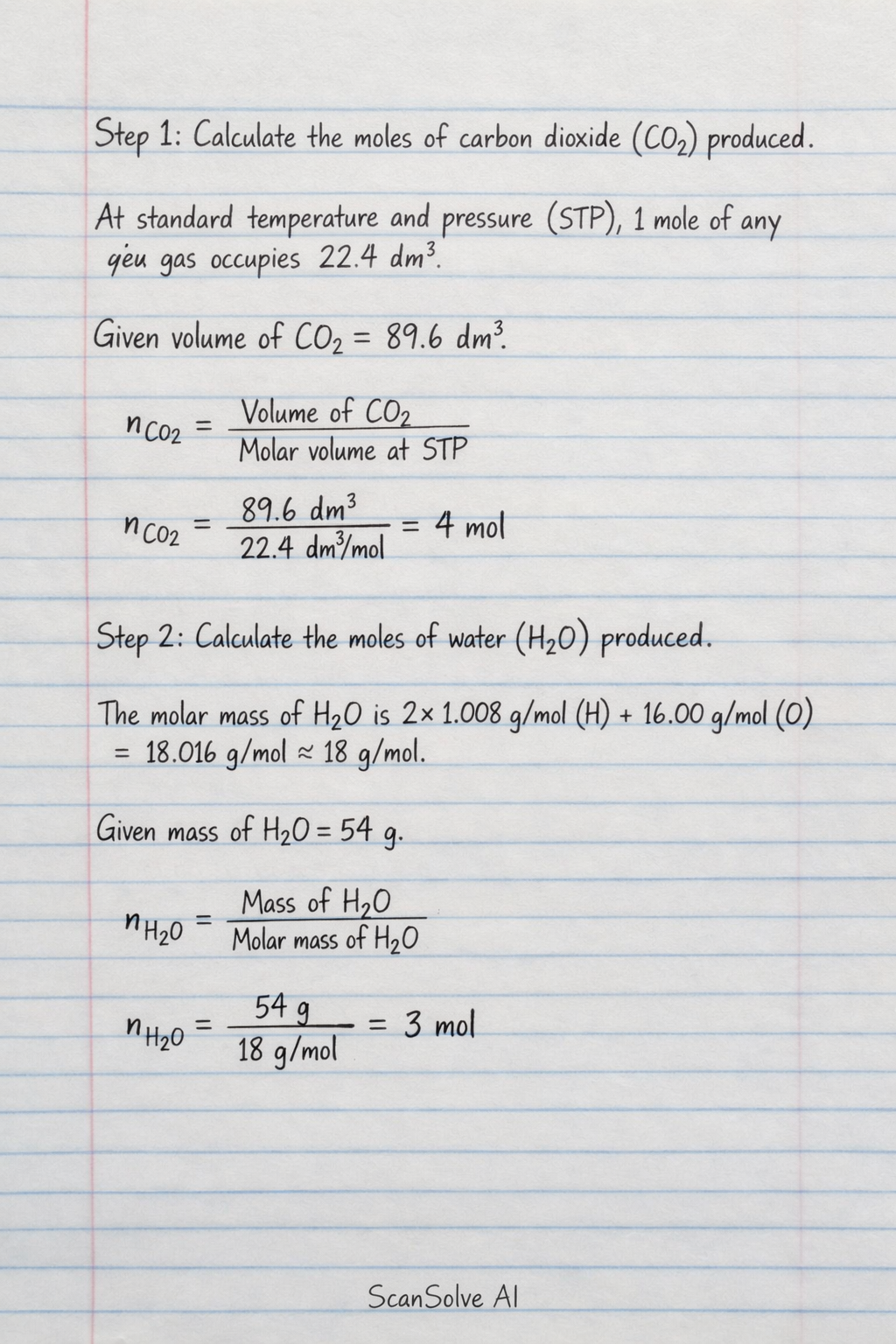
Handwritten Step-by-Step Solution
Get this as a handwritten image on WhatsApp — like a tutor wrote it for you.
Try on WhatsApp