

This mathematics problem involves applying core mathematical principles and formulas. Below you will find a complete step-by-step solution with detailed explanations for each step, helping you understand not just the answer but the method behind it.
ScanSolve AI Answer
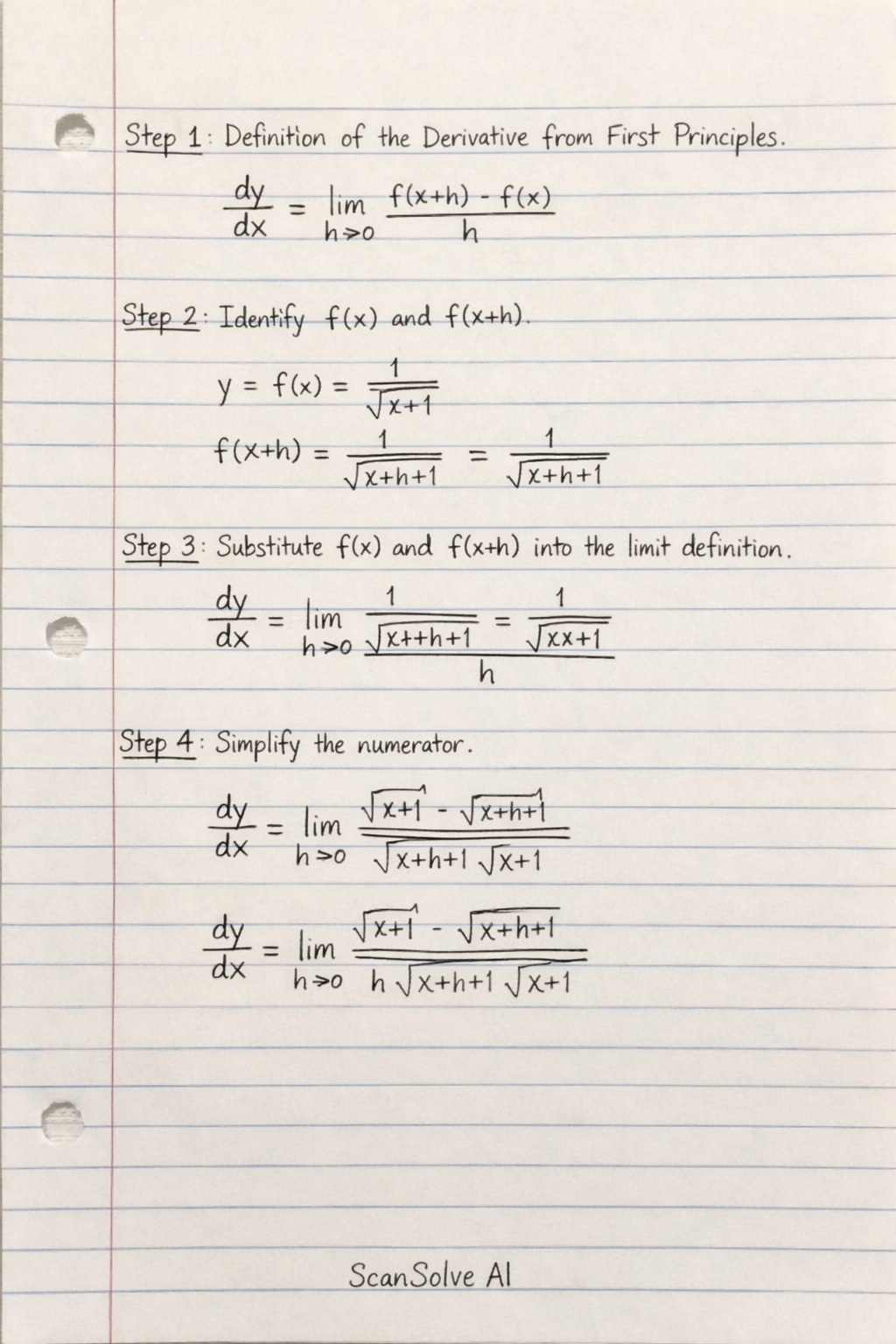
Step 1: Write down the definition of the derivative from the first principle. The derivative of a function f(x) is given by: (dy)/(dx) = _h 0 (f(x+h) - f(x))/(h) Step 2: Identify f(x) and f(x+h). Given y = f(x) = (1)/(sqrt(x+1)). Then f(x+h) = (1)/(sqrt((x+h)+1)) = (1)/(sqrt(x+h+1)). Step 3: Substitute f(x) and f(x+h) into the limit definition. (dy)/(dx) = _h 0 (1)/(sqrt(x+h+1)) - (1)/(sqrt(x+1))h Step 4: Simplify the numerator by finding a common denominator. (dy)/(dx) = _h 0 sqrt(x+1) - sqrt(x+h+1)sqrt(x+h+1)sqrt(x+1)h (dy)/(dx) = _h 0 sqrt(x+1) - sqrt(x+h+1)hsqrt(x+h+1)sqrt(x+1) Step 5: Multiply the numerator and denominator by the conjugate of the numerator. The conjugate of sqrt(x+1) - sqrt(x+h+1) is sqrt(x+1) + sqrt(x+h+1). (dy)/(dx) = _h 0 sqrt(x+1) - sqrt(x+h+1)hsqrt(x+h+1)sqrt(x+1) × sqrt(x+1) + sqrt(x+h+1)sqrt(x+1) + sqrt(x+h+1) (dy)/(dx) = _h 0 (sqrt(x+1))^2 - (sqrt(x+h+1))^2hsqrt(x+h+1)sqrt(x+1)(sqrt(x+1) + sqrt(x+h+1)) (dy)/(dx) = _h 0 ((x+1) - (x+h+1))/(hsqrt(x+h+1)x+1)(sqrt(x+1) + sqrt(x+h+1)) (dy)/(dx) = _h 0 (x+1-x-h-1)/(hsqrt(x+h+1)x+1)(sqrt(x+1) + sqrt(x+h+1)) (dy)/(dx) = _h 0 (-h)/(hsqrt(x+h+1)x+1)(sqrt(x+1) + sqrt(x+h+1)) Step 6: Cancel out h and evaluate the limit. (dy)/(dx) = _h 0 (-1)/(sqrt(x+h+1)x+1)(sqrt(x+1) + sqrt(x+h+1)) Now, substitute h=0: (dy)/(dx) = (-1)/(sqrt(x+0+1)x+1)(sqrt(x+1) + sqrt(x+0+1)) (dy)/(dx) = (-1)/(sqrt(x+1)x+1)(sqrt(x+1) + sqrt(x+1)) (dy)/(dx) = (-1)/((x+1)(2sqrt(x+1))) (dy)/(dx) = (-1)/(2(x+1)^1)(x+1)^1/2 (dy)/(dx) = (-1)/(2(x+1)^3/2) The derivative of y = (1)/(sqrt(x+1)) from the first principle is -(1)/(2(x+1)^3/2).