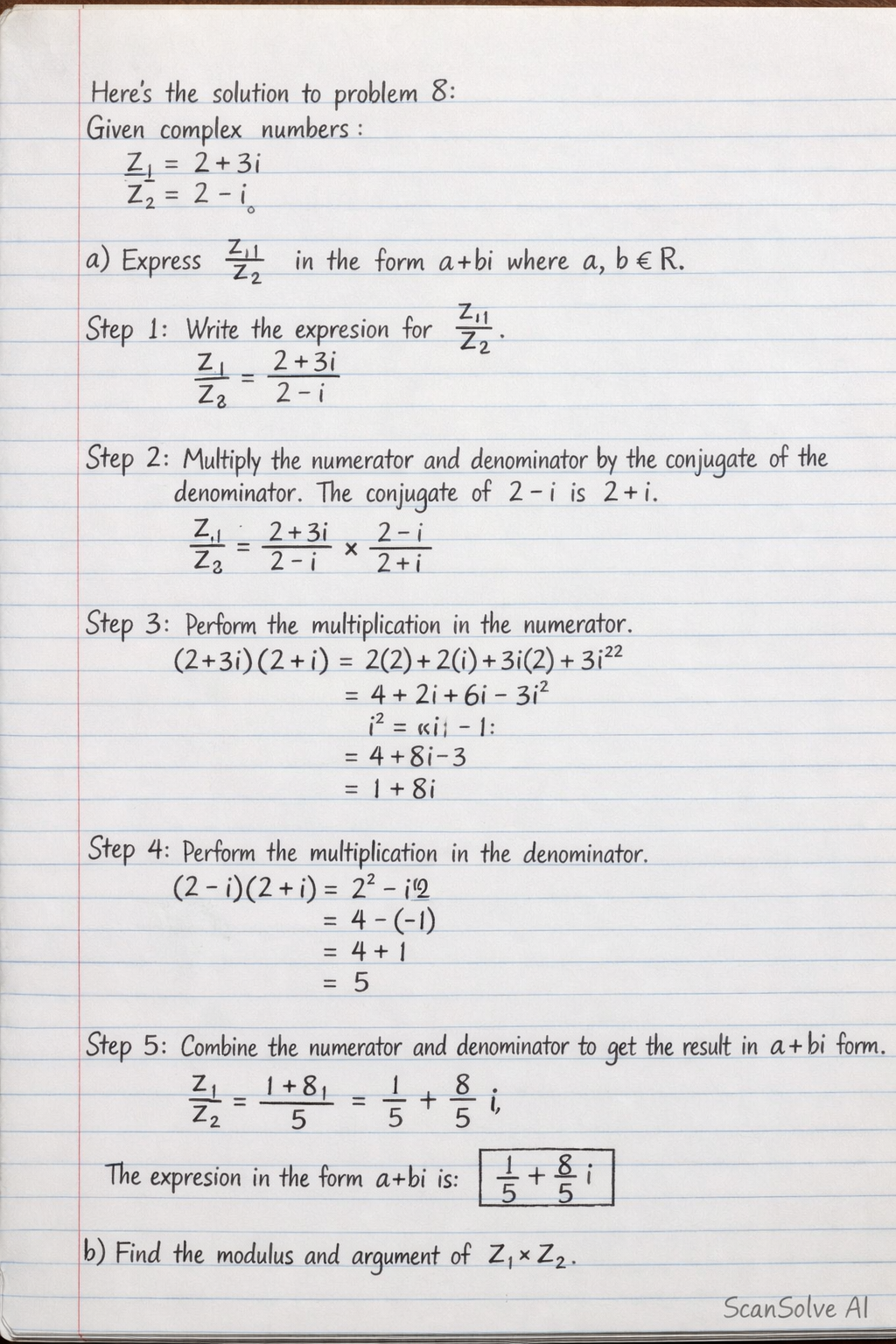
Given Z1 = 2 + 3i and Z2 = 2 - i, express racZ1Z2 in the form a + bi and find the modulus and argument of Z1 imes Z2.
|Mathematics
Given Z1 = 2 + 3i and Z2 = 2 - i, express racZ1Z2 in the form a + bi and find the modulus and argument of Z1 imes Z2.
ScanSolve AI Answer
Answer
51+58i
Here's the solution to :
Given complex numbers:
Z1=2+3iZ2=2−i
a) Express Z2Z1 in the form a+bi where a,b∈R.
Step 1: Write the expression for Z2Z1.
Z2Z1=2−i2+3i
Step 2: Multiply the numerator and denominator by the conjugate of the denominator. The conjugate of 2−i is 2+i.
Z2Z1=2−i2+3i×2+i2+i
Step 3: Perform the multiplication in the numerator.
(2+3i)(2+i)=2(2)+2(i)+3i(2)+3i(i)=4+2i+6i+3i2
Since i2=−1:
=4+8i−3=1+8i
Step 4: Perform the multiplication in the denominator.
(2−i)(2+i)=22−i2=4−(−1)=4+1=5
Step 5: Combine the numerator and denominator to get the result in a+bi form.
Z2Z1=51+8i=51+58i
The expression in the form a+bi is 51+58i.
b) Find the modulus and argument of Z1×Z2.
Step 1: Calculate the product Z1×Z2.
Z1×Z2=(2+3i)(2−i)=2(2)+2(−i)+3i(2)+3i(−i)=4−2i+6i−3i2
Since i2=−1:
=4+4i−3(−1)=4+4i+3=7+4i
Step 2: Find the modulus of Z1×Z2. For a complex number z=x+yi, the modulus is ∣z∣=x2+y2.
∣Z1×Z2∣=∣7+4i∣=72+42=49+16=65
Step 3: Find the argument of Z1×Z2. For z=x+yi in the first quadrant (x>0,y>0), the argument is arg(z)=arctan(xy).
Since 7+4i is in the first quadrant:
arg(Z1×Z2)=arctan(74)
The modulus is 65 and the argument is arctan(74).
c) Given also that Z3 is a complex number such that ∣Z3∣=5 and the argument of Z3 is 3π, express Z3Z1×Z2 in polar form.
Step 1: Write Z3 in polar form.
Given ∣Z3∣=5 and arg(Z3)=3π.
Z3=5(cos(3π)+isin(3π))
Step 2: Write Z1×Z2 in polar form using the results from part b).
Let Z12=Z1×Z2.
∣Z12∣=65 and arg(Z12)=arctan(74).
Z12=65(cos(arctan(74))+isin(arctan(74)))
Step 3: Express Z3Z12 in polar form. If za=ra(cosθa+isinθa) and zb=rb(cosθb+isinθb), then zbza=rbra(cos(θa−θb)+isin(θa−θb)).
Here, ra=65, θa=arctan(74), rb=5, θb=3π.
Z3Z1×Z2=565(cos(arctan(74)−3π)+isin(arctan(74)−3π))
The expression in polar form is 565(cos(arctan(74)−3π)+isin(arctan(74)−3π)).
Was this helpful?
Need help with your own homework?
Get instant step-by-step solutions to any question. Free to start.
This mathematics problem involves applying core mathematical principles and formulas. Below you will find a complete step-by-step solution with detailed explanations for each step, helping you understand not just the answer but the method behind it.
ScanSolve AI Answer
Here's the solution to problem 8: Given complex numbers: Z_1 = 2 + 3i Z_2 = 2 - i a) Express (Z_1)/(Z_2) in the form a + bi where a, b R. Step 1: Write the expression for (Z_1)/(Z_2). (Z_1)/(Z_2) = (2 + 3i)/(2 - i) Step 2: Multiply the numerator and denominator by the conjugate of the denominator. The conjugate of 2 - i is 2 + i. (Z_1)/(Z_2) = (2 + 3i)/(2 - i) × (2 + i)/(2 + i) Step 3: Perform the multiplication in the numerator. (2 + 3i)(2 + i) = 2(2) + 2(i) + 3i(2) + 3i(i) = 4 + 2i + 6i + 3i^2 Since i^2 = -1: = 4 + 8i - 3 = 1 + 8i Step 4: Perform the multiplication in the denominator. (2 - i)(2 + i) = 2^2 - i^2 = 4 - (-1) = 4 + 1 = 5 Step 5: Combine the numerator and denominator to get the result in a+bi form. (Z_1)/(Z_2) = (1 + 8i)/(5) = (1)/(5) + (8)/(5)i The expression in the form a+bi is (1)/(5) + (8)/(5)i. b) Find the modulus and argument of Z_1 × Z_2. Step 1: Calculate the product Z_1 × Z_2. Z_1 × Z_2 = (2 + 3i)(2 - i) = 2(2) + 2(-i) + 3i(2) + 3i(-i) = 4 - 2i + 6i - 3i^2 Since i^2 = -1: = 4 + 4i - 3(-1) = 4 + 4i + 3 = 7 + 4i Step 2: Find the modulus of Z_1 × Z_2. For a complex number z = x + yi, the modulus is |z| = sqrt(x^2 + y^2). |Z_1 × Z_2| = |7 + 4i| = sqrt(7^2 + 4^2) = sqrt(49 + 16) = sqrt(65) Step 3: Find the argument of Z_1 × Z_2. For z = x + yi in the first quadrant (x>0, y>0), the argument is (z) = ((y)/(x)). Since 7 + 4i is in the first quadrant: (Z_1 × Z_2) = ((4)/(7)) The modulus is sqrt(65) and the argument is ((4)/(7)). c) Given also that Z_3 is a complex number such that |Z_3| = 5 and the argument of Z_3 is ()/(3), express (Z_1 × Z_2)/(Z_3) in polar form. Step 1: Write Z_3 in polar form. Given |Z_3| = 5 and (Z_3) = ()/(3). Z_3 = 5 ((()/(3)) + i (()/(3))) Step 2: Write Z_1 × Z_2 in polar form using the results from part b). Let Z_12 = Z_1 × Z_2. |Z_12| = sqrt(65) and (Z_12) = ((4)/(7)). Z_12 = sqrt(65) ((((4)/(7))) + i (((4)/(7)))) Step 3: Express Z_12Z_3 in polar form. If z_a = r_a( _a + i _a) and z_b = r_b( _b + i _b), then (z_a)/(z_b) = (r_a)/(r_b)((_a - _b) + i (_a - _b)). Here, r_a = sqrt(65), _a = ((4)/(7)), r_b = 5, _b = ()/(3). (Z_1 × Z_2)/(Z_3) = sqrt(65)5 ((((4)/(7)) - ()/(3)) + i (((4)/(7)) - ()/(3))) The expression in polar form is sqrt(65)5 ((((4)/(7)) - ()/(3)) + i (((4)/(7)) - ()/(3))).