
We read your photo as:
Find the gradient of the given curves at the indicated points.
Mathematics
ScanSolve AI Answer
Answer
Step-by-step solution
2 stepsTo find for the given function, we first simplify the expression for .
Simplify the expression for .
The numerator is a perfect square trinomial, which can be factored as .
Assuming , we can cancel out one term from the numerator and denominator.
Differentiate with respect to .
Now, we find the derivative of .
Using the power rule and the constant rule :
Was this helpful?
Try one yourself
A new problem that tests the same skill.
Still stuck on this one?
Ask a follow-up, and the answer starts from this question.
Got a different question?Ask your own question
More Mathematics Questions
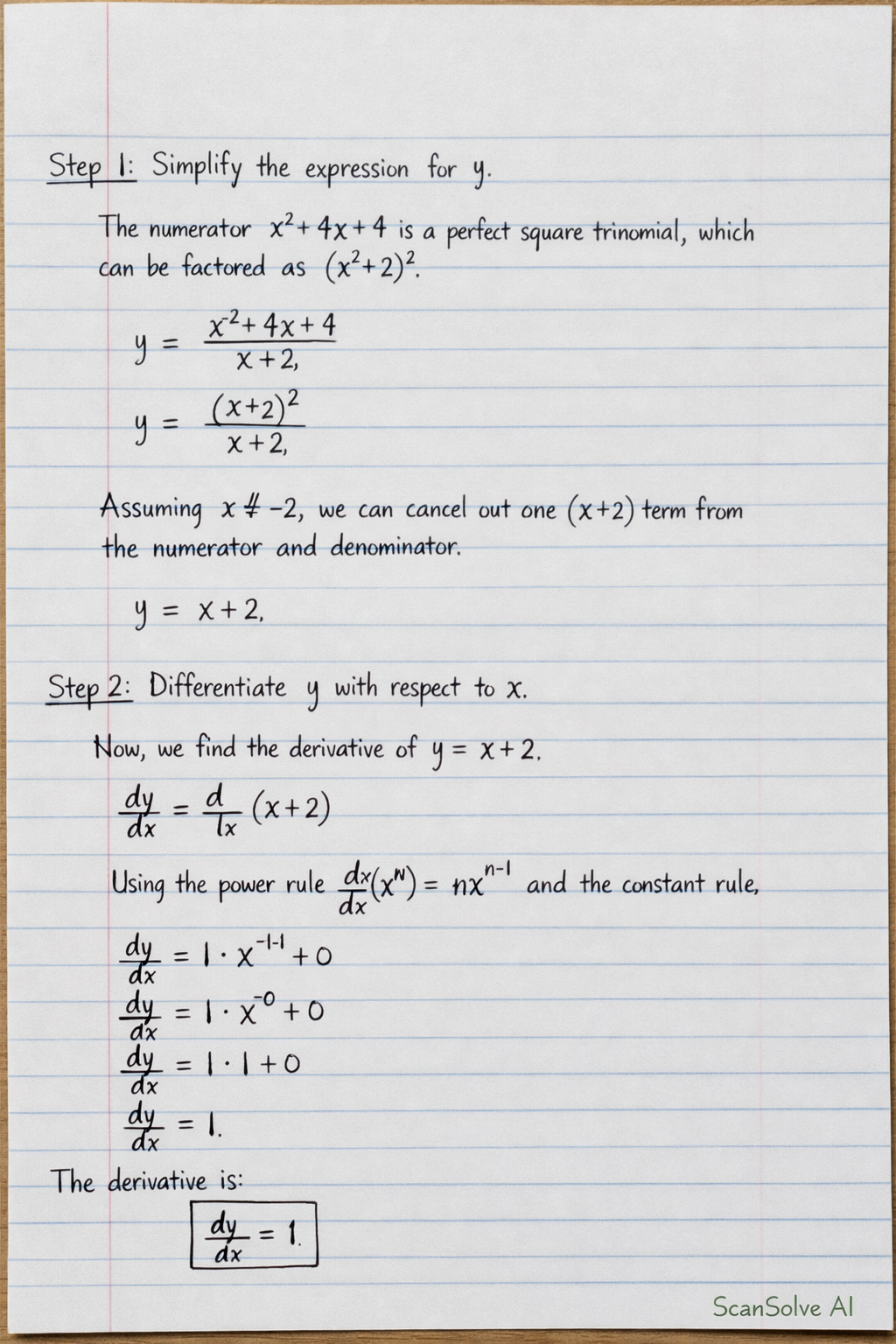
Handwritten Step-by-Step Solution
Get this as a handwritten image on WhatsApp — like a tutor wrote it for you.
Try on WhatsApp