
Graph △ABC with vertices A(1, 2), B(3, 4), and C(2, 0). Perform the following sequence of transformations: Step 1: Translate △ABC using the vector to obtain △A′B′C′ Step 2: Reflect △A′B′C′ in the y-axis to obtain △A″B″C″ Step 3: Rotate △A″B″C″ through 90° anticlockwise about the origin to obtain △A‴B‴C‴ Step 4: Enlarge △A‴B‴C‴ with a scale factor of k = 2 centred at the origin to obtain △A⁴B⁴C⁴ Show your work clearly, including: The coordinate rule and coordinates for each transformation step A labelled graph showing the original triangle and all four images (△ABC, △A′B′C′, △A″B″C″, △A‴B‴C‴, △A⁴B⁴C⁴) A comparison of the perimeter of △ABC and △A⁴B⁴C⁴
ScanSolve AI Answer
Step-by-step solution
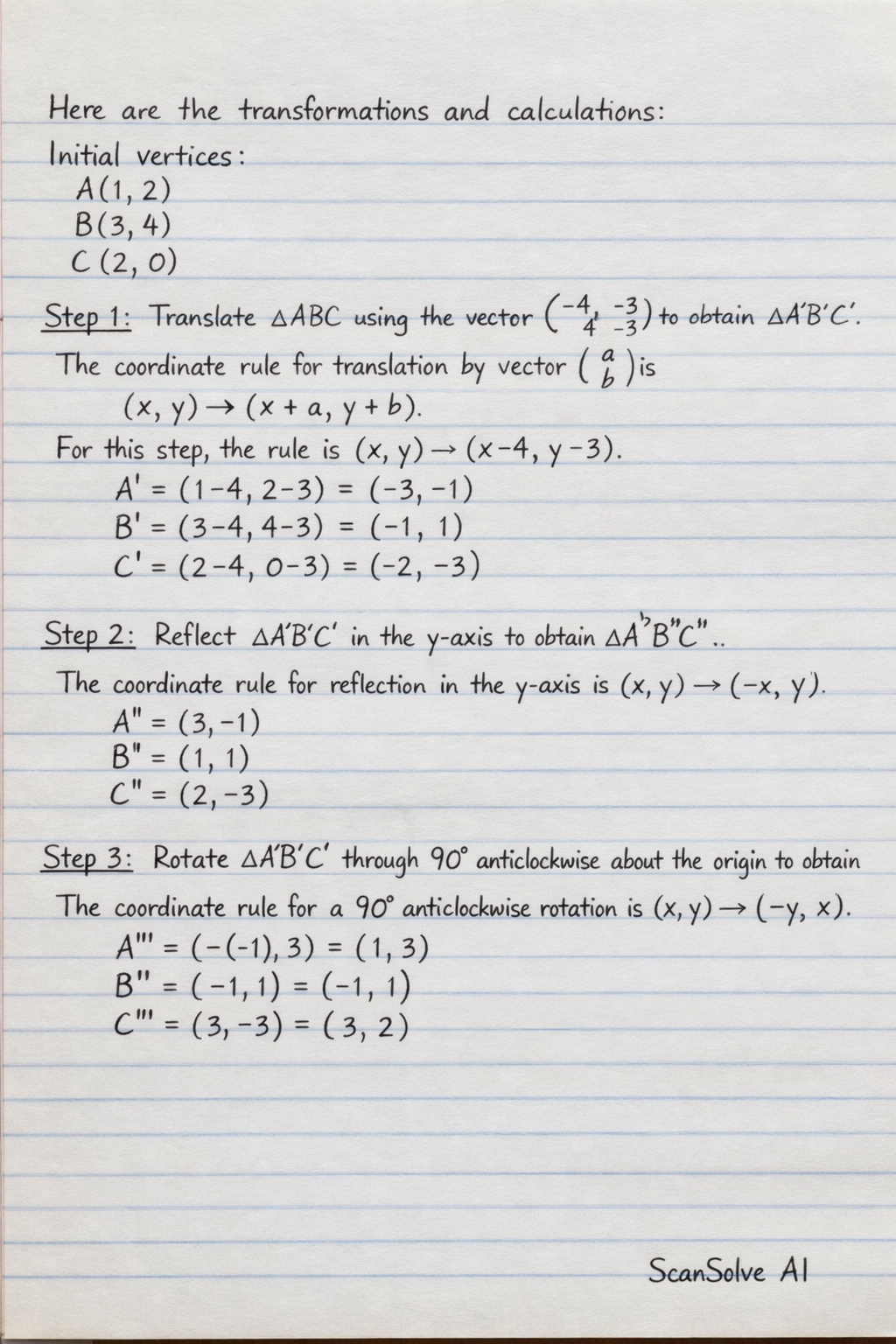
7 stepsHere are the transformations and calculations:
Initial vertices:
A$(1, 2)$
B$(3, 4)$
C$(2, 0)$
Translate △ABC using the vector to obtain △A′B′C′.
The coordinate rule for translation by vector is .
For this step, the rule is .Reflect △A′B′C′ in the y-axis to obtain △A″B″C″.
The coordinate rule for reflection in the y-axis is .
Rotate △A″B″C″ through 90° anticlockwise about the origin to obtain △A‴B‴C‴.
The coordinate rule for a 90° anticlockwise rotation about the origin is .
Enlarge △A‴B‴C‴ with a scale factor of centred at the origin to obtain △A⁴B⁴C⁴.
The coordinate rule for enlargement with scale factor centred at the origin is .
For this step, the rule is .Graphing the triangles.
To graph, plot the following vertices for each triangle on a coordinate plane and connect them:
- △ABC: A(1, 2), B(3, 4), C(2, 0)
- △A′B′C′: A′(-3, -1), B′(-1, 1), C′(-2, -3)
- △A″B″C″: A″(3, -1), B″(1, 1), C″(2, -3)
- △A‴B‴C‴: A‴(1, 3), B‴(-1, 1), C‴(3, 2)
- △A⁴B⁴C⁴: A⁴(2, 6), B⁴(-2, 2), C⁴(6, 4)
Calculate the perimeter of △ABC.
The distance formula is .
Perimeter of △ABC
Calculate the perimeter of △A⁴B⁴
Still stuck on this one?
Ask a follow-up, and the answer starts from this question.
More Mathematics Questions
Handwritten Step-by-Step Solution
Get this as a handwritten image on WhatsApp — like a tutor wrote it for you.
Try on WhatsApp