
We read your photo as:
Graph the feasible region for the following system of inequalities: 2x + 3y <= 6, x - 2y >= -3, x >= 0, y >= 0.
ScanSolve AI Answer
Step-by-step solution
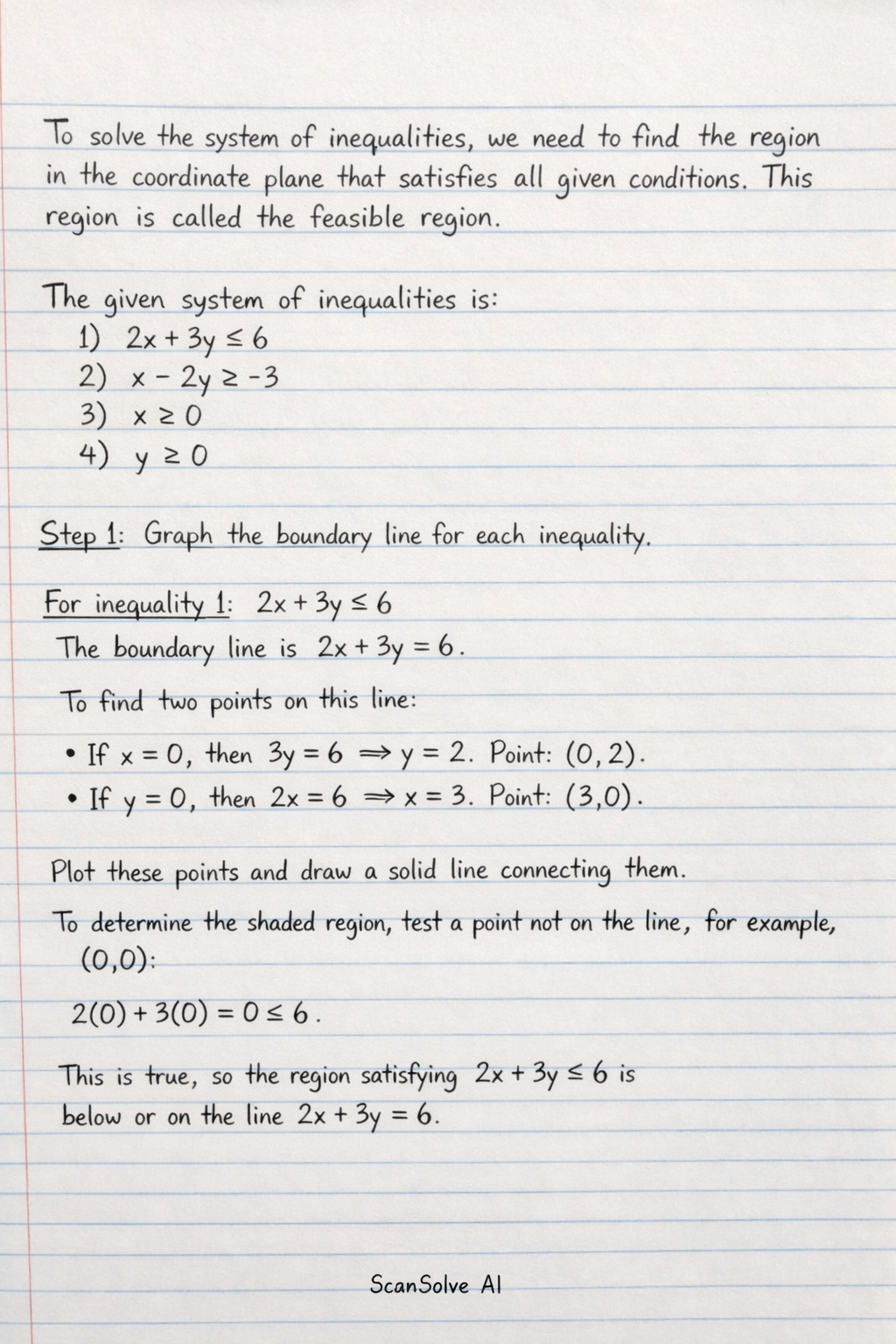
3 stepsTo solve the system of inequalities, we need to find the region in the coordinate plane that satisfies all given conditions. This region is called the feasible region.
The given system of inequalities is:
Graph the boundary line for each inequality.
For inequality 1:
The boundary line is .
To find two points on this line:- If , then . Point: .
- If , then . Point: . Plot these points and draw a solid line connecting them. To determine the shaded region, test a point not on the line, for example, : . This is true, so the region satisfying is below or on the line .
For inequality 2:
The boundary line is .
To find two points on this line:- If , then . Point: .
- If , then . Point: . Plot these points and draw a solid line connecting them. To determine the shaded region, test a point not on the line, for example, : . This is true, so the region satisfying is above or on the line .
For inequality 3:
This represents all points to the right of or on the y-axis.For inequality 4:
This represents all points above or on the x-axis.Identify the feasible region.
The feasible region is the area where all four shaded regions overlap. Since and , the feasible region will be restricted to the first quadrant.
Find the vertices of the feasible region.
The vertices are the intersection points of the boundary lines that define the feasible region.
- Intersection of and :
- Intersection of and : Substitute into :
- Intersection of and : Substitute into :
- Intersection of and : From the second equation, . Substitute this into the first equation: Now substitute back into :
The solution to the system of inequalities is the feasible region, which is a polygon defined by its vertices.
The vertices of the feasible region are:
The feasible region is the quadrilateral bounded by these four points.
Still stuck on this one?
Ask a follow-up, and the answer starts from this question.
More Mathematics Questions
Handwritten Step-by-Step Solution
Get this as a handwritten image on WhatsApp — like a tutor wrote it for you.
Try on WhatsApp