
We read your photo as:
Here are the solutions to the questions you sent. Question (i) There are 86,969 sacks of maize, 69,594 sacks of rice, and 90,743 sacks of wheat in a store for sale. Find the total amount of food grain
ScanSolve AI Answer
Answers
2 partsStep-by-step solution
4 stepsHere are the solutions to the questions you sent.
Part i· 2 steps
There are 86,969 sacks of maize, 69,594 sacks of rice, and 90,743 sacks of wheat in a store for sale. Find the total amount of food grains in storage.
Add the number of sacks of maize, rice, and wheat.
Perform the addition.
The total amount of food grains in storage is .
Part ii1,564,032
A town has a total population of 7,000,000. The population of women is 3,570,586 and the population of men is 1,865,382. Find the number of children in the town.
Calculate the total population of adults (women and men).
Subtract the adult population from the total population to find the number of children.
The number of children in the town is .
Part iii
A 10-meter ladder rests against a vertical wall. The base of the ladder is at a distance of meters from the wall and makes angle with the ground.
The question is incomplete, but based on the diagram and typical problems of this type, we can establish the relationships between , the height the ladder reaches on the wall (let's call it ), and the angle .
Given:
- Ladder length (hypotenuse) =
- Distance from wall (adjacent to ) =
- Angle with the ground =
Using trigonometry for a right-angled triangle:
-
Relationship for :
Therefore, .
-
Relationship for the height () the ladder reaches on the wall:
Therefore, .
-
Relationship between and :
-
Pythagorean Theorem:
Since the specific question is missing, these are the fundamental relationships derived from the given information. For example, if the question asked for in terms of , the answer would be .
Try one yourself
A new problem that tests the same skill.
Still stuck on this one?
Ask a follow-up, and the answer starts from this question.
More Mathematics Questions
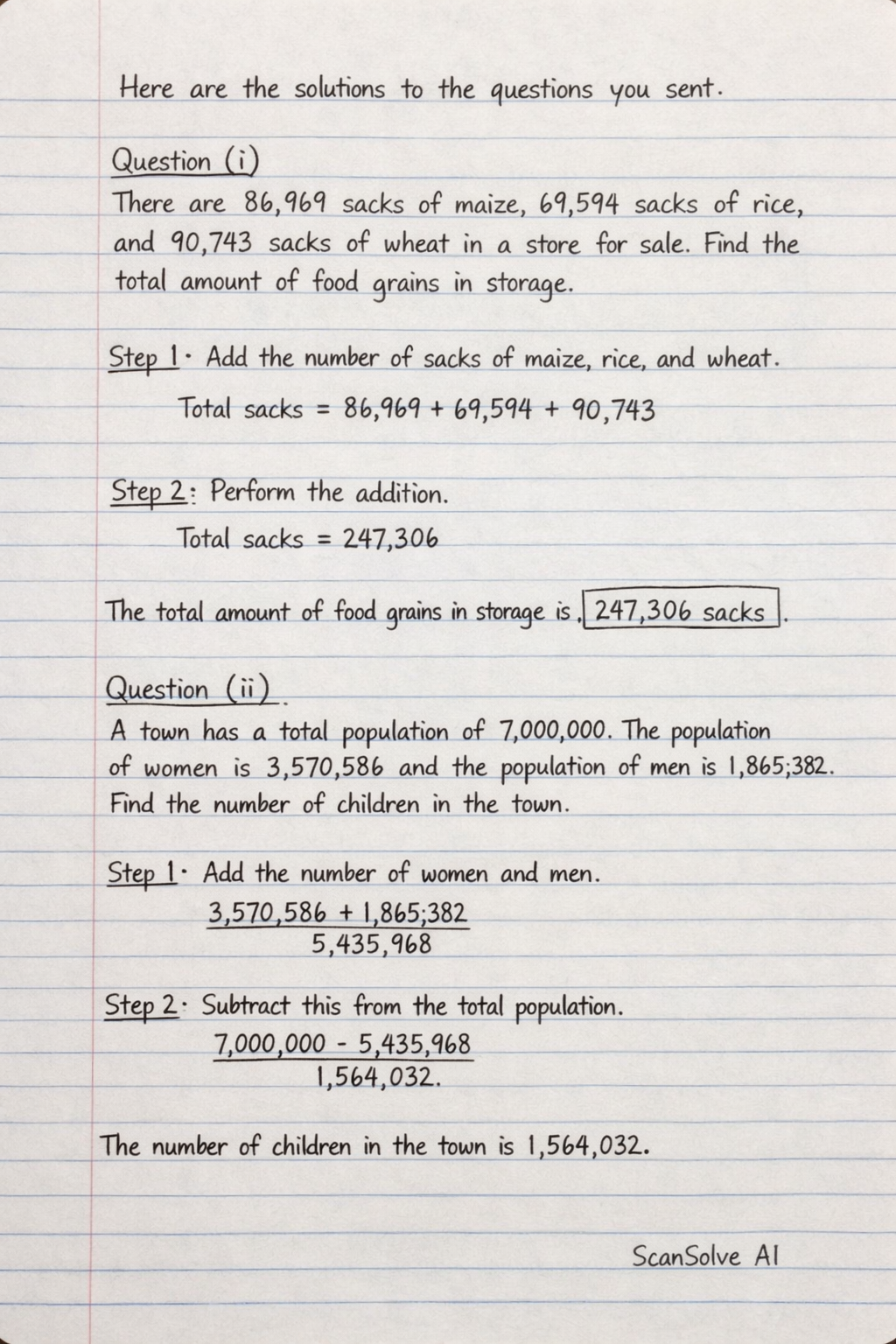
Handwritten Step-by-Step Solution
Get this as a handwritten image on WhatsApp — like a tutor wrote it for you.
Try on WhatsApp