
I need a course outline of First semester MCM 101,209,211, 309, MAC409/407 from week 1 to week 13
Mathematics
ScanSolve AI Answer
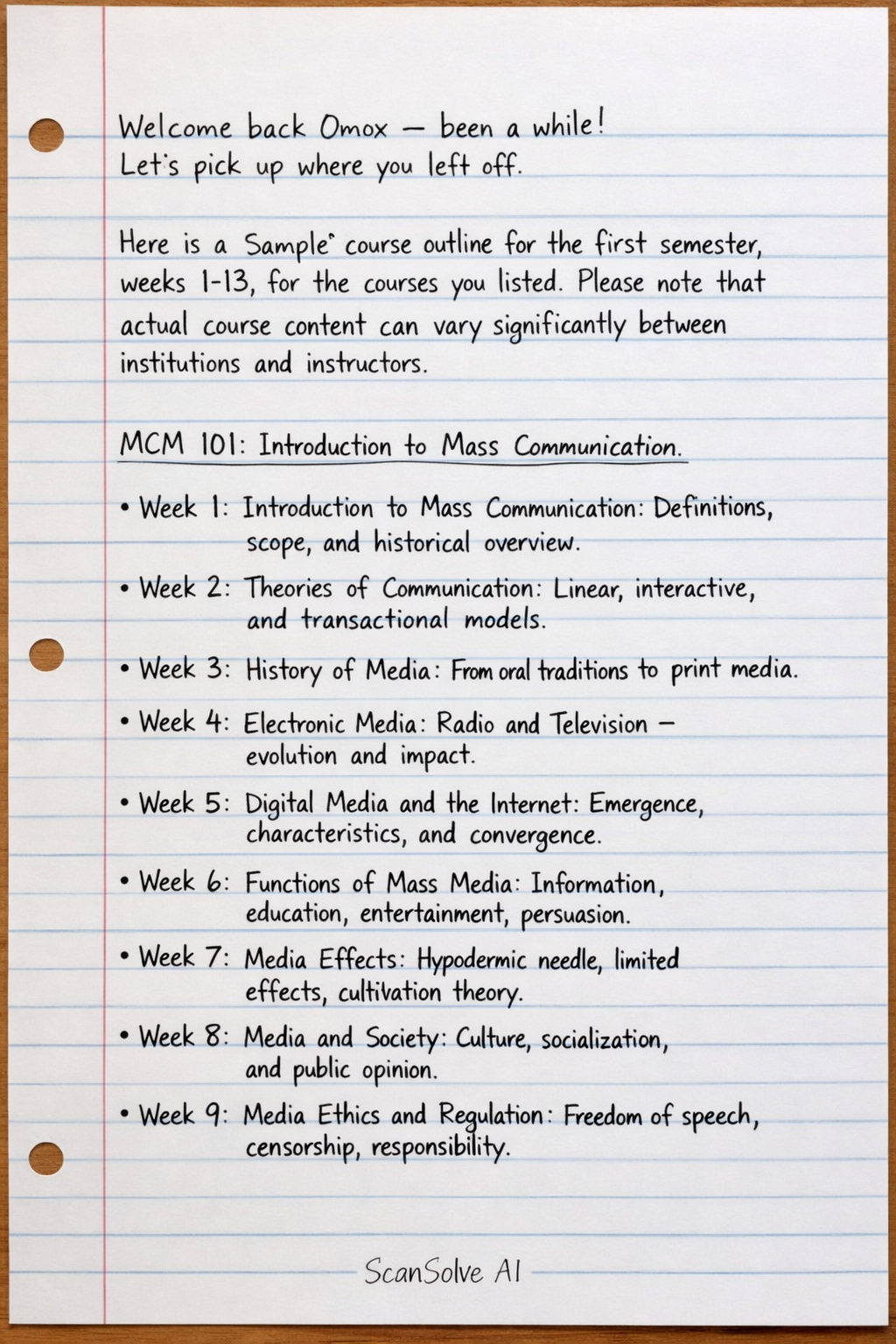
Here is a sample course outline for the first semester, weeks 1-13, for the courses you listed. Please note that actual course content can vary significantly between institutions and instructors.
MCM 101: Introduction to Mass Communication
- Week 1: Introduction to Mass Communication: Definitions, scope, and historical overview.
- Week 2: Theories of Communication: Linear, interactive, and transactional models.
- Week 3: History of Media: From oral traditions to print media.
- Week 4: Electronic Media: Radio and Television – evolution and impact.
- Week 5: Digital Media and the Internet: Emergence, characteristics, and convergence.
- Week 6: Functions of Mass Media: Information, education, entertainment, persuasion.
- Week 7: Media Effects: Hypodermic needle, limited effects, cultivation theory.
- Week 8: Media and Society: Culture, socialization, and public opinion.
- Week 9: Media Ethics and Regulation: Freedom of speech, censorship, responsibility.
- Week 10: Journalism: Principles, types, and roles in a democratic society.
- Week 11: Advertising: History, types, and persuasive techniques.
- Week 12: Public Relations: Concepts, strategies, and ethical considerations.
- Week 13: Global Media and Future Trends: International communication, new technologies.
MCM 209: Media Writing and Reporting
- Week 1: Introduction to News Writing: Principles of clarity, conciseness, accuracy.
- Week 2: News Values and Elements: Timeliness, proximity, prominence, impact.
- Week 3: The Inverted Pyramid Style: Structure and application.
- Week 4: Leads (Ledes): Types and effective writing.
- Week 5: Gathering Information: Interviewing techniques, observation, research.
- Week 6: Attribution and Sourcing: Ethical considerations and best practices.
- Week 7: Writing for Print Media: News reports, features, editorials.
- Week 8: Writing for Broadcast Media: Radio and TV news scripts.
- Week 9: Writing for Digital Media: Online news, blogs, social media.
- Week 10: Feature Writing: Human interest, profiles, investigative features.
- Week 11: Opinion Writing: Editorials, columns, reviews.
- Week 12: Media Law and Ethics in Reporting: Defamation, privacy, copyright.
- Week 13: Practical Reporting Exercises and Portfolio Development.
MCM 211: Media Production Techniques
- Week 1: Introduction to Media Production: Overview of stages and roles.
- Week 2: Audio Production Fundamentals: Sound theory, microphones, recording.
- Week 3: Audio Editing Software: Basic operations and techniques.
- Week 4: Radio Program Production: Scripting, voice-overs, sound effects.
- Week 5: Visual Communication Principles: Composition, lighting, color.
- Week 6: Camera Operation: Types of cameras, shots, angles, movement.
- Week 7: Video Production Workflow: Pre-production (storyboarding, scripting).
- Week 8: Video Production Workflow: Production (shooting, directing).
- Week 9: Video Editing Software: Non-linear editing basics.
- Week 10: Post-Production Techniques: Transitions, effects, sound mixing.
- Week 11: Television Program Formats: News, documentary, drama, commercials.
- Week 12: Digital Media Production: Web content, short-form video for social media.
- Week 13: Project Work and Portfolio Review.
MCM 309: Communication Research Methods
- Week 1: Introduction to Communication Research: Importance, types, ethical considerations.
- Week 2: Research Process: Problem formulation, literature review, hypotheses/questions.
- Week 3: Quantitative Research Methods: Overview and design.
- Week 4: Survey Research: Design, sampling, questionnaire construction.
- Week 5: Content Analysis: Design, coding, reliability, validity.
- Week 6: Experimental Research: Design, variables, control groups.
- Week 7: Data Analysis (Quantitative): Descriptive statistics.
- Week 8: Data Analysis (Quantitative): Inferential statistics (introduction).
- Week 9: Qualitative Research Methods: Overview and design.
- Week 10: In-depth Interviewing and Focus Groups: Techniques and analysis.
- Week 11: Ethnography and Case Studies: Observational methods.
- Week 12: Data Analysis (Qualitative): Thematic analysis, discourse analysis.
- Week 13: Research Report Writing: Structure, presentation, ethical reporting.
MAC 409/407: Quantitative Methods for Social Sciences (Sample)
- Week 1: Review of Basic Statistics: Measures of central tendency and dispersion.
- Week 2: Probability Theory: Basic concepts, rules, and distributions.
- Week 3: Sampling Techniques: Random, stratified, cluster, and non-probability sampling.
- Week 4: Hypothesis Testing: Null and alternative hypotheses, Type I and Type II errors.
- Week 5: Parametric Tests: T-tests (one-sample, independent, paired).
- Week 6: Analysis of Variance (ANOVA): One-way ANOVA.
- Week 7: Non-Parametric Tests: Chi-square test for independence and goodness-of-fit.
- Week 8: Correlation Analysis: Pearson's r, Spearman's rho, interpretation.
- Week 9: Simple Linear Regression: Model, assumptions, interpretation of coefficients.
- Week 10: Multiple Linear Regression: Model extension, interpretation, multicollinearity.
- Week 11: Introduction to Statistical Software (e.g., SPSS, R): Data entry and basic analysis.
- Week 12: Advanced Regression Topics: Dummy variables, interaction terms.
- Week 13: Application of Quantitative Methods in Research: Case studies and project work.
Was this helpful?
Still stuck on this one?
Ask a follow-up, and the answer starts from this question.
Got a different question?Ask your own question
More Mathematics Questions
QWhat is the course outline for ICH 112, Engineering graphics & solid modeling I?QPlease provide detailed notes on the following topics from the COS 101 course outline: Basic…QMIS Entrepreneurship Electronics Networking Hardware Database Operating System Generate a study…QWhat is the breakdown of the Mathematics (211) syllabus, including TMA and Public Examination…QA survey of 200 students found that 75 offered MTH 101, 86 offered PHY 101, and 100 offered CS 101…
Handwritten Step-by-Step Solution
Get this as a handwritten image on WhatsApp — like a tutor wrote it for you.
Try on WhatsApp