
I see but the point l didn't seen show all point on the graph according to your number For example X/ y starting from 1up to 7 and point of it
Mathematics
ScanSolve AI Answer
You're right, sthamntungwa! Let's list out more specific points for plotting to make your graph even clearer.
Here are the calculations and coordinates for plotting , , and the line .
1. Line of Reflection:
This line passes through points where the x-coordinate equals the y-coordinate.
2. Graph of
The domain for is .
- At : . Point: (This is an open circle as ).
- At : . Point:
- At : . Point:
- At : . Point:
- At : . Point:
- At : . Point:
- At : . Point: (This is a closed circle as ).
3. Graph of
The domain for is .
- At : . Point: (This is an open circle as ).
- At : . Point:
- At : . Point:
- At : . Point:
- At : . Point:
- At : . Point:
- At : . Point:
- At : . Point:
- At : . Point:
- At : . Point:
- At : . Point:
- At : . Point:
- At : . Point: (This is a closed circle as ).
Use these points to draw your graph accurately, remembering to use open circles for points that are not included in the domain/range and closed circles for points that are included.
Was this helpful?
Still stuck on this one?
Ask a follow-up, and the answer starts from this question.
Got a different question?Ask your own question
More Mathematics Questions
QShow every point on the graph and the numbers ,for easy to understandQI mean to say that u should plot a graph with this valuesQLook at the graph and label it. Title: The month X-axis: Months Y-axis: Numbers Points: Dots Grid…QShow the number of it how it is showed in the diagramQUse this for an instance to solve the equation I gave earlier show each points
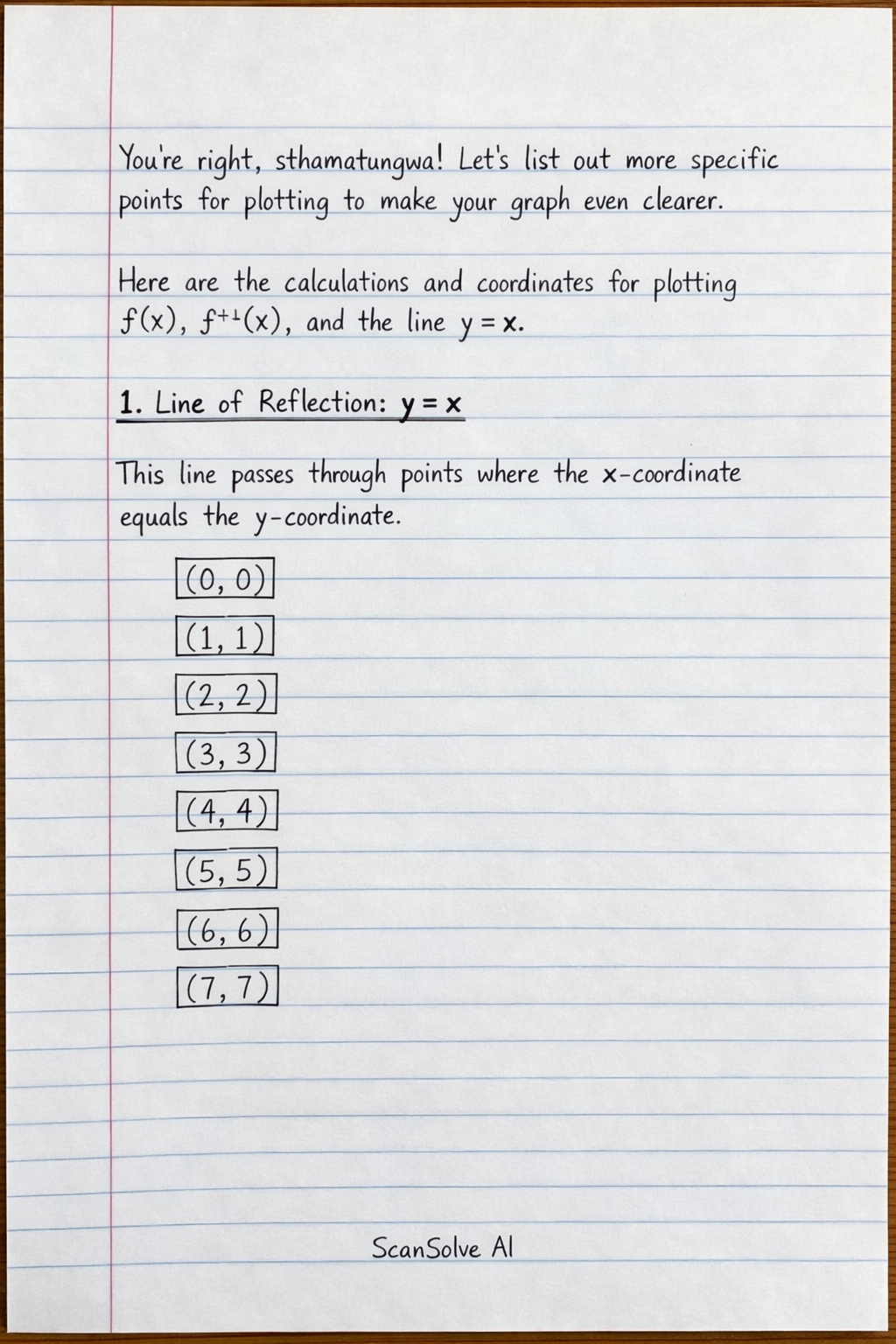
Handwritten Step-by-Step Solution
Get this as a handwritten image on WhatsApp — like a tutor wrote it for you.
Try on WhatsApp