

This mathematics problem involves applying core mathematical principles and formulas. Below you will find a complete step-by-step solution with detailed explanations for each step, helping you understand not just the answer but the method behind it.
ScanSolve AI Answer
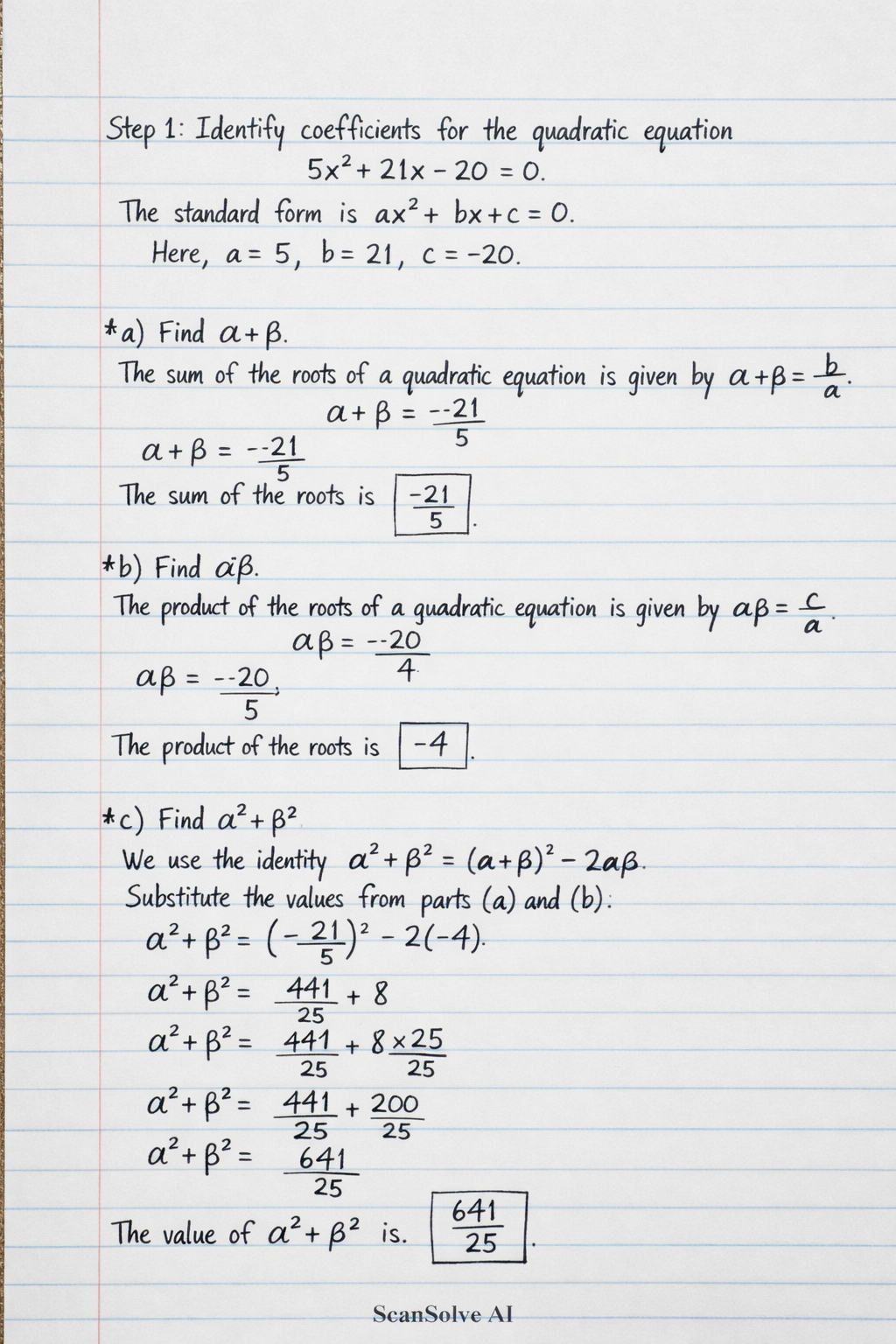
Step 1: Identify coefficients for the quadratic equation 5x^2 + 21x - 20 = 0. The standard form is ax^2 + bx + c = 0. Here, a=5, b=21, c=-20. a) Find + The sum of the roots of a quadratic equation is given by + = -(b)/(a). + = -(21)/(5) The sum of the roots is -(21)/(5). b) Find The product of the roots of a quadratic equation is given by = (c)/(a). = (-20)/(5) = -4 The product of the roots is -4. c) Find ^2 + ^2 We use the identity ^2 + ^2 = ( + )^2 - 2 . Substitute the values from parts (a) and (b): ^2 + ^2 = (-(21)/(5))^2 - 2(-4) ^2 + ^2 = (441)/(25) + 8 ^2 + ^2 = (441)/(25) + (8 × 25)/(25) ^2 + ^2 = (441)/(25) + (200)/(25) ^2 + ^2 = (641)/(25) The value of ^2 + ^2 is (641)/(25). d) Find ^3 + ^3 We use the identity ^3 + ^3 = ( + )^3 - 3 ( + ). Substitute the values from parts (a) and (b): ^3 + ^3 = (-(21)/(5))^3 - 3(-4)(-(21)/(5)) ^3 + ^3 = -(9261)/(125) - 12((21)/(5)) ^3 + ^3 = -(9261)/(125) - (252)/(5) To combine these, find a common denominator, which is 125: ^3 + ^3 = -(9261)/(125) - (252 × 25)/(125) ^3 + ^3 = -(9261)/(125) - (6300)/(125) ^3 + ^3 = -(15561)/(125) The value of ^3 + ^3 is -(15561)/(125). e) Find (1)/() + (1)/() Combine the fractions: (1)/() + (1)/() = ( + )/( ) Substitute the values from parts (a) and (b): (1)/() + (1)/() = (-21)/(5)-4 (1)/() + (1)/() = (21)/(5) × (1)/(4) (1)/() + (1)/() = (21)/(20) The value of (1)/() + (1)/() is (21)/(20). f) Find (1)/(^2) + (1)/(^2) Combine the fractions: (1)/(^2) + (1)/(^2) = (^2 + ^2)/(( )^2) Substitute the values from parts (b) and (c): (1)/(^2) + (1)/(^2) = (641)/(25)(-4)^2 (1)/(^2) + (1)/(^2) = (641)/(25)16 (1)/(^2) + (1)/(^2) = 64125 \