

This mathematics problem involves applying core mathematical principles and formulas. Below you will find a complete step-by-step solution with detailed explanations for each step, helping you understand not just the answer but the method behind it.
ScanSolve AI Answer
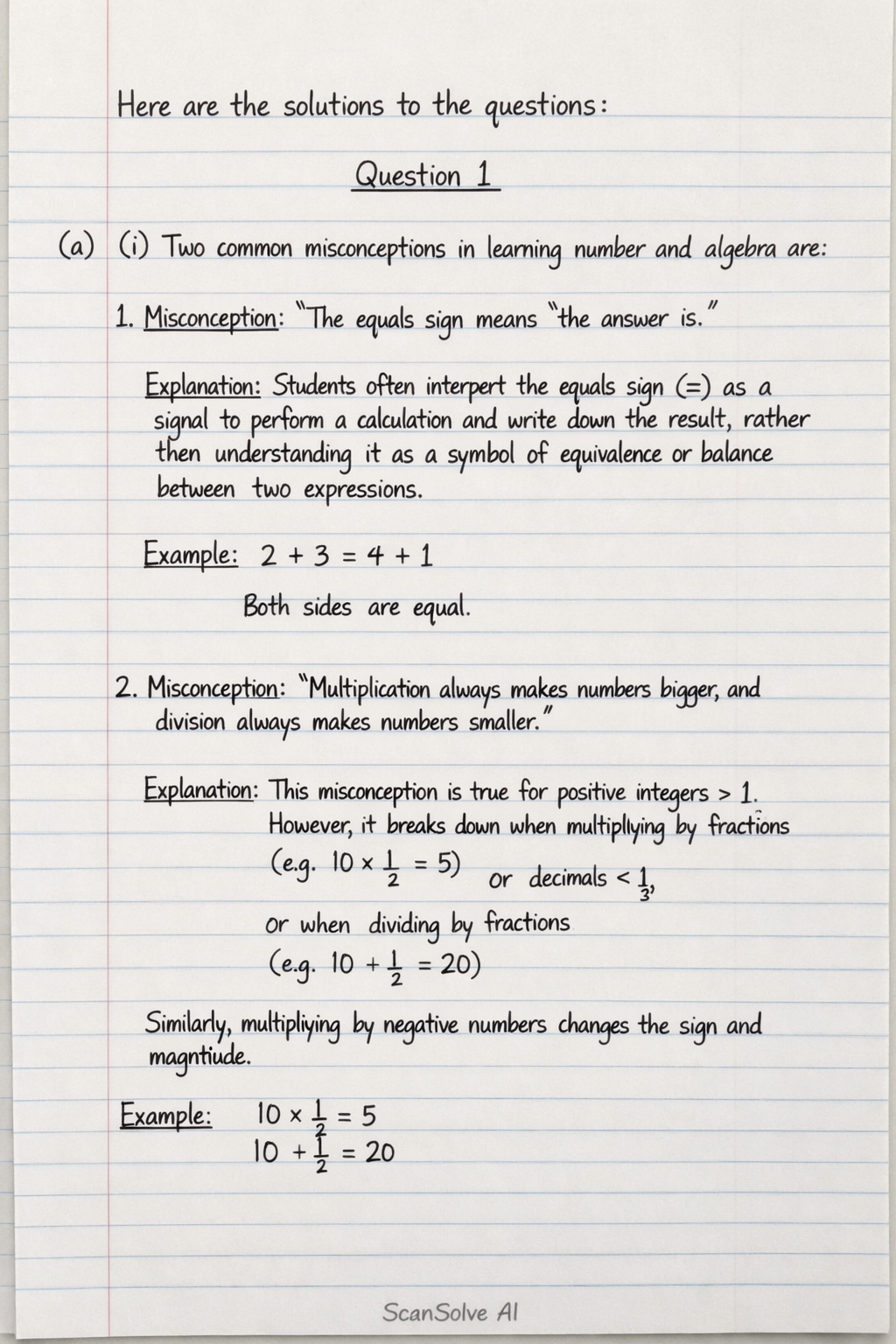
Here are the solutions to the questions: Question 1 a) (i) Two common misconceptions in learning number and algebra are: 1. Misconception: "The equals sign means 'the answer is'." Explanation:* Students often interpret the equals sign (=) as a signal to perform a calculation and write down the result, rather than understanding it as a symbol of equivalence or balance between two expressions. This can hinder their ability to solve algebraic equations where the unknown is not isolated on one side, or to understand equations like 2 + 3 = 4 + 1. 2. Misconception: "Multiplication always makes numbers bigger, and division always makes numbers smaller." Explanation:* This misconception is true for positive integers greater than 1. However, it breaks down when multiplying by fractions (e.g., 10 × (1)/(2) = 5) or decimals less than 1, or when dividing by fractions (e.g., 10 ÷ (1)/(2) = 20). Similarly, multiplying by negative numbers changes the sign and magnitude in a way that contradicts this belief. a) (ii) Given the set of numbers, S = \-3, -1, 0, 2, 4\. (α) Identify which numbers are natural numbers, which are whole numbers, and which are integers.