
We read your photo as:
Identify the given differential equation and parameters.
ScanSolve AI Answer
Step-by-step solution
9 stepsIdentify the given differential equation and parameters.
The rate of change of mass of RA is given by the differential equation:
We are given and the initial condition .
For the equation to be dimensionally consistent, if is in kg and is in kg/sec, then must be in . We will assume that the unit "kg/sec" for is a typo and use with units of .Substitute the value of into the differential equation.
Rearrange the equation into the standard form of a first-order linear differential equation, .
Here, and .
Calculate the integrating factor, .
Multiply the differential equation by the integrating factor.
The left side is the derivative of the product : .
The right side simplifies to .
So, the equation becomes:Integrate both sides with respect to .
Solve for by dividing by .
Use the initial condition to find the constant .
Substitute and :
Substitute the value of back into the equation for .
The mass of RA for is:
Still stuck on this one?
Ask a follow-up, and the answer starts from this question.
More Mathematics Questions
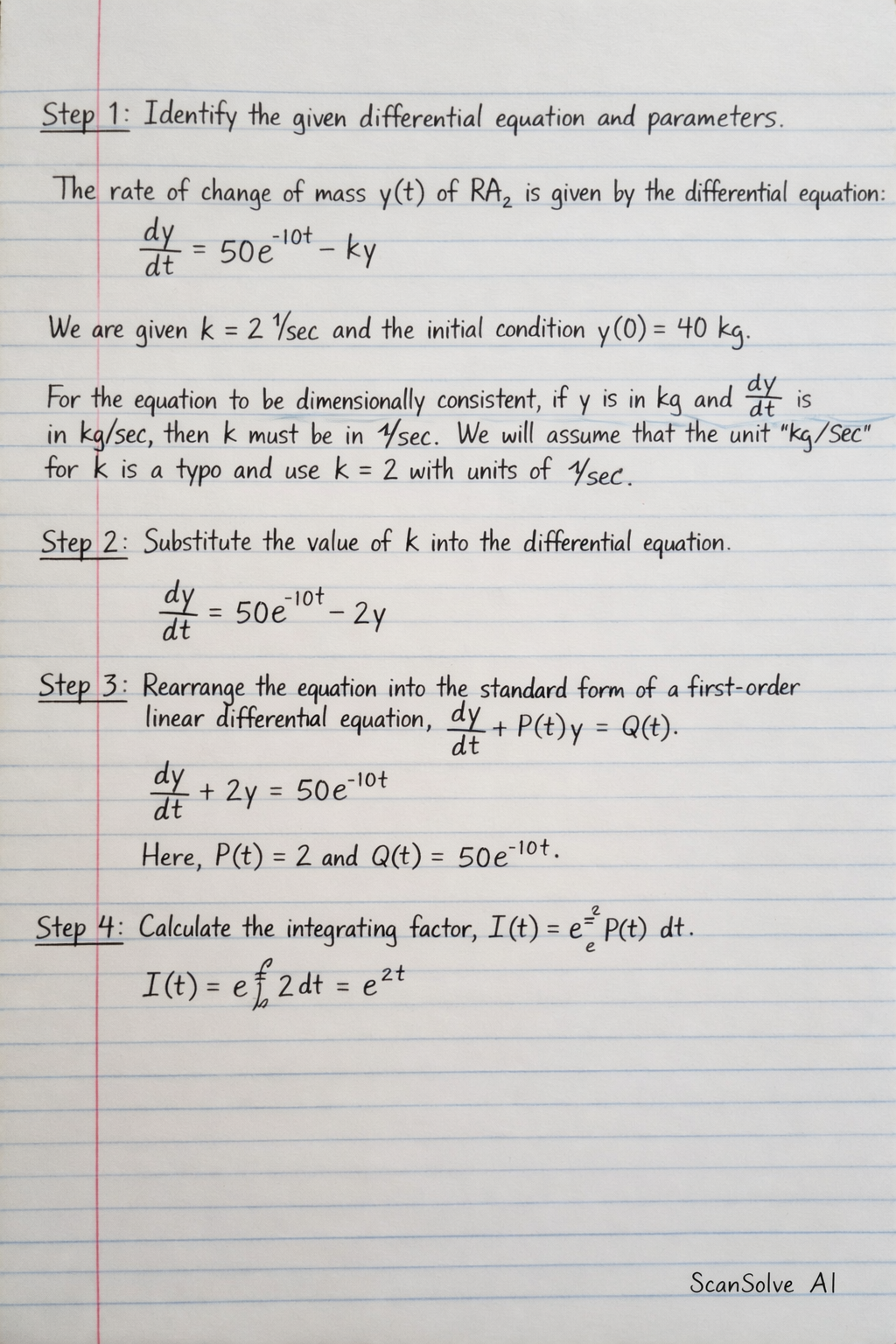
Handwritten Step-by-Step Solution
Get this as a handwritten image on WhatsApp — like a tutor wrote it for you.
Try on WhatsApp