We read your photo as:

Identify the given dimensions and calculate the outer radius.

Mathematics

ScanSolve AI Answer

Answer

D

3,140 dm33,140 \text{ dm}^3

Step-by-step solution

8 steps

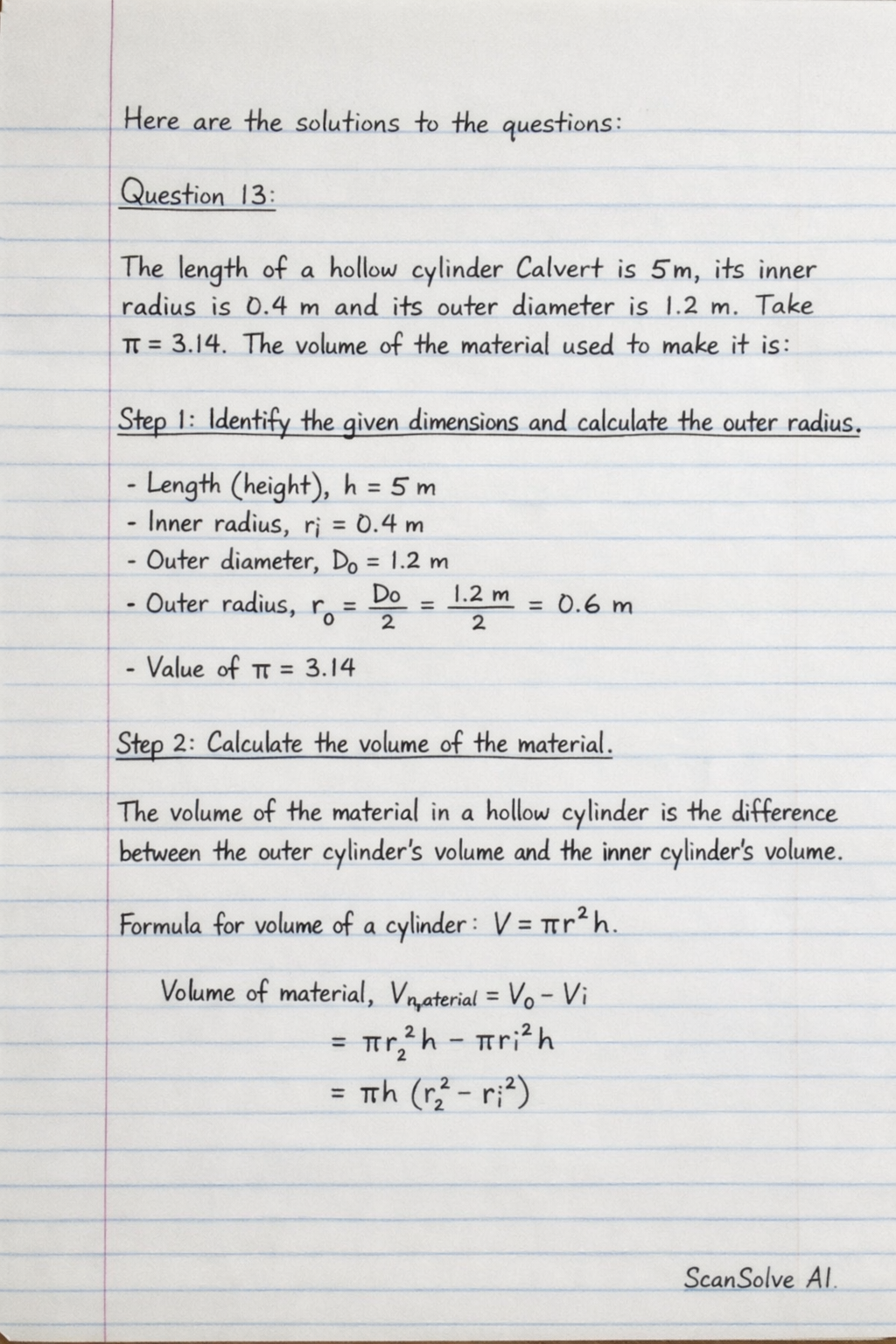
Here are the solutions to the questions:

Question 13: The length of a hollow cylinder Calvert is 5 m5 \text{ m}, its inner radius is 0.4 m0.4 \text{ m} and its outer diameter is 1.2 m1.2 \text{ m}. Take π=3.14\pi = 3.14. The volume of the material used to make it is:

  1. Identify the given dimensions and calculate the outer radius.

    Length (height), h=5 mh = 5 \text{ m}
    Inner radius, ri=0.4 mr_i = 0.4 \text{ m}
    Outer diameter, Do=1.2 mD_o = 1.2 \text{ m}
    Outer radius, ro=Do2=1.2 m2=0.6 mr_o = \frac{D_o}{2} = \frac{1.2 \text{ m}}{2} = 0.6 \text{ m}
    Value of π=3.14\pi = 3.14

  2. Calculate the volume of the material.

    The volume of the material in a hollow cylinder is the difference between the outer cylinder's volume and the inner cylinder's volume.
    The formula for the volume of a cylinder is V=πr2hV = \pi r^2 h.
    Volume of material, Vmaterial=Vo−Vi=πro2h−πri2h=πh(ro2−ri2)V_{\text{material}} = V_o - V_i = \pi r_o^2 h - \pi r_i^2 h = \pi h (r_o^2 - r_i^2).

    Substitute the values:

    Vmaterial=3.14×5 m×((0.6 m)2−(0.4 m)2)V_{\text{material}} = 3.14 \times 5 \text{ m} \times ((0.6 \text{ m})^2 - (0.4 \text{ m})^2) Vmaterial=3.14×5 m×(0.36 m2−0.16 m2)V_{\text{material}} = 3.14 \times 5 \text{ m} \times (0.36 \text{ m}^2 - 0.16 \text{ m}^2) Vmaterial=3.14×5 m×0.20 m2V_{\text{material}} = 3.14 \times 5 \text{ m} \times 0.20 \text{ m}^2 Vmaterial=3.14×1 m3V_{\text{material}} = 3.14 \times 1 \text{ m}^3 Vmaterial=3.14 m3V_{\text{material}} = 3.14 \text{ m}^3
  3. Convert the volume from cubic meters (m3\text{m}^3) to cubic decimeters (dm3\text{dm}^3).

    We know that 1 m=10 dm1 \text{ m} = 10 \text{ dm}.
    Therefore, 1 m3=(10 dm)3=1000 dm31 \text{ m}^3 = (10 \text{ dm})^3 = 1000 \text{ dm}^3.

    Vmaterial=3.14 m3×1000 dm31 m3V_{\text{material}} = 3.14 \text{ m}^3 \times \frac{1000 \text{ dm}^3}{1 \text{ m}^3} Vmaterial=3140 dm3V_{\text{material}} = 3140 \text{ dm}^3

    The correct option is d) 3,140 dm33,140 \text{ dm}^3.

    Question 14: A shopkeeper has a mixture of red sorghum flour and white sorghum flour weighing 40 kg40 \text{ kg}. One type costs 1,900 FRW1,900 \text{ FRW} per kg and another cost 2,100 FRW2,100 \text{ FRW} per kg. If the mixture is sold at 2,000 FRW2,000 \text{ FRW} per kg, find the number of kg of each type.

  4. Define variables and set up equations.

    Let xx be the mass (in kg) of the red sorghum flour (costing 1,900 FRW/kg1,900 \text{ FRW/kg}).
    Let yy be the mass (in kg) of the white sorghum flour (costing 2,100 FRW/kg2,100 \text{ FRW/kg}).

    The total mass of the mixture is 40 kg40 \text{ kg}:

    x+y=40(1)x + y = 40 \quad (1)

    The total cost of the mixture, if sold at 2,000 FRW/kg2,000 \text{ FRW/kg}, is 40 kg×2,000 FRW/kg=80,000 FRW40 \text{ kg} \times 2,000 \text{ FRW/kg} = 80,000 \text{ FRW}.
    The total cost of the ingredients must equal this total cost:

    1900x+2100y=80,000(2)1900x + 2100y = 80,000 \quad (2)
  5. Solve the system of equations.

    From equation (1), express yy in terms of xx:

    y=40−xy = 40 - x

    Substitute this expression for yy into equation (2):

    1900x+2100(40−x)=80,0001900x + 2100(40 - x) = 80,000 1900x+84000−2100x=80,0001900x + 84000 - 2100x = 80,000

    Combine like terms:

    −200x=80,000−84000-200x = 80,000 - 84000 −200x=−4000-200x = -4000

    Divide by −200-200:

    x=−4000−200x = \frac{-4000}{-200} x=20 kgx = 20 \text{ kg}
  6. Find the value of yy.

    Substitute x=20x = 20 into y=40−xy = 40 - x:

    y=40−20y = 40 - 20 y=20 kgy = 20 \text{ kg}

    So, there are 20 kg20 \text{ kg} of red sorghum flour and 20 kg20 \text{ kg} of white sorghum flour.

    The correct option is a) 20 kg20 \text{ kg} and 20 kg20 \text{ kg}.

    Question 15: The sum of interior angles of a regular polygon is 1440∘1440^\circ.

    a) Find the number of sides of this polygon.

    b) Name the polygon.

    a) Find the number of sides of this polygon.

  7. Use the formula for the sum of interior angles of a polygon.

    The sum of the interior angles (SS) of a polygon with nn sides is given by the formula:

    S=(n−2)×180∘S = (n-2) \times 180^\circ

    Given S=1440∘S = 1440^\circ.

  8. Substitute the given sum into the formula and solve for nn.

    (n−2)×180∘=1440∘(n-2) \times 180^\circ = 1440^\circ

    Divide both sides by 180∘180^\circ:

    n−2=1440180n-2 = \frac{1440}{180} n−2=8n-2 = 8

    Add 2 to both sides:

    n=8+2n = 8 + 2 n=10n = 10

    The number of sides of the polygon is 10\boxed{\text{10}}.

    b) Name the polygon.

    A polygon with 10 sides is called a decagon.

Was this helpful?

Try one yourself

A new problem that tests the same skill.

Still stuck on this one?

Ask a follow-up, and the answer starts from this question.

Got a different question?Ask your own question
Handwritten step-by-step solution preview

Handwritten Step-by-Step Solution

Get this as a handwritten image on WhatsApp — like a tutor wrote it for you.

Try on WhatsApp