This mathematics problem involves applying core mathematical principles and formulas. Below you will find a complete step-by-step solution with detailed explanations for each step, helping you understand not just the answer but the method behind it.
ScanSolve AI Answer
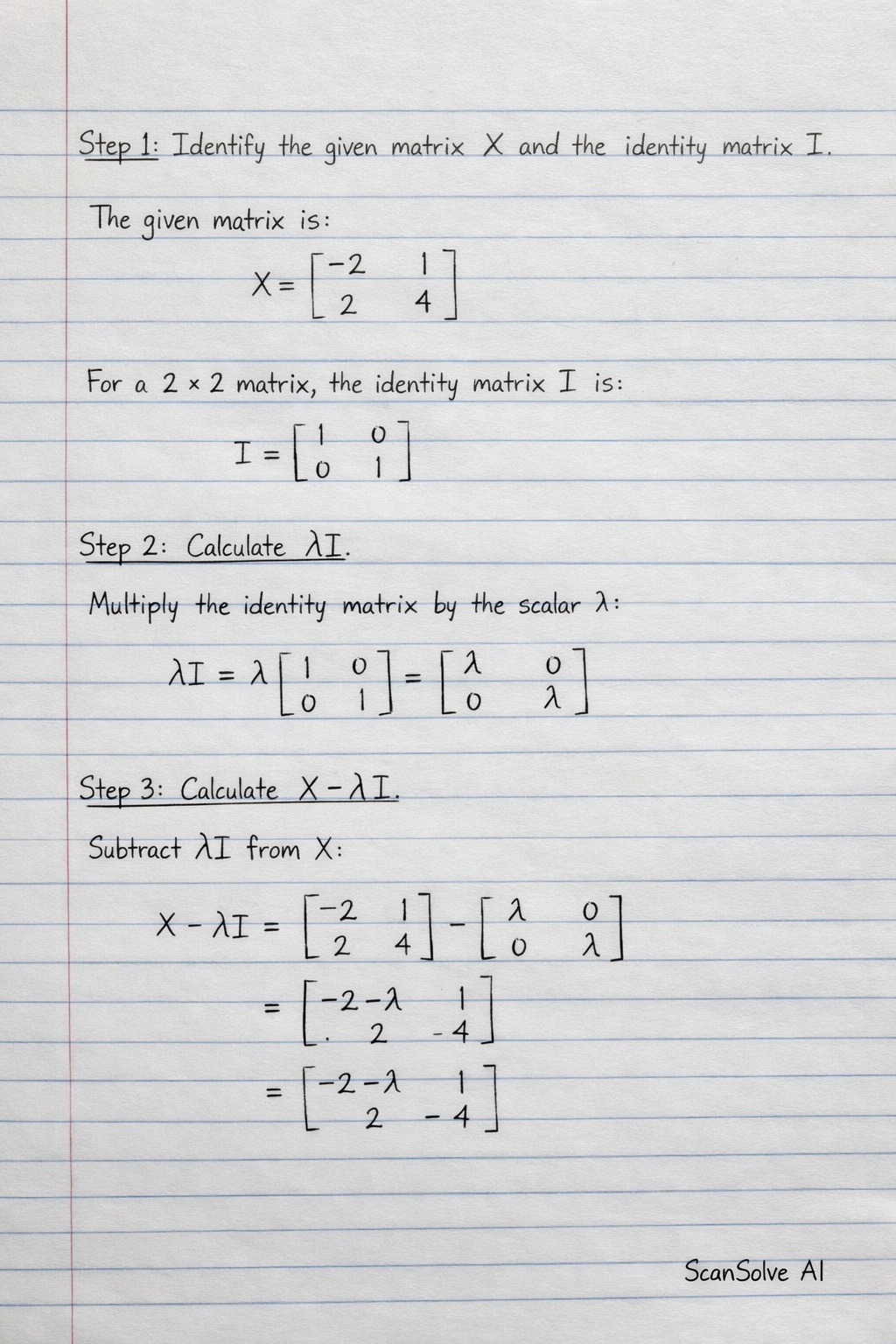
Step 1: Identify the given matrix $X$ and the identity matrix $I$.
The given matrix is:
$$X = \begin{pmatrix} -2 & 1 \\ 2 & 4 \end{pmatrix}$$
For a $2 \times 2$ matrix, the identity matrix $I$ is:
$$I = \begin{pmatrix} 1 & 0 \\ 0 & 1 \end{pmatrix}$$
Step 2: Calculate $\lambda I$.
Multiply the identity matrix by the scalar $\lambda$:
$$\lambda I = \lambda \begin{pmatrix} 1 & 0 \\ 0 & 1 \end{pmatrix} = \begin{pmatrix} \lambda & 0 \\ 0 & \lambda \end{pmatrix}$$
Step 3: Calculate $X - \lambda I$.
Subtract $\lambda I$ from $X$:
$$X - \lambda I = \begin{pmatrix} -2 & 1 \\ 2 & 4 \end{pmatrix} - \begin{pmatrix} \lambda & 0 \\ 0 & \lambda \end{pmatrix} = \begin{pmatrix} -2 - \lambda & 1 - 0 \\ 2 - 0 & 4 - \lambda \end{pmatrix} = \begin{pmatrix} -2 - \lambda & 1 \\ 2 & 4 - \lambda \end{pmatrix}$$
Step 4: Set the determinant $|X - \lambda I|$ to zero.
The determinant of a $2 \times 2$ matrix $\begin{pmatrix} a & b \\ c & d \end{pmatrix}$ is $ad - bc$.
So, for $X - \lambda I$:
$$|X - \lambda I| = (-2 - \lambda)(4 - \lambda) - (1)(2)$$
We are given that $|X - \lambda I| = 0$:
$$(-2 - \lambda)(4 - \lambda) - 2 = 0$$
Step 5: Expand and simplify the equation to find $\lambda$.
Expand the product:
$$-8 + 2\lambda - 4\lambda + \lambda^2 - 2 = 0$$
Combine like terms:
$$\lambda^2 - 2\lambda - 10 = 0$$
Step 6: Solve the quadratic equation for $\lambda$ using the quadratic formula.
The quadratic formula for $a\lambda^2 + b\lambda + c = 0$ is $\lambda = \frac{-b \pm \sqrt{b^2 - 4ac}}{2a}$.
Here, $a=1$, $b=-2$, $c=-10$.
$$\lambda = \frac{-(-2) \pm \sqrt{(-2)^2 - 4(1)(-10)}}{2(1)}$$
$$\lambda = \frac{2 \pm \sqrt{4 + 40}}{2}$$
$$\lambda = \frac{2 \pm \sqrt{44}}{2}$$
Simplify $\sqrt{44}$:
$$\sqrt{44} = \sqrt{4 \times 11} = \sqrt{4} \times \sqrt{11} = 2\sqrt{11}$$
Substitute this back into the expression for $\lambda$:
$$\lambda = \frac{2 \pm 2\sqrt{11}}{2}$$
Factor out 2 from the numerator:
$$\lambda = \frac{2(1 \pm \sqrt{11})}{2}$$
$$\lambda = 1 \pm \sqrt{11}$$
The values of $\lambda$ are $1 + \sqrt{11}$ and $1 - \sqrt{11}$.
The final answer is $\boxed{1 \pm \sqrt{11}}$.
Identify the given matrix X and the identity matrix I.
|Mathematics
Identify the given matrix X and the identity matrix I.
ScanSolve AI Answer
Step 1: Identify the given matrix X and the identity matrix I.
The given matrix is:
X=(−2214)
For a 2×2 matrix, the identity matrix I is:
I=(1001)
Step 2: Calculate λI.
Multiply the identity matrix by the scalar λ:
λI=λ(1001)=(λ00λ)
Step 3: Calculate X−λI.
Subtract λI from X:
X−λI=(−2214)−(λ00λ)=(−2−λ2−01−04−λ)=(−2−λ214−λ)
Step 4: Set the determinant ∣X−λI∣ to zero.
The determinant of a 2×2 matrix (acbd) is ad−bc.
So, for X−λI:
∣X−λI∣=(−2−λ)(4−λ)−(1)(2)
We are given that ∣X−λI∣=0:
(−2−λ)(4−λ)−2=0
Step 5: Expand and simplify the equation to find λ.
Expand the product:
−8+2λ−4λ+λ2−2=0
Combine like terms:
λ2−2λ−10=0
Step 6: Solve the quadratic equation for λ using the quadratic formula.
The quadratic formula for aλ2+bλ+c=0 is λ=2a−b±b2−4ac.
Here, a=1, b=−2, c=−10.
λ=2(1)−(−2)±(−2)2−4(1)(−10)λ=22±4+40λ=22±44
Simplify 44:
44=4×11=4×11=211
Substitute this back into the expression for λ:
λ=22±211
Factor out 2 from the numerator:
λ=22(1±11)λ=1±11
The values of λ are 1+11 and 1−11.
The final answer is 1±11.
Need help with your own homework?
Get instant step-by-step solutions to any question. Free to start.