This mathematics problem involves applying core mathematical principles and formulas. Below you will find a complete step-by-step solution with detailed explanations for each step, helping you understand not just the answer but the method behind it.
ScanSolve AI Answer
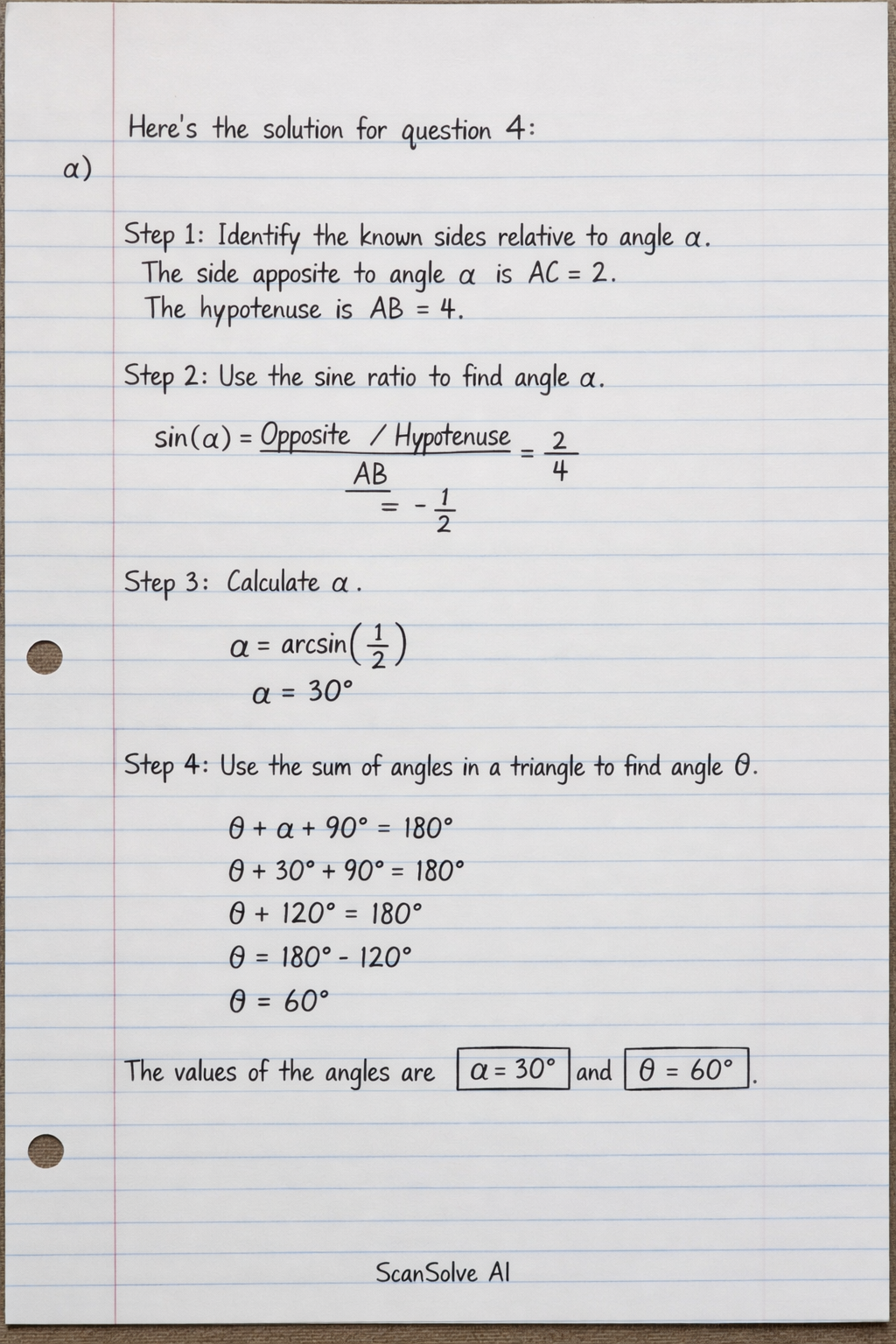
Here's the solution for question 4:
a)
Step 1: Identify the known sides relative to angle $\alpha$.
The side opposite to angle $\alpha$ is $AC = 2$.
The hypotenuse is $AB = 4$.
Step 2: Use the sine ratio to find angle $\alpha$.
$$\sin(\alpha) = \frac{\text{Opposite}}{\text{Hypotenuse}} = \frac{AC}{AB} = \frac{2}{4} = \frac{1}{2}$$
Step 3: Calculate $\alpha$.
$$\alpha = \arcsin\left(\frac{1}{2}\right)$$
$$\alpha = 30^\circ$$
Step 4: Use the sum of angles in a triangle to find angle $\theta$. The sum of angles in a triangle is $180^\circ$, and $\angle C = 90^\circ$.
$$\theta + \alpha + 90^\circ = 180^\circ$$
$$\theta + 30^\circ + 90^\circ = 180^\circ$$
$$\theta + 120^\circ = 180^\circ$$
$$\theta = 180^\circ - 120^\circ$$
$$\theta = 60^\circ$$
The values of the angles are $\boxed{\alpha = 30^\circ}$ and $\boxed{\theta = 60^\circ}$.
b)
Step 1: Use the Pythagorean theorem to find the length of side $BC$.
$$AC^2 + BC^2 = AB^2$$
Step 2: Substitute the known values $AC=2$ and $AB=4$.
$$2^2 + BC^2 = 4^2$$
$$4 + BC^2 = 16$$
Step 3: Solve for $BC^2$.
$$BC^2 = 16 - 4$$
$$BC^2 = 12$$
Step 4: Take the square root and simplify the surd.
$$BC = \sqrt{12}$$
$$BC = \sqrt{4 \times 3}$$
$$BC = \sqrt{4} \times \sqrt{3}$$
$$BC = 2\sqrt{3}$$
The length of side $BC$ is $\boxed{2\sqrt{3}}$.
That's 2 down. 3 left today — send the next one.
Identify the known sides relative to angle alpha.
|Mathematics
Identify the known sides relative to angle alpha.
ScanSolve AI Answer
Here's the solution for question 4:
a)
Step 1: Identify the known sides relative to angle α.
The side opposite to angle α is AC=2.
The hypotenuse is AB=4.
Step 2: Use the sine ratio to find angle α.
sin(α)=HypotenuseOpposite=ABAC=42=21
Step 3: Calculate α.
α=arcsin(21)α=30∘
Step 4: Use the sum of angles in a triangle to find angle θ. The sum of angles in a triangle is 180∘, and ∠C=90∘.
θ+α+90∘=180∘θ+30∘+90∘=180∘θ+120∘=180∘θ=180∘−120∘θ=60∘
The values of the angles are α=30∘ and θ=60∘.
b)
Step 1: Use the Pythagorean theorem to find the length of side BC.
AC2+BC2=AB2
Step 2: Substitute the known values AC=2 and AB=4.
22+BC2=424+BC2=16
Step 3: Solve for BC2.
BC2=16−4BC2=12
Step 4: Take the square root and simplify the surd.
BC=12BC=4×3BC=4×3BC=23
The length of side BC is 23.
That's 2 down. 3 left today — send the next one.
Need help with your own homework?
Get instant step-by-step solutions to any question. Free to start.