
We read your photo as:
Identify the knowns and the unknown in the right-angled triangle.
ScanSolve AI Answer
Answer
Step-by-step solution
8 stepsHere are the solutions for questions 3 and 4.
3. Find the exact length of AC.
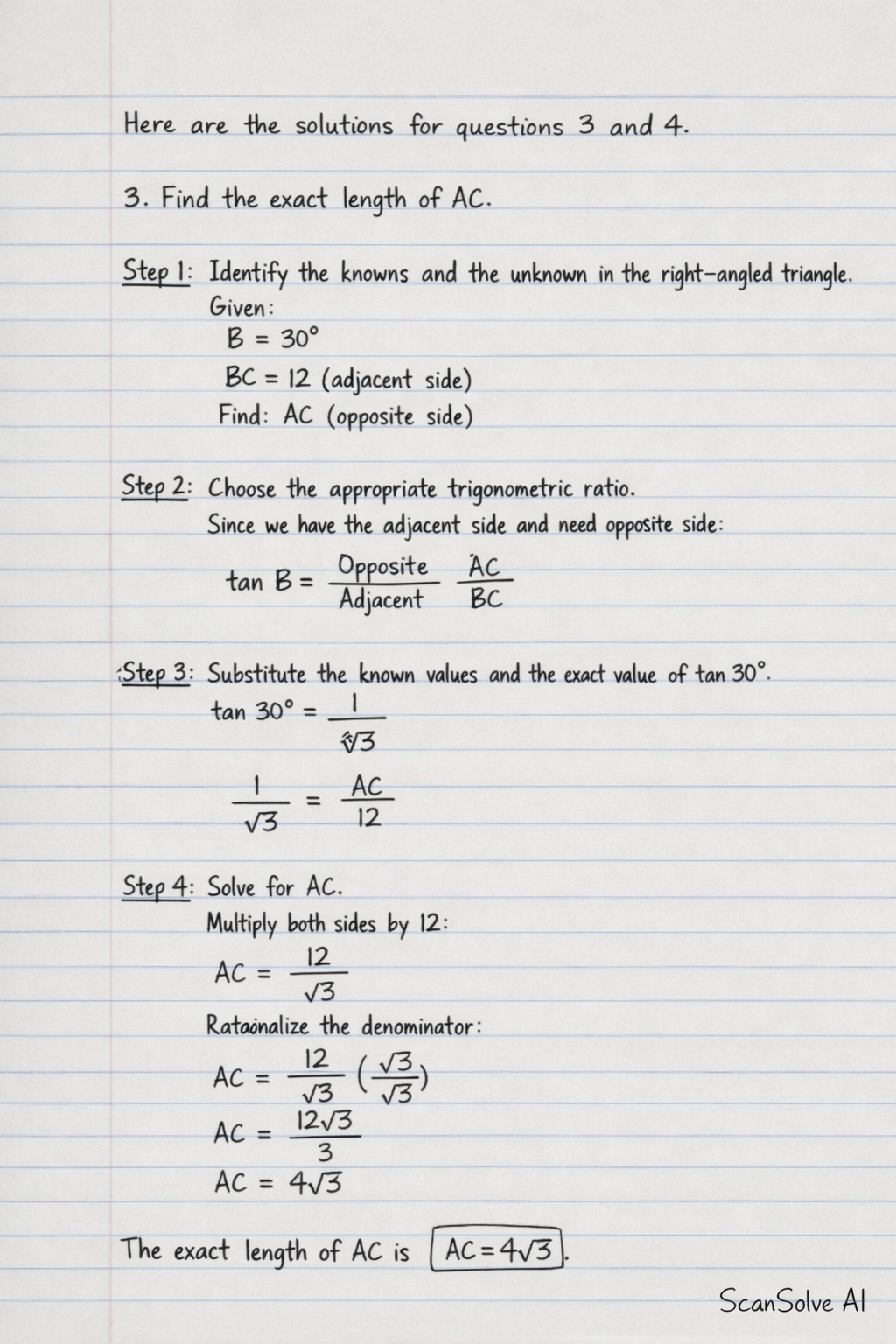
Identify the knowns and the unknown in the right-angled triangle.
We are given:
- Angle .
- Side (this is the side adjacent to angle B). We need to find:
- Side (this is the side opposite to angle B).
Choose the appropriate trigonometric ratio.
Since we have the adjacent side and need the opposite side relative to angle B, we use the tangent function:
Substitute the known values and the exact value of .
We know that .
Solve for AC.
Multiply both sides by 12:
To rationalize the denominator, multiply the numerator and denominator by :
The exact length of AC is .
4. Q is due East of R and due South of P. The bearing of R from Q is . Show this information on the diagram.
Since no diagram is provided for this question, I will describe how to represent this information.
Place point Q as a central reference.
"Q is due East of R" means that if you are at R, Q is directly to your East.
Conversely, R is directly to the West of Q.
"Q is due South of P" means that if you are at P, Q is directly to your South.
Conversely, P is directly to the North of Q.
"The bearing of R from Q is " confirms that R is to the West of Q.
From Q, a bearing of is directly West.
To show this on a diagram:
- Draw point Q.
- Draw a North line from Q.
- Draw a line segment extending West from Q, and label the endpoint R. This represents R being due West of Q (or Q being due East of R).
- Draw a line segment extending North from Q, and label the endpoint P. This represents P being due North of Q (or Q being due South of P).
- Indicate the angle of clockwise from the North line at Q to the line segment QR.
Try one yourself
A new problem that tests the same skill.
Still stuck on this one?
Ask a follow-up, and the answer starts from this question.
More Mathematics Questions
Handwritten Step-by-Step Solution
Get this as a handwritten image on WhatsApp — like a tutor wrote it for you.
Try on WhatsApp