
We read your photo as:
Identify the properties of the equilateral triangle PQR.
ScanSolve AI Answer
This answer stops before the end.
It was cut off when it was first written. Ask ScanSolve this question again for the full working.
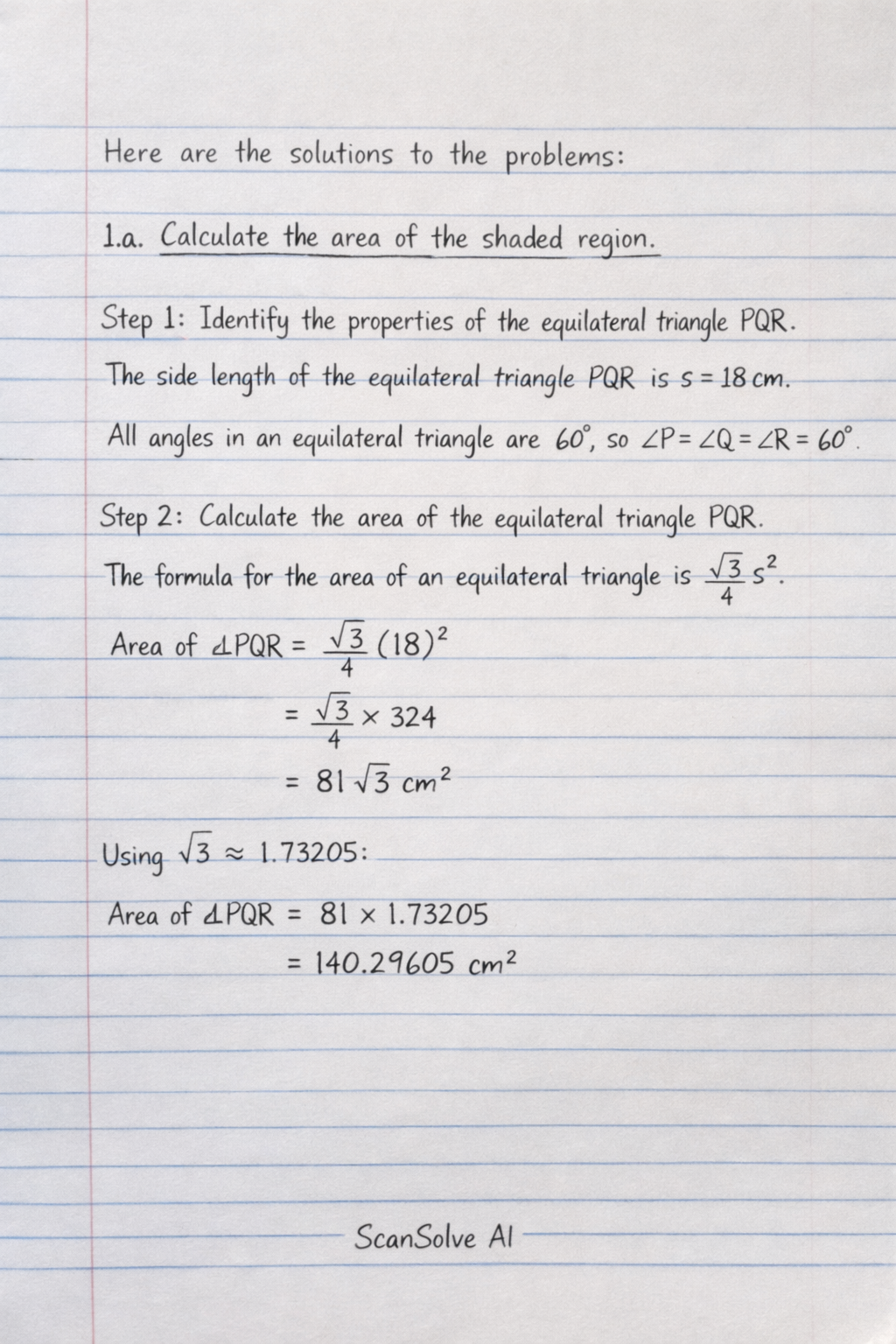
Here are the solutions to the problems:
1.a. Calculate the area of the shaded region.
Step 1: Identify the properties of the equilateral triangle PQR.
The side length of the equilateral triangle PQR is cm.
All angles in an equilateral triangle are , so .
Step 2: Calculate the area of the equilateral triangle PQR.
The formula for the area of an equilateral triangle is .
Using :
Step 3: Determine the radius of the sector PAB.
The arc is centered at P and touches QR at M. This means PM is the radius of the sector.
In an equilateral triangle, the line segment from a vertex to the midpoint of the opposite side (PM) is also an altitude.
Consider the right-angled triangle PQM, where cm and cm.
Using the Pythagorean theorem:
So, the radius of the sector is cm.
Step 4: Calculate the area of the sector PAB.
The angle of the sector is .
The formula for the area of a sector is .
Using :
Step 5: Calculate the area of the shaded region.
The shaded region is the area of the triangle PQR minus the area of the sector PAB.
Correct to two decimal places:
The area of the shaded region is .
1.b. Solve the equation
Step 1: Isolate the square root term.
Step 2: Square both sides of the equation to eliminate the square root.
Step 3: Solve for .
Subtract from both sides:
Subtract 4 from both sides:
Divide by 4:
Step 4: Check the solution by substituting back into the original equation.
The solution is correct.
The value of a is .
1.c. The ratio of the age of a mother to that of the daughter is 11:3. If the mother is 55 years old, what will be the ratio of their ages in 5 years time?
Step 1: Determine the current ages of the mother and daughter.
Let the mother's age be and the daughter's age be .
Given ratio .
Given mother's current age years.
We can write the ratio as .
Substitute :
To find , cross-multiply:
Still stuck on this one?
Ask a follow-up, and the answer starts from this question.
More Mathematics Questions
Handwritten Step-by-Step Solution
Get this as a handwritten image on WhatsApp — like a tutor wrote it for you.
Try on WhatsApp